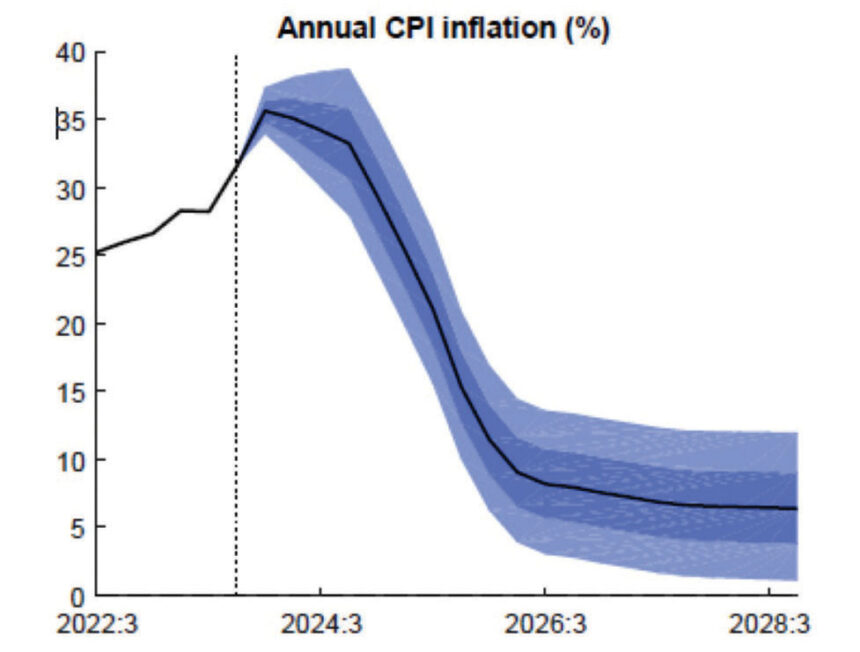
The Reserve Bank of Malawi (RBM) has reiterated its projection that headline inflation—the rate at which commodity prices change at a given period in an economy—would remain high, averaging 30 percent in 2024.
This is contained in a statement of the Monetary Policy Committee (MPC) second meeting of 2024 published by the central bank over the weekend.
This means that Malawians will continue to feel the pinch over high commodity prices on the market.
The statement indicates that there is high money supply growth, underperformance of the export sector and higher global oil prices which pose major risks to the inflation outlook.
This is coming at a time inflation was seen declining from 35 percent in January to 31.8 percent in March.
- Advertisement -
However, inflation averaged 33.4 percent in the first quarter of 2024, considering the 33.5 percent inflation rate recorded in February.
Meanwhile, RBM has maintained the policy rate—the rate at which commercial banks borrow from the central bank as lender of last resort—at 26 percent. It increased the Liquidity Reserve Ratio (LRR) by 100 basis points to 8.75 percent.
“In making this decision, the MPC took into account the recent deceleration in inflation and its continued downward projected trend in the near term. However, the committee noted that there are upside risks to the inflation outlook, including the projected lower crop harvest, high money supply growth and higher global oil prices,” the statement reads.
Catholic University of Malawi Head of Economics Department Angela Seyama said, in the recent past, the central bank was increasing the policy rate in an attempt to tame rocketing inflation but the objective was not met.
- Advertisement -
- Advertisement -
“This means that our inflation does not depend on the policy rate. It is not about monetary aggregates. In my opinion, it is a good idea that they have maintained the policy rate rather than increasing it.
“Secondly, when the policy rate increases, it also increases interest rates that the banks charge, which makes borrowing expensive and, in turn, decreases investment. Now that the policy rate has not increased, it means that interest rates will not increase, as well, which is good for the economy since interest rates are low and affordable,” Seyama said.

Economist Marvin Banda said while RBM aims to lower the rate of money supply growth using the LRR, the 100-basis points’ increase is not high enough.
“Monetary policy rate has averaged lower than M2 by a considerable amount which explains why the inflationary pressures are higher for longer as it is seen as the getaway car for the runaway fiscus.
“Much of what determines near-term outcomes is often quite idiosyncratic, for us it’s the agricultural-business cycle which peaks around June when the import cover, as a proxy measure of exogenous inflationary pressures, is usually at its highest yet quarterly real GDP data is not compiled. Therefore, it becomes difficult to forecast by a macroeconomic model designed to capture stylised business cycle dynamics,” Banda said.
A recent publication by the World Bank, Africa’s Pulse, has shown that Malawi has the third highest overall inflation and food-inflation rates in 2024.
Titled ‘Tackling Inequalities to Revitalise Growth and Alleviate Poverty in Africa’, the publication ranks Malawi third with overall inflation recorded at 35 percent in January and 33.5 percent in February after Zimbabwe (34.8 percent in January and 47.6 percent in February) and Sierra Leone (47.42 percent in January and 42.52 percent in February).
Malawi is also third on the list of countries with the highest food-inflation after Egypt and Sierra Leone.
The Bretton Woods institution has since tipped countries with stubbornly high levels of inflation such as Malawi, Ethiopia, Zimbabwe and Sierra Leone to remain restrictive on the monetary policy stance.