 President Lazarus Chakwera’s reshuffling of his Cabinet has sparked debate, particularly in light of the country’s current economic crisis.
The reshuffle has come at a critical time for Malawi, which is grappling with some of the worst economic challenges in its history.
Inflation has risen to record levels; the currency is under pressure and poverty is widespread.
The nation had hoped that Chakwera would respond to these challenges by forming a Cabinet that would bring new ideas, competent leadership and a clear strategy for economic recovery.
Instead, the reshuffle has raised more questions than it has answered, leaving many to wonder whether Chakwera is genuinely committed to transforming the country or if his actions are primarily driven by political considerations.
- Advertisement -
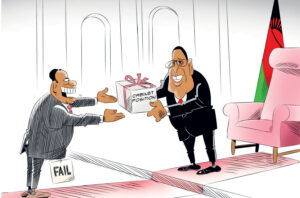
First and foremost, it is deeply concerning that Chakwera has maintained a significant number of ministers who have demonstrably failed in their roles.
In a time when Malawi’s economy is in shambles, one would expect the President to make bold decisions and surround himself with leaders who can bring real change.
Instead, he has opted to retain many of the same individuals who have been in charge during the country’s economic decline.
Ministers like Finance Minister Simplex Chithyola Banda and Agriculture Minister Sam Kawale have failed to deliver on their portfolios, yet both have been kept in their positions.
- Advertisement -
- Advertisement -
This is particularly perplexing when one considers the severity of the economic crisis and the urgency required in addressing it.
Chithyola Banda, for instance, has presided over a period of high inflation, a weakening currency and poor fiscal management, yet he remains in charge of the country’s finances.
Similarly, Kawale’s tenure as Agriculture Minister has been marked by insufficient efforts to tackle food insecurity, a pressing issue in Malawi.
These ministers have shown little ability to navigate the complex challenges facing their respective sectors, yet Chakwera has decided that they deserve more time to prove themselves.
What makes this decision even more baffling is the fact that Chakwera has been quick to remove other ministers, most notably Harry Mkandawire, who was serving as Minister of Defence.
Mkandawire’s removal is one of the few changes in the reshuffle, yet his ousting raises important questions.
If Mkandawire, who was in charge of the Defence portfolio, is considered a failure, why are ministers like Banda and Kawale, who have similarly failed in their roles, allowed to stay on?
The selective nature of this reshuffle calls into question the President’s commitment to performance-based leadership and raises concerns that decisions are being made based on loyalty rather than competence.
Another troubling aspect of the reshuffle is the decision to increase the size of the Cabinet rather than reduce it.
Malawi is facing severe economic constraints and austerity measures are necessary to restore fiscal discipline and reduce public spending.
In this context, one might have expected Chakwera to downsize the Cabinet as a symbolic gesture of his commitment to fiscal prudence.
Instead, the President has opted to increase the number of ministers, which seems out of touch with the economic reality the country is facing.
Expanding the Cabinet not only increases the financial burden on the state, but it also undermines the message that the government is serious about tackling inefficiency and reducing waste.
It suggests that Chakwera is more interested in rewarding political allies and securing support ahead of the upcoming elections than in making the difficult choices required to put the country on a sustainable path to recovery.
This brings us to the political motivations behind the reshuffle. One of the most glaring examples of this is the decision to bring two opposition lawmakers into the Cabinet.
The move appears to be an attempt to shore up political support ahead of the 2025 elections rather than a genuine effort to bring in capable, reform-minded individuals.
These lawmakers have been outspoken in their support of the Chakwera administration, but their inclusion in the Cabinet seems more like a reward for political loyalty than an acknowledgment of their qualifications or potential to contribute to governance.
This decision further highlights the political nature of the reshuffle and raises concerns that Chakwera is prioritising political expediency over the needs of the country.
At a time when Malawi is facing economic collapse, the reshuffle was an opportunity for Chakwera to assemble a team of technocrats—individuals with the expertise, experience and vision necessary to steer the country towards economic stability.
However, the new Cabinet appears to be a continuation of the old one, with many of the same people who have presided over the country’s decline remaining in power.
The idea that these ministers, who have failed time and again, will suddenly turn things around is highly unlikely.
It is difficult to see how the same faces that have contributed to the country’s economic woes can provide the leadership required to solve the country’s problems.
The situation is made even more frustrating by the fact that Malawians were sold an expensive dream during the 2020 elections.
When Chakwera was elected, there was a sense of optimism in the air. Many believed that he would bring about the change that the country so desperately needed and his promises of good governance and economic recovery gave hope to millions.
However, as time has passed, it has become increasingly clear that the leadership under Chakwera has failed to live up to expectations.
The country is worse off than it was before and the people who voted for change are now regretting their decision.
The promise of transformation has been replaced by a sense of disillusionment, as the same political elites continue to hold power and fail to deliver.
With elections less than nine months away, one might have expected Chakwera to make decisions that reflected the urgency of the situation and the need to restore public confidence.