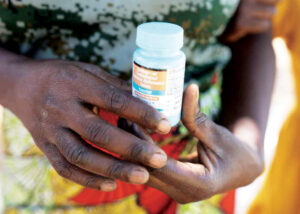
Peer support and community programmes are giving young people the confidence and care they need to live full lives, ALICK PONJE writes.
The laughter and chatter of buoyant teenagers ring out across the small hall of a health centre in Ntchisi North.
Fourteen-year-old Franklin sits among his peers, sharing stories about school, family and life with HIV. For him, these Saturday teen club meetings are both social gatherings and lifelines.
“Meeting new friends and seeing that others like me live normal happy lives is amazing. It gives me hope,” Franklin says with a shy smile.
These stories illustrate both progress and persistent gaps in the fight against HIV, particularly for children and adolescents, who remain among the most vulnerable when it comes to early diagnosis, treatment and long-term care.
- Advertisement -
Malawi’s overall progress in tackling HIV is historic.
Once one of the countries hardest hit by the epidemic, it has drastically reduced new infections and Aids-related deaths through sustained public health efforts.
Between 2010 and 2024, new HIV infections fell by more than 78 percent thanks to widespread treatment access and prevention programmes, while annual deaths have also sharply declined.
Even more strikingly, Malawi achieved the global 95-95-95 HIV targets by 2024, ahead of the global 2025 deadline.
- Advertisement -
- Advertisement -
This means 95 percent of people living with HIV know their status, 95 percent of those are on antiretroviral therapy (ART) and 95 percent of those on ART are virally suppressed.

“This achievement places Malawi among the few countries that have met the ambitious 95- 95-95 targets,” Beatrice Matanje, Chief Executive Officer of the National Aids Commission (Nac), says.
But a closer look reveals gaps that are “painfully clear”, according to advocates.
Among children aged 0–14 living with HIV, only 58 percent are on ART, well below the national average and global targets, leaving thousands without the life-saving medication they need.
An estimated 57,000 children in Malawi live with HIV and 29 percent of them remain untested, unaware of their status and untreated.
Even as Malawi’s achievements inspire, treatment advocates warn that this gap among children shows where progress remains uneven.
Adolescents and young children continue to face significant barriers to diagnosis, treatment initiation and long-term care.
Understanding the impact of these service gaps requires meeting young people whose lives are shaped by HIV long after their initial diagnosis.
At a health centre in Dedza, 18-year-old Chisomo, who lost her family and now lives independently, found healthcare and purpose in a teen club.
It offers peer support, life skills training and open conversations about relationships and living with HIV. It has transformed Chisomo’s isolation into a sense of belonging.
“It makes me feel that I can live a normal life. HIV is part of me but it doesn’t define me,” she says.
Fourteen-year-old Beston, diagnosed at age 10, struggled with treatment adherence until he joined his teen club.
Today he is stable, attending school regularly and looking ahead. His mother, Mercy, beams when she talks about his progress.
“When I see him attend the teen club each Saturday, it gives me confidence in his future because he is as confident, himself, as ever,” she says.
These experiences highlight how community-based programmes, when adequately supported, can transform narratives of fear and exclusion into stories of resilience and belonging.
Meanwhile, as Malawi works to sustain these gains, international agencies warn that faltering funding and service disruptions could reverse years of progress, particularly for children.
Unicef and the UN Joint Programme on HIV and Aids model that if programme coverage falls by half, an additional 1.1 million children could acquire HIV, and 820,000 more could die of Aids-related causes globally by 2040.
This would bring total infections among children to three million and deaths to 1.8 million.
Even maintaining current service coverage will still result in 1.9 million new infections and nearly one million deaths among children by 2040 due to the slow pace of overall progress.
“The world was making progress in the HIV response, but persistent gaps remained even before abrupt global funding cuts disrupted services.
“The choice is clear: invest today or risk reversing decades of progress and losing millions of young lives,” Anurita Bains, Unicef Associate Director of HIV and Aids, says.
In Malawi, recent shifts in international aid have already placed pressure on health funding.
Civil society organisations and Nac have raised concerns about reduced funding from major donors such as the United States, historically one of the largest contributors to the country’s HIV programmes.
Matanje advises that Malawi must use the shrinking international funding pool to “rethink how to manage our national HIV response” through unity among government, partners and communities.

Elsewhere, barriers such as stigma, gender norms and limited youth-friendly services restrict access to prevention and treatment for adolescents, meaning that even where services exist, they are not always reaching those who need them most.
Unice f reports that adolescent girls face entrenched social and gender barriers that limit their access to sexual and reproductive health services as well as HIV care, problems compounded by stigma and harmful social norms.
Healthcare workers themselves face challenges in navigating these sensitive conversations.
Studies in Malawi show significant barriers to disclosure of HIV status to children, with many healthcare providers citing a lack of training and standardised tools, according to reports.
As a result, many children remain uninformed about their own status and less engaged in their own care.
Broadly, activists argue that integrating HIV care with broader health services, including reproductive health and digital health innovations, could help bridge gaps in continuity of care and confidentiality.
On a cool Saturday morning in Ntchisi, as teen club participants share laughter, challenges and aspirations, the scene feels ordinary, like any group of teenagers spending time together.
But for measurably more young people living with HIV, these moments are extraordinary.
“When younger children see us, they see someone they can be,” one teen club member says.
Yet without renewed investment, tailored strategies and global solidarity, there is a risk that safe spaces like these will eventually become rare.