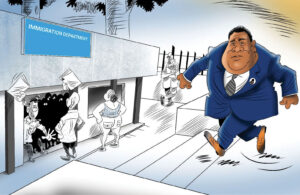
 After the worst passport issuance crisis in recent memory, one would have expected authorities to genuinely find ways of addressing the problem once and for all.
The passion with which President Lazarus Chakwera talked about how huge a breach of national security the crisis was seemed to imply every once and fibre in the world would be employed to get the system online in its fullest.
Yet, after that spirited speech, just like several others he had delivered before, passport applicants continued to struggle to get the documents. They still do.
For whatever reason, the leadership at the Department of Immigration and Citizenship Services (Dics) has not been hauled over the hot coals as would be the case with others who clearly fail in their duties and responsibilities.
Elsewhere, where practical good governance matters, such a national predicament would have seen at least one head rolling.
- Advertisement -
If it was not Dics Director Brigadier General Charles Kalumo (retired), it should have been Homeland Security Minister Ken Zikhale Ng’oma.
They are presiding over the biggest passport mess in the country’s history, but continue riding in their fuel-guzzling SUVs because they work for a government that does not care about sanctions and rewards.
Today, we were supposed to be talking about the passport issuance system being perfectly up and running.
After the difficult period when passport applicants lost hope and opportunities when the system was officially confirmed to be down, the all-important travel documents were supposed to be being issued in droves.
- Advertisement -
- Advertisement -
In fact, that was the promise from authorities— that once the so-called hacking had been defeated, Malawians would no longer be spending days waiting for their passports.
Yet, we continue seeing people struggling to get their passports at Dics offices.
Someone obviously continues to fail to do their job. It should no longer be an issue of the system being slow or not fully operational; it should be about why that is happening and why no lesson was learnt from the gruelling crunch.
You would expect the highest levels of due diligence in identifying a new printer, having experienced a big crisis and having learnt that now should not be a time of compromise.
It is even insulting for Zikhale Ng’oma to be telling Malawians that the printing machines, which have been acquired from a new supplier, are slowing down the passport issuance process.
When government was engaging the supplier, the ideal aim was supposed to be addressing challenges that are still rocking the Immigration Department regarding the issuance of passports.
So, not even the clichéd visit by the minister— wrongly christened as ‘surprise’—will bring the required efficiency at Dics if government continues to repeat the very same mistakes that created the crisis.
There was no need for Zikhale Ng’oma to pay the so-called surprise visit as though he expected that some miracle would expedite a slow passport issuance system that we all know is the making of his ministry and his government.
There was no need for him to ‘take to task’ those officers he found outside Immigration offices in Blantyre because he should have known that there is always time to cool off, especially in a government department that has been knocked to its knees.
The public relations stunt by the minister is typical of problem projections which failures often deploy to be seen to be working.
No surprise visit to Dics offices will wipe out the mess that has been created there. Only doing the right thing will do.
Zikhale Ng’oma should stop talking about the passport issuance system fully getting back on track soon, because those sentiments are not new.
The time of playing political games with such an important issue should be over now.
For far too long, Malawians have been complaining about incessant struggles to access passports, and are not really interested in some public relations stunts by anyone, let alone a minister who should have been glorying in having resolved the issue.
The time for assurances is long gone. What Malawians in desperate need of the travel documents want is having the passports in their hands so that they can travel outside the country for medical attention and education opportunities.
A ‘surprise’ visit to Dics offices by any high-level dignitary from anyone anywhere in the world will not solve the passport crisis just as the absence of due diligence in identifying an efficient printing system will continue smacking the nation in its face.
The root of the problem at the department should be clear to all those who care, so that they will not waste time visiting the offices to hound innocent workers who do with what they have.