education outcomes
By Leah Malimbasa:
Pearson Bojana of Mankhusu Village, Traditional Authority Malemia in Nsanje District, has always aspired to be a teacher.
However, several nightmares confronted his dream for years, including failure to get admitted to any of the fully accredited government teachers training colleges (TTC) after numerous attempts.
“Since 2016, I have been applying and on four occasions I was not successful,” Bojana recalls.
“What hurt me most was that I was very sure I qualified for admission, but limited space in the existing TTCs prevented me from making it to the colleges,” he added.
- Advertisement -
Bojana applied for the spot the fifth time.
“This time, my application coincided with the establishment of three new TTCs namely, Chikwawa, Rumphi and Mchinji, so I was confident that this time I would be admitted,” he said.
Bojana, just like his classmate Egily Mikoyo from Thyolo District, who also made multiple attempts before her admission into the college, was successful and finally got selected to be trained as a teacher.
Ministry of Education Public Relations Officer Mphatso Nkuonera says government opened the three TTCs this year to boost the number and output of trained primary school teachers in the country.
- Advertisement -
- Advertisement -
“Each TTC has a capacity of 600 students and candidates were selected on bed capacity,” Nkuonera says.
He adds that the development addresses enabler number five of Malawi 2063, the country’s long-term development plan, which focuses on human capital development.
According to Chikwawa TTC acting Principal, Ellen Simango, the college opened its doors on May 15, 2023 and has so far enrolled 600 students, 300 males and 300 females.
“The fruits of the college will be enjoyed by the whole nation because, in the long run, the teachers we are training will contribute to improving the education sector,” Simango added.
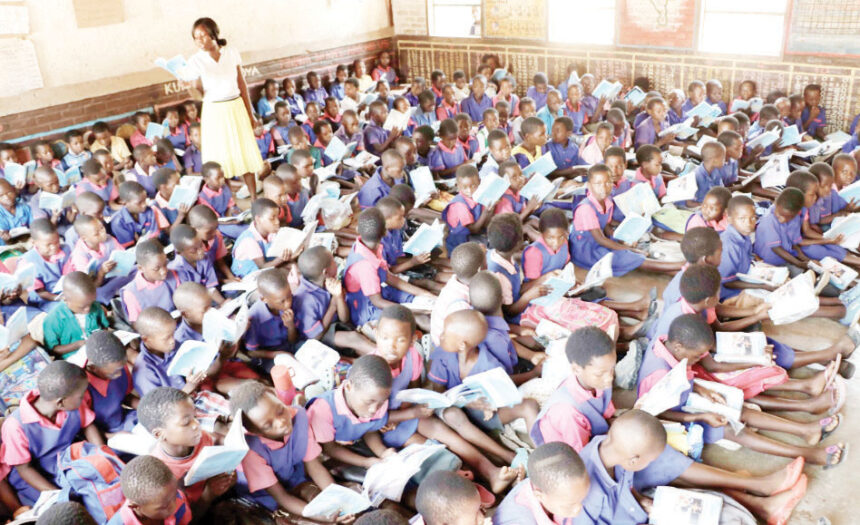
As of 2022, Ministry of Education statistics showed that there were over 4.9 million learners in the country’s primary schools against a primary school teacher population of 85,000, translating to a teacher-learner ratio of 1:58.
“However, when unqualified teachers are removed from the equation, the ratio is 1:62. Whichever way, these are a lot of learners for one teacher,” education expert Steve Sharra says.
Sharra adds that because of deployment challenges, many teachers end up teaching more learners per class than the national average requires.
He says this is a big challenge to the provision of quality education in primary schools and that teaching and learning happen more efficiently when class sizes are small.
“In a smaller class, a teacher is able to pay attention to each individual child and to give him or her special attention as needed.
“In many countries, they aim for class sizes of 20 to 30 learners per teacher. That is what we should also aim for in the long run,” Sharra explains.
He indicates that achieving this is not easy as training and recruiting more teachers and constructing more classroom blocks costs more.
“The establishment of the three new TTCs is a step in the right direction, assuming that all the student teachers from these colleges graduate two years from now,” Sharra explains.
District Commissioner (DC) for Chikwawa, Nardin Kamba, also argues that the establishment of the three colleges is a shot in the arm for the country’s economy as every sector in the economy needs well educated individuals.
“The establishment of these three colleges is a step towards achieving Malawi 2063 and United Nations Sustainable Development Goal 4, which aims at ensuring inclusive and equitable quality education and promoting lifelong learning opportunities for all,” Kamba says.
He adds that it was unfortunate in the past to see potential teachers failing to get admission into TTCs because of inadequate space.
“With the new three colleges, jobs have even been created for tutors while small-scale businesses are also thriving within the communities. The infrastructure also adds beauty to the districts,” the DC says.
Kamba notes that to improve the quality of education in the country, teacher education should be prioritised and be of high quality too.
He then commends government for the “face-lift” given to teacher education through the three colleges.
“It was a wise move for the government to invest in teacher education. Teachers graduate to teach exactly the way they are taught; so if we invest inadequately in teacher education it is our primary school learners who will bear the brunt of poor quality education,” he said.
Sharra believes investing in education should be the responsibility of everyone including the private sector because they reap “huge benefits” when they recruit people who have been educated using public funds.—Mana