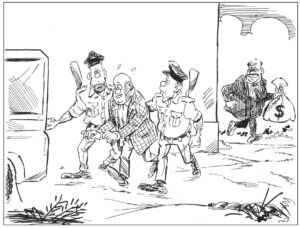
 There is a familiar pattern in Malawian politics, one that plays out almost every time power changes hands.
It begins with arrests, swift, dramatic and very public. Airport interceptions and solemn statements about the rule of law.
For a moment, it feels as though accountability has finally arrived. But if recent history is any guide, that moment rarely lasts.
Since the return of the Democratic Progressive Party (DPP) to power in September last year, the country has once again seen a string of arrests targeting former officials and politically exposed individuals.
The message is predictable: a renewed commitment to fighting corruption, restoring integrity and holding past leaders to account.
- Advertisement -
Yet there is good reason to be sceptical about whether these arrests will lead to meaningful results.
Malawians do not have to look far back to see why. During the time of the Malawi Congress Party, the country saw a similar wave of high-profile arrests.
Individuals linked to DPP were picked up, charged and put in the spotlight. The language was much the same. A crackdown on corruption, a turning point for governance, a new era of accountability.
But what became of those cases?
- Advertisement -
- Advertisement -
Many stalled. Some dragged on in the courts, slowed by delays and legal tactics. Others were discontinued in circumstances that raised serious questions.
Files lost urgency. Witnesses faded from view. Momentum disappeared. In the end, the spectacle of arrest proved stronger than the substance of prosecution.
Now, as the roles reverse, the pattern seems to be repeating itself.
This is what should concern us most. It is not only the arrests themselves, but the growing sense that they are part of a political routine rather than a real search for justice.
It is hard to ignore the feeling that Malawi’s political elite, across party lines, may be working within an unspoken understanding.
Arrest when in power. Make it visible. Make it loud. But stop short of seeing it through.
If that is the case, then what we are witnessing is not accountability, but performance.
There are, of course, exceptions. It would be wrong to suggest that every arrest lacks merit.
There are cases where evidence is strong, investigations are sound and prosecutions could succeed. Some individuals may still be convicted, and rightly so. But these cases appear to be few.
The wider trend suggests something else, where arrests serve more as political signals than as tools of justice.
The effects of this pattern are serious. First, it weakens public trust. Each cycle of arrests followed by stalled cases deepens public doubt.
People begin to see the justice system not as independent, but as part of political strategy. The law becomes something that is performed, not enforced.
Second, it puts pressure on institutions. When cases are started without the intention or ability to complete them, it strains investigators, prosecutors and the courts.
Resources are used on cases that may never be concluded, while stronger cases risk delay.
Third, and most worrying, it encourages impunity. If political figures begin to see arrests as temporary setbacks, part of a cycle that will pass, then the law loses its power to deter.
Corruption becomes a risk that can be managed rather than a crime that carries real consequences.
This is the idea many Malawians now talk about quietly. An informal club among political elites. Today’s accusers become tomorrow’s accused, and the cycle continues.
Arrests are made for attention, for headlines and to satisfy public demand for action. But there is a belief that no one will go too far, because everyone has something to lose.
Whether such a club truly exists may not matter. What matters is that the pattern makes it believable.
And perception, in matters of justice, matters greatly.
If Malawi is to break this cycle, it will need more than arrests.
Investigations must be thorough, not rushed. Cases must be pursued to the end, not dropped when political interests change. The courts must be free from interference, both real and perceived.
Above all, justice must not be selective. It must not depend on who is in power. It must apply to all, even when it is uncomfortable.
Until then, each new wave of arrests will be met with doubt, not hope. Malawians have seen this before. They know how it tends to end.
The real danger is that this doubt becomes acceptance. When people begin to believe that justice is only for show, the rule of law begins to weaken.
That risk goes beyond politics. It affects the future of the country itself.
For now, the arrests continue. Statements are made. But the true test is not the arrest.
It is what follows. And that is where recent history gives little confidence.