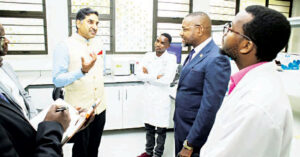
A small blood sample, a few minutes and an immediate answer. That is the idea behind a portable diagnostic tool that young Malawian innovators hope could help reduce avoidable newborn deaths.
In many health facilities in the country, pregnant women often wait days for laboratory results confirming infections such as syphilis.
Those delays can cost valuable time needed for treatment. In rural clinics where laboratory infrastructure is limited, the consequences can include miscarriage, stillbirth or neonatal death.
A group of students and researchers at Kamuzu University of Health Sciences (Kuhes) is working on a solution.
They are developing Changu, which means fast, a rapid point-ofcare syphilis test designed to detect active infection within minutes and allow treatment during the same clinic visit.
- Advertisement -
Nyasha Nguluwe, a third-year medical laboratory science student and Malawian team lead on the project, says the innovation is ultimately about timing.
“The advantage is speed and accuracy. Health workers can confirm infection during the same clinic visit and begin treatment immediately,” Nguluwe says.
He says delays in the current system often force patients to return for results.
“By the time results come back, we have already lost valuable time. Some patients do not return and opportunities for early treatment are lost,” he says.
- Advertisement -
- Advertisement -
Changu is designed to address this by bringing testing closer to the patient. Instead of relying on antibody detection, which can miss early infection or remain positive after treatment, the test identifies the DNA of Treponema pallidum, the bacterium that causes syphilis.
A molecular process amplifies small amounts of genetic material, allowing active infection to be detected quickly. In practical terms, diagnosis and treatment can happen during the same visit.
Results are typically available within seven to thirty minutes, with many positive cases detected in about ten minutes, according to Nguluwe.
“Changu means fast. It is about giving mothers and babies a better chance at life through timely diagnosis and treatment,” he says.
Validation work has involved 711 biobanked samples tested in Melbourne, Australia, through blinded comparison with standard laboratory PCR testing.
The results showed a sensitivity of 98.3 percent and a specificity of 99.9 percent, with two false negatives and six false positives recorded.
Further testing is planned in Malawi to assess performance under routine clinic conditions.
The next phase will focus on how the technology performs in settings where electricity supply, transport systems and laboratory support are often limited.
To suit these conditions, Changu uses freeze-dried reagents stored inside single-use cartridges. These remain stable at room temperature for up to 18 months and do not require refrigeration.
The device can operate on battery or mains electricity and requires only 12 volts. A standard battery can power the system for nearly a week, making it suitable for rural and peri-urban clinics.
Nguluwe says the system was designed with frontline health workers in mind.
“Health workers can be trained in less than an hour. The system guides you step by step so it can be used even outside a laboratory setting,” he says. The urgency behind the innovation reflects the burden of congenital syphilis in Malawi.
About two percent of pregnancies are affected, translating to roughly 8,000 cases annually. Many of these lead to miscarriage, stillbirth or neonatal death despite being preventable.
With around 600,000 births each year, national deployment of Changu could allow early detection and treatment for an estimated 12,000 pregnant women annually.
Kuhes Vice-Chancellor Professor Macpherson Mallewa says innovations such as Changu reflect a wider shift towards research driven by local needs.
“All our research is based on Malawi’s own problems. If people are unhealthy, they cannot be productive. Solving health problems is at the centre of building an economy,” Mallewa says. He says the university is focused on ensuring that research moves beyond academic spaces into clinics where it is needed.
The institution’s growing research profile has been recognized internationally.
The Nature Index recently ranked Kuhes sixth among African academic institutions in health sciences research output.
The index tracks publications in leading natural and health science journals and measures both output and researcher contribution.
The ranking reflects work across clinical sciences, reproductive medicine, nutrition and dietetics, cardiovascular medicine, haematology, pharmacology, pharmaceutical sciences, medical microbiology and health systems research.
During the reporting period, Kuhes collaborated with 255 international institutions and 11 local partners, reflecting strong global research engagement alongside domestic collaboration.
Between October 2024 and September 2025, the university ranked sixth in Africa in health sciences research, tenth across all academic disciplines and eleventh across all sectors.
Mallewa describes the achievement as significant for a young institution established in 2021.
“To receive such recognition for a university that is barely four years old is a huge achievement. It shows that Malawi can produce globally recognised research,” he says.
Professor Henry Mwandumba of the Malawi Liverpool-Wellcome Research Programme says the ranking reflects broader national progress.
“Being ranked sixth among African academic institutions in health sciences research is a milestone not only for Kuhes but for Malawi as a nation,” he says.
begin their academic journey
“It validates our collective work towards high-impact research that directly addresses the health challenges facing our region.” Kuhes has expanded rapidly since becoming an independent university. Student enrolment has grown from about 2,000 to nearly 6,000.
In 2024, the university held its first graduation as an independent institution, followed by a second graduation in August 2025.
Among key milestones was the graduation of Malawi’s first locally trained dentists under the Bachelor of Dental Surgery programme in the School of Medicine and Oral Health.
The institution also produced its first locally trained mental health nursing specialists and public mental health care specialists through master’s programmes offered by the School of Nursing.
A Bachelor of Occupational Therapy programme has also been introduced and recently accredited by the World Federation of Occupational Therapists.
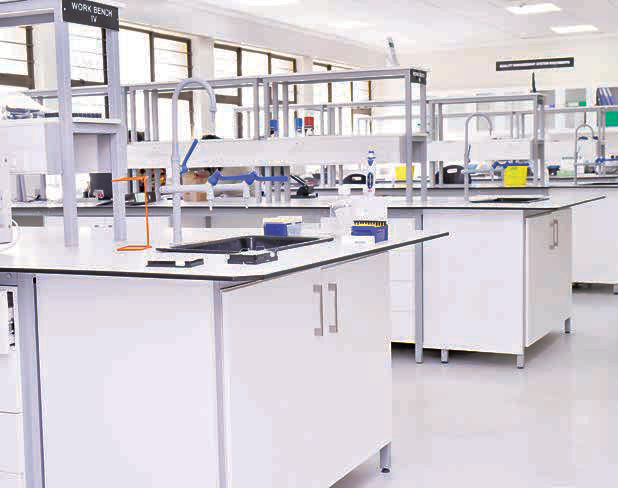
Beyond Changu and academic expansion, Kuhes operates one of the most extensive health science laboratory systems in Malawi.
Professor Fanuel Lampiao, chairperson of laboratory development at the institution, says the laboratories play a central role in healthcare and training.
“Our laboratories go far beyond student teaching. They support patient care, diagnostics, research and national quality systems,” Lampiao says.
He says the biochemistry laboratory conducts tests that help clinicians assess organ function and detect disease, including kidney and liver function, cholesterol levels, hormone profiles and tumour markers used in cancer diagnosis and monitoring.
“We are helping clinicians understand what is happening inside the body so they can make informed decisions,” Lampiao says.
He says automated haematology systems and immunoassays allow rapid processing of large volumes of samples, improving efficiency while maintaining accuracy.
The Pharmacy Department Laboratory has also expanded into drug discovery, pharmaceutical quality control, medicinal chemistry and formulation science.
Lampiao says the university’s Quality Assurance Programme helps strengthen laboratory systems across Malawi.
“When laboratory results are reliable, clinicians make better decisions and patients receive better outcomes,” he says.
Looking ahead, the university plans to establish a pharmaceutical manufacturing plant at Kameza Campus with World Bank support. Its most ambitious vision, according to Mallewa, is a purposebuilt high-tech university teaching hospital aimed at reducing the need for overseas medical referrals.
“We want to reverse external medical referrals and attract patients to Malawi. We believe Malawi can develop medical tourism because the capacity is here,” Mallewa says.
In the meantime, the students behind Changu continue refining a tool they hope will change how syphilis is diagnosed in Malawi. Their work sits within a wider effort at Kuhes to turn research into practical solutions for national health challenges, from maternal care to laboratory systems and medical training.
They believe each test, validation and trial brings them closer to a future where results are delivered in minutes rather than days and treatment begins before a patient leaves the clinic.