 You may not like many of those who have issues with the Malawi Electoral Commission (Mec) and the current administration.
Everyone is entitled to their views regarding how Mec is conducting itself and there is nothing wrong with that.
The current administration, despite its many blunders, also has supporters who believe it is performing. They, too, have the right to be wrong, because no one has a monopoly on that condition.
Clearly, there are issues Mec has tried, particularly of late, to explain thoroughly. As a result, the continued reservations we keep hearing may no longer hold much weight.
Still, there remains information about the election that has not been communicated clearly, largely because Mec was initially quite economical with the truth.
- Advertisement -
Nevertheless, everyone has the right to express themselves in ways that satisfy their convictions, including through public demonstrations.
After all, this is a democracy, where even the foolish have the right, especially when they gather in large numbers, to display their folly.
In fact, demonstrations have proven to be a highly effective means of communicating public dissatisfaction to those in authority.
It does not matter whether you agree with them or not.
- Advertisement -
- Advertisement -
That is why those who took to the streets on Thursday in various parts of the country had every right to express themselves through an act protected by the Constitution.
The current administration cannot suddenly seek to suppress the dissent expressed through demonstrations, particularly after having passionately supported them while in opposition.
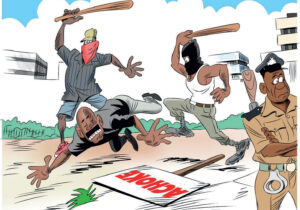
The attack on journalist-cum-activist Sylvester Namiwa in Lilongwe was both barbaric and deeply regrettable.
Namiwa was simply exercising his right to free expression, like many others, and should never have been subjected to such violence, especially in the presence of security officers.
Violence and lawlessness breed more of the same. Permitting such acts to go unaddressed is unacceptable.
It is both unfortunate and shameful that our security institutions, particularly the police, have been reduced to tools for enabling political violence in a country once known as one of the most peaceful in Africa.
Inspector General of Police Merlyn Yolamu should feel ashamed for allowing violence against citizens exercising their democratic rights to go unchecked.
It is particularly troubling that the Lilongwe incident occurred at a time when the police have been under sustained criticism for repeatedly failing to act in similar situations.
The incompetence and indifference of the service were painfully evident on Thursday.
It is difficult to imagine how Yolamu can reconcile that incident with her repeated claims of leading a professional, impartial police service.
Yet, on Thursday, we all saw the police aligning themselves with thugs, criminals and arsonists who hijacked a peaceful march that infringed on no one’s rights.
This event, like several others before it, will be remembered as one of the most barbaric episodes enabled by a government that once promised not to compromise on the rule of law.
With elections approaching, it is essential that peaceful protests be allowed to proceed without interference from those seeking political advantage.
It is disturbing that Lilongwe has become a hotspot where thugs feel emboldened to attack demonstrators or anyone perceived to oppose the current administration.
What remains true is that the seeds being sown today will return to haunt someone tomorrow.
As my senior, Madalitso Musa, often says, time is a savage, and it can be merciless in its reckoning.
Today, some wield power not in the service of justice but as a weapon to silence, to harm, to destroy.
They brutalise dissenting voices, feeling they are untouchable. But time is not silent. Time records.
Every act of cruelty, every blow dealt in the name of control is etched into its relentless memory.
You may believe you have won because the people are quiet and the cameras have moved on. But time will bring your deeds back to you.
It may not be through the courts or prison, but through something more enduring; something like legacy, decay and disgrace.
You send men in plain clothes and dark vans. You give them no badge, only permission, permission to beat, to drag, to disappear. You speak of order while sewing chaos.
To brutalise peaceful protesters is to strike at the very soul of a people. It is not strength. It is cowardice.
And while your violence may silence voices for a night, time remembers every cry. Every scream is etched into its ledger. Every broken body is a line in the indictment it is preparing for you.
There is no hiding place from what time will unveil.
Time has no allegiance to thugs or their enablers. They may break bones, but time will break them.
Time will judge. And for those who believe their cruelty will last forever, remember this: time is a savage in its justice. And it always comes to collect.