


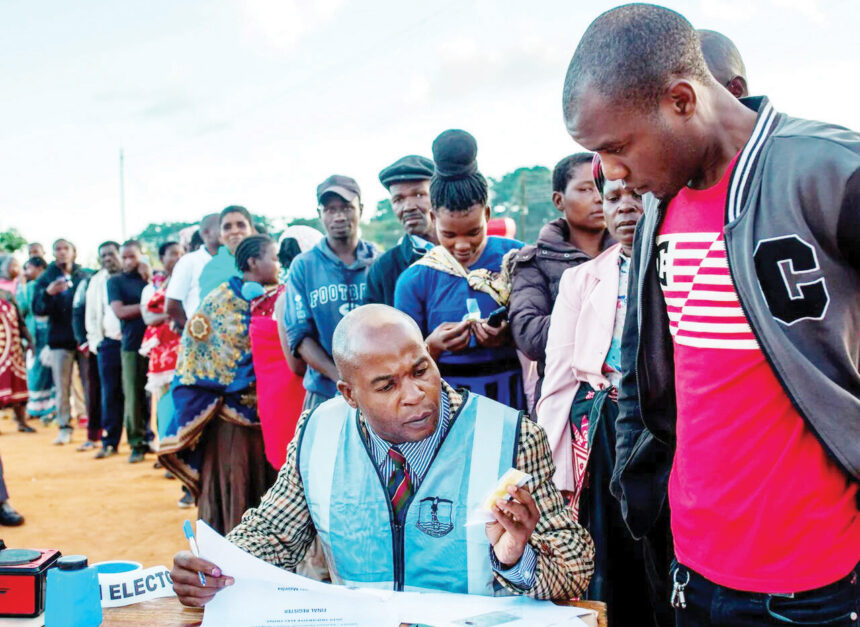
As Malawi prepares for its high-stakes elections this September, political rallies and party clashes continue to dominate the headlines.
Yet amid the noise and power struggles, a crucial demographic remains sidelined: young voters and emerging leaders with the potential to reshape the country’s future.
In political hotspots such as Mangochi, youth involvement is too often viewed through the lens of violence, with young people portrayed as instruments of disruption rather than drivers of change.
To challenge this narrative, the Centre for Social Accountability and Transparency (Csat) is working to empower young people and restore their “rightful place” in the democratic process.

“Too often, young people are only mentioned in connection with political violence. However, they possess ideas, energy and the will to make a difference in how Malawi is governed,” says Csat’s Project Coordinator Albert Lulaka.
- Advertisement -
According to Lulaka, the media plays a critical role in this mission.
He states that in a climate where public discourse can either marginalise or empower, the way stories are framed is crucial.
“We cannot achieve meaningful youth participation if the media continues to portray them as pawns in political games. Journalists must be partners in this journey, not merely reporting what goes wrong but also highlighting what young people are doing right,” he argues.
To this end, Csat has organised media forums, training sessions and community dialogues on young people’s role in politics.
- Advertisement -
- Advertisement -
Last week, the organisation engaged journalists in Mangochi on how they can ethically report on elections in line with legal requirements while amplifying young voices.
Journalist Steward Gwaladi of the Malawi Broadcasting Corporation expressed concern that many young people still view themselves as leaders of tomorrow; a mindset that hinders their engagement in the present.
“As journalists, we have a responsibility to challenge that thinking by showcasing young leaders making a difference here in Malawi and across the world,” Gwaladi states.
He notes that real stories of youth success, from councillors and Members of Parliament in Malawi to youth-led movements elsewhere, can shift mindsets and encourage active participation.
“The power of example is stronger than slogans. Reporting on young people achieving real political impact shows others that it is possible,” Gwaladi adds.
His view aligns with Csat’s strategy to shape public narratives.
“The media shapes public perception. If we want the country to take young leaders seriously, that perception must change. Journalists have the power to highlight local solutions, challenge stereotypes and hold leaders to account,” Lulaka says.
Mangochi-based freelance journalist William Kasiya described last week’s training as a timely boost amid rising political tensions and intensifying campaigns.
He underlined the need for journalists to report with integrity and depth.
“Our political landscape, not only here in Mangochi but across the country, is evolving, and the way stories are told must evolve as well,” Kasiya said.
He added that understanding the legal framework governing election coverage is essential.
“We revisited laws we had previously skimmed over but never fully applied. Understanding them helps protect the democratic process and the public,” he explained.
In an era of misinformation and division, journalistic ethics took centre stage.
Participants were encouraged to practise thoughtful self-censorship, not to suppress truth but to verify facts, balance perspectives and build public trust.

“Being cautious before pressing ‘publish’ is key. This training has sharpened our professionalism and reminded us why ethical journalism is more important than ever,” Kasiya said.
Perhaps the most important shift, echoed by both Gwaladi and Kasiya, is a renewed focus on voters, not just politicians, as the centre of election coverage.
The training challenged journalists to place young people at the forefront, not only as voters but as candidates and changemakers.
“Youth voices have been overlooked for far too long. While the Constitution sets a minimum age for presidential candidates, there is no upper limit, skewing leadership towards older generations. We must bring young perspectives into the spotlight,” Kasiya said.
This focus extends beyond media rhetoric, the facilitators reiterated to the journalists.
The training and previous activities form part of Csat’s project on ‘Strengthening the Meaningful Participation of Young People in Electoral Processes’, piloted in Mangochi District.
Funded by the German Government through the Institute for Foreign Cultural Relations, the initiative empowers young people as peace advocates and active participants in democracy.
“Too often, politicians exploit the youth as agents of violence. We are here to change that narrative. Our aim is national despite working on the ground in Mangochi,” Lulaka says.
The project targets three key traditional authorities of Mponda, Chowe and Namavi, but its impact extends further through media outreach, including radio and newspaper campaigns.
It also promotes civic education, encouraging young people to become peer educators and election monitors.
From voter registration to election day, volunteers help monitor proceedings and raise public awareness.
“When young people monitor elections, they become defenders of democracy. They are less likely to be manipulated when they understand the process and their rights,” Lulaka said previously.
Csat works alongside religious leaders, political party representatives, local councils and the Malawi Electoral Commission to promote awareness and accountability.
Returning to the media, Lulaka’s message is clear: “Do not simply report the noise. Amplify the voices that matter. If young people are leading in their communities, they deserve headlines, not footnotes.”