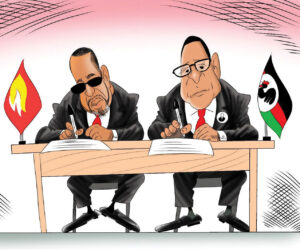
 Political alliances in Malawi seldom survive beyond an election. They are in fact unions of convenience sealed to wrestle power from a governing party.
In the event that the alliance fails to succeed at the elections, it is rare that the unity that was there during discussions and agreements to go together endures for more years.
We have seen alliances that were forged in the past to oust governing parties from power, before the biggest fraud on the political scene—the Tonse— arrived.
The pacts have quietly disappeared into the mists of time, because they were never really meant to last.
So, to some of us, it was very palpable that the Tonse Alliance would not last beyond the June 2020 court-sanctioned presidential election, only that many people in it appeared to have missed that reality.
- Advertisement -
They got immersed in the March 19, 2020 showboating by their leaders, now- President Lazarus Chakwera and Vice-President Saulos Chilima when the two appeared at that stage at Kamuzu Institute for Sports to sign an agreement they should have known had no legal backing.
Political alliances, which are essentially electoral alliances in the correct sense, are marriages of convenience which would be hard to stand legal tests.
That is why the truth remains that whatever Chakwera and Chilima agreed ahead of the court-ordered election is a deal between them.
They might have indeed reached an agreement that after Chakwera rules for the first five years, he should hand over the mantle to Chilima to lead the alliance.
- Advertisement -
- Advertisement -
Maybe the vision was that the alternation would continue for as long as those who curved it remained around—or just their spirits.
But how that would be real remains a contentious issue.
Chilima was Chakwera’s running-mate at the election and there was no Tonse Alliance on the ballot papers.
There was no UTM let alone its flag anywhere near the document, for the party had agreed to slip into the shadows of Malawi Congress Party (MCP).
In the country’s official records, there is no such a thing as Tonse Alliance, for it was never registered by the Registrar of Political Parties neither does it have any office anywhere.
In fact, by consistently referring to a political entity called Tonse Alliance in official activities, we are being very wrong, even though political pragmatism would let us off.
It is only for the essence that partners in the alliance should feel being part of government. Well, some of them even accepted at the very beginning that the electoral alliance had died on the arrival of election results.
What remained was the “good hearts” of those who were now leading the country.
They were and are still required to imagine what would have been the case if they never partnered others at the election.
With the 50+1 system that came into force following the Constitutional Court’s judgement, MCP was not going to win the election at one go.
It desperately needed a partner that would support the ousting of Democratic Progressive Party (DPP) from power.
UTM itself, led by someone who had fallen out of the then-governing party’s favour, was not going to make it on its own.
Even DPP itself—despite being a governing party— was not going to win in that election.
Electoral alliances were inevitable. In fact, DPP itself went into one with its mother party United Democratic Front because officials in DPP knew they would not win the election, with the 50+1 system in place on their own.
The point I am driving at is that MCP needed to be grateful to UTM as much as UTM needed to be grateful to MCP. Their coming together fulfilled their mutual dream of kicking DPP out of power.
It would seem the challenge now is that UTM members feel they are not “eating” as much as their MCP counterparts from government coffers.
They no longer feel being part of government.
Perhaps, it is high time proper laws and regulations to guide the formation and management of alliances were put in place.
But like some legal minds argue, the laws that government the establishment and management of political parties are enough.
So, it would be ideal to surmise that alliances should remain what they often are: convenient unions that can only thrive at the goodwill of those who lead government after winning an election.
It is more a moral than a legal or political question.