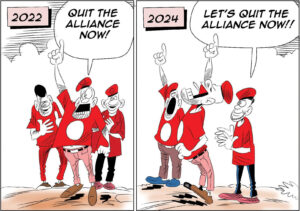
 UTM is a party with mixed fortunes. Its members sometimes exhibit an overhyped feeling of self-importance and can be very militant in their approach to issues.
Regarding the Tonse Alliance—which the party played a crucial role in forming—UTM members have the right to feel aggrieved and seek ways to no longer be part of the current administration.
They did so yesterday before their leaders finally announced that the party had left the alliance.
This formalises the move, as it was widely known that those who did not secure jobs in the current administration felt excluded and no longer considered themselves part of the alliance.
However, some of its senior members currently hold significant government roles, including positions in Cabinet and embassies.
- Advertisement -
These individuals may now have to resign, given the party’s explicit departure from the alliance.
Those who remain, possibly aligned with their Malawi Congress Party (MCP) counterparts, might consider leaving UTM to maintain favour with the governing party.
This is where the challenge lies in openly declaring departure from the alliance.
From the outset, certain UTM members, hoping to enjoy the financial gains their MCP counterparts receive in government, decided they were no longer part of the alliance.
- Advertisement -
- Advertisement -
Some justified their opposition to the government by claiming they sought better outcomes for Malawi, though their true motive may have been frustration with being sidelined.
Nevertheless, their grievances were not unfounded.
Without UTM, MCP would not have achieved government. The two parties combined their strengths to oust the Democratic Progressive Party (DPP) in the 2020 court-ordered presidential election.
However, the agreement underpinning their victory was not legally binding and relied on mutual moral considerations to function.
Following the tragic plane crash that claimed UTM leader and Vice- President Saulos Chilima’s life on June 10, the party’s departure from the alliance became more evident.
Members advocating for the move, including those who protested at Vice- President Michael Usi’s residence Friday, argued they did not benefit from the alliance.
They expected jobs and contracts, predominantly secured by MCP.
Those enjoying positions in the current government might not have supported calls to leave the alliance.
Nonetheless, members urging UTM to exit have previously indicated the alliance had effectively ended.
Perhaps now is indeed the time for them to formally decide their next steps.
An elective convention could resolve the party’s current turmoil.
Chilima was always central to UTM and his death has, in a way, intensified internal divisions, which, fortunately for the party, have remained under wraps.
Confusion among outspoken members oscillated between declaring they had already left the alliance and expressing a desire to do so.
They had already opted to keep distancing themselves from the current administration, as seen in their absence from Usi’s swearing-in ceremony.
Otherwise, they risked appearing contradictory, calling for departure from an alliance they claimed to have already abandoned, while their party colleagues continue to benefit from government positions.
They may be surprised to see more UTM members receiving key government appointments.
Yet, they cannot compel those benefiting from the government to resign.
Politicians often prioritise personal gain, as evidenced by those in government remaining silent on party matters, despite being aware of internal dissent.
Frustrated UTM members must relinquish self-centredness and realise they are not the focal point of Malawi’s affairs.
MCP’s unreliability in agreements has been demonstrated, prompting calls to reconsider dealings with them.
However, pushing UTM members still benefiting from the pact with the governing party to leave will be challenging.
This political game poses a steep learning curve for frustrated UTM members.
They can now be sure of how to respond to the so-called betrayal at the hands of MCP, especially as the country marches towards the 2025 elections.
Otherwise, what will they do if some of their leaders remain in a government where they went because of the alliance that was in place?
What will happen if more UTM leaders get government positions in the next few days while the party has announced that it is no longer part of the alliance?
It appears what will happen next will be everyone deciding their own political actions.
We are witnessing politics in a dynamic way and might just be surprised at some decisions that will be made by some UTM leaders in a few days to come.