By Wanangwa Tembo:
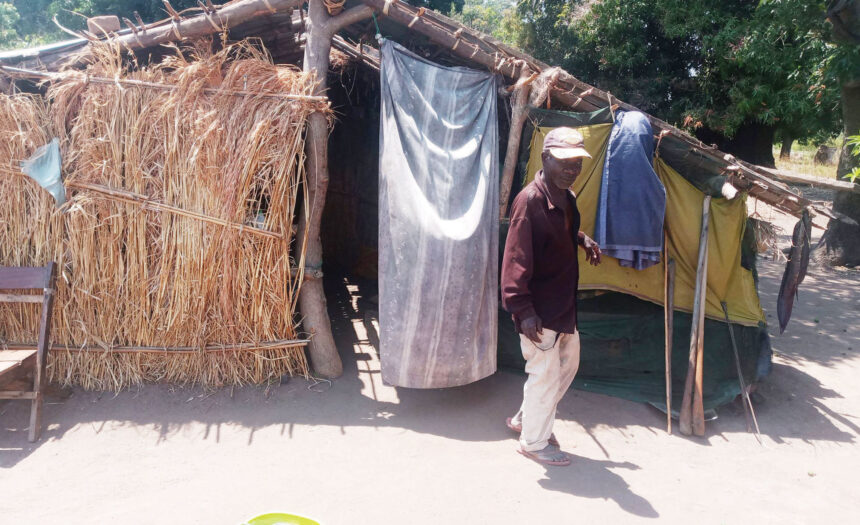
In the flatlands of Nyungwe, in Karonga, 68-year-old Baija Manda lives with his wife, seven children and three grandchildren in a makeshift structure, located about 10 metres from the notorious Wovwe River.
He recalls a traumatic night in February when a crashing sound abruptly woke him from sleep.
“We were asleep as a family when we heard a loud noise, followed by a sharp cry from one of the children,” he says. “When I woke up, I couldn’t find the door—it was blocked by debris. The house had collapsed.”
The injured child was rushed to hospital and the rest of the family sought refuge at a nearby school, which would become their temporary home for three months.
- Advertisement -
“Wovwe River used to be around 200 metres away from here. But in February, it overflowed and carved new paths, destroying homes along the way,” Manda says.
Heavy rains in Chitipa and Karonga led to severe runoff, flooding Tilora, Chimbilili and Hara streams.
These streams converged to form a large pool that eventually drained into Wovwe River. The river burst its banks, causing chaos in the lakeshore communities.
The floodwaters swept away crops, livestock and household items, including blankets, utensils and food, leaving the communities destitute.
- Advertisement -
- Advertisement -
The river’s course changed, bringing it within five metres of Manda’s former home and about 10 metres from the makeshift structure where his family now lives.
Though it is September and many rivers have dried up, Wovwe remains turbulent and continues to threaten the family.
“This structure is unsafe as it exposes us to various biting insects. Moreover, it lacks proper room divisions, leaving us without privacy,” Manda says.
He is one of 724 survivors in the district who received cash transfers from the Malawi Red Cross Society to help rebuild their lives after three months in a camp.
However, the rebuilding process has been slow, as the funds have long been exhausted.
“We are grateful for the support from Red Cross during this disaster, but we still face many challenges.
“We have moulded bricks and bought iron sheets, but we lack money to hire bricklayers, purchase cement or buy planks for roofing,” Manda grumbles.
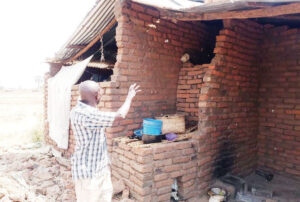
Another survivor, Alantos Mzumala, agrees with Manda, noting that there are still significant gaps in the rebuilding process.
“Some of us have purchased land in upland areas but lack funds to begin construction. Others have bricks ready but lack other resources.
“The common challenge is that we cannot fully rebuild without further support,” Mzumala says.
He is concerned that the upcoming rainy season could exacerbate their difficulties.
“The floods left us with nothing. We lost food, crops and everything in our homes. The only thing we were left with is life,” Mzumala says.
Karonga District Council Disaster Risk Management Officer, Humphrey Magalasi, says the district, one of the most disaster-prone in the northern region, frequently experiences flooding, strong winds, droughts and outbreaks like cholera.
“In the 2023-24 rainfall season, the district received heavy rains from January to April, affecting 3,500 households,” Magalasi explains.
“But we received substantial support from the government and stakeholders, including Red Cross. With the Red Cross, we planned and worked together throughout the process, from assessment to response,” Magalasi says.
As part of the Disaster Risk Management Committee and co-lead in shelter and camp management, MRCS has been a crucial actor, mobilising both food and non-food support for the survivors.
MRCS Emergency Operations Coordinator Louis Tobias Solomon expresses satisfaction that the flood survivors have effectively used the funds they received.
“Malawi Red Cross Society, in its role as an auxiliary to the public authority, collaborated closely with the government to assess the flooding.
“Our findings revealed that Karonga, Nkhotakota, Kasungu and Lilongwe districts were heavily affected. We secured K971 million from the International Federation of Red Cross and Red Crescent through the Disaster Response Emergency Fund,” Solomon explains.
The fund aimed to provide indirect support to 12,375 people and direct support to 3,000 people in the affected districts for a three-month period.
The intervention included immediate livelihood support through cash transfers and efforts to strengthen community resilience through promoting livelihood and risk reduction activities.
Approximately 5,000 people received direct support, while over 200,000 people benefited indirectly through awareness campaigns on cholera, disaster preparedness and the prevention of gender-based violence.
At least 600 households received K400,000 each for shelter rehabilitation and basic needs, while 400 families received K150,000 for basic needs.
The humanitarian organisation also supported district health offices with essential items like chlorine and facilitated health outreach clinics in hard-to-reach areas.
“We provided a comprehensive package, including sanitary items like soap, sleeping mats and blankets, to alleviate suffering alongside the cash transfers,” Solomon says.
He notes that most of the beneficiaries were from the lakeshore districts of Karonga and Nkhotakota due to the extent of the destruction, compared to Kasungu and Lilongwe.
“I am pleased to see that most of the communities we targeted have used their funds as intended and are rebuilding their homes,” he says.
Nonetheless, Village Head Kayaghala 2 of Nyungwe, whose community was severely affected, stresses that more needs to be done before the next rainy season to ensure that the survivors’ lives are fully restored to normalcy.—Mana