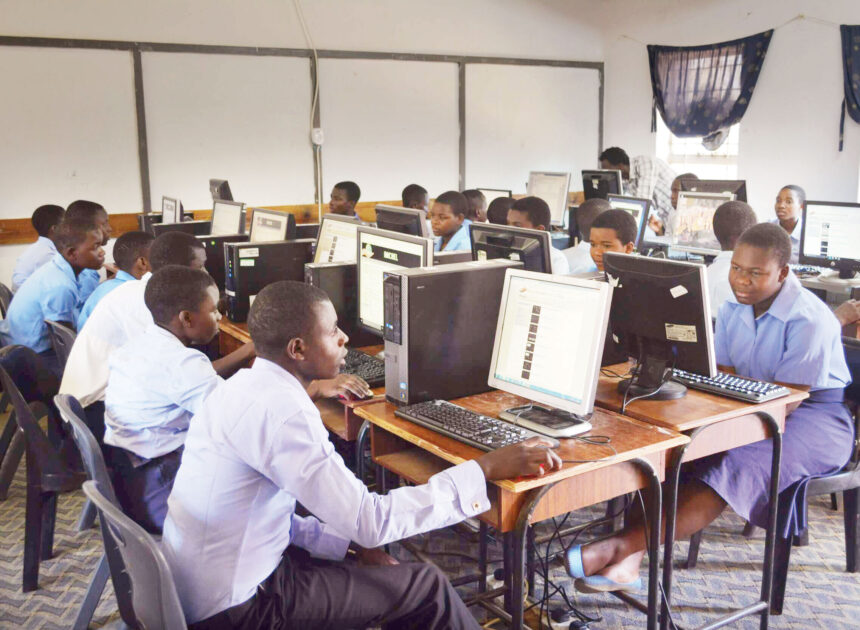

Lonjezo Sitima, captivated by technology’s transformative potential, dreams of becoming a computer technician.
However, her rural school in Mangochi lacks essential infrastructure such as electricity and a computer laboratory, which dampens her ability to gain practical computer skills.
Her teacher relies on traditional methods, such as writing everything on the board, which limits the students’ opportunities for hands-on learning.
When she heard earlier this year that the Malawi Communications Regulatory Authority (Macra) was launching an initiative to build 75 information and communication technology (ICT) laboratories, Lonjezo hoped her school would benefit.
“But now I know we will not have the laboratory. I envy those who are benefitting from the project,” she says glumly.
- Advertisement -
‘Ambitious project’
Macra’s Connect-a-School project aims to enhance the capacity of community day secondary schools (CDSS) in Malawi to serve as community ICT centres, reaching out to 40,000 students and 250,000 community members.
Macra asserts that this nationwide initiative, funded by the Universal Service Fund (USF), is intended to drive digital transformation and foster economic growth in Malawi.
At the groundbreaking ceremony for a centre at Nkope CDSS in Mangochi, Ronald Tembo, head of USF at Macra, said the project aligns with the National Digitalisation Policy.
- Advertisement -
- Advertisement -
“We have adopted a unique model where we collaborate with the community, particularly trained artisans from the [Technical, Entrepreneurial and Vocational Education and Training Authority].
“To ensure universal internet access, Macra is working on establishing a diplomatic data corridor and introducing data to cover all rural areas with affordable and reliable internet,” Tembo said.
He added that Macra is installing technology towers to extend mobile network and broadcasting signals in underserved communities.
Additionally, Macra plans to construct 9,000 ICT laboratories across various public institutions, with an estimated cost of over K7 billion.
Director of Science, Technology and Innovation in the Ministry of Education, Chomora Mikeka, described the Connect-a-School project as crucial for developing human capital in line with the demands of the digital labour market.
Mikeka stressed the project’s importance in facilitating digital transformation and economic growth in the country.
“Malawians have called for ICT labs in every school to support educational digitalisation and the country’s digital transformation. Providing connectivity to schools is essential for achieving Malawi 2063, our long-term development plan,” he said.
Disparity in access
With about 880 CDSSs in Malawi, which play a crucial role in providing secondary education to students, especially in rural and underserved areas, the Connect-a-School project’s reach of only 75 CDSSs—representing just eight percent of such schools—leaves learners like Lonjezo feeling left behind.

The issue is compounded by CDSSs’ poor performance in national examinations, attributed to resource constraints, insufficient teaching materials, lack of modern educational technology, overcrowded classrooms and a shortage of qualified teachers.
“In my class, we have over 100 students. Computers would ease the burden on teachers by assisting each of us individually.
“Nowadays, educational information is readily available on the internet. With an ICT laboratory, our performance would improve significantly,” Lonjezo says, her face tinged with faint hope.
Studies indicate that many students in CDSSs come from low-income families, which can affect their ability to focus on their studies due to factors such as needing to work to support their families or having inadequate study environments at home.
Most do not have ICT devices at home to complement their studies.
Macra says it acknowledges the government’s recognition of the importance of connecting educational institutions to the internet and its inclusion of ICT access in the ICT Policy.
The policy outlines specific measures to integrate ICTs into educational practices and administration.
“The government has several other initiatives aimed at connecting schools with the internet, including Last Mile Connectivity, which has connected 145 schools and colleges across the country,” the regulator says.
Rural education challenges
However, for learners like Lonjezo, whose schools lack the ICT equipment and infrastructure found in others, the policy’s implementation falls short.
They miss out on benefits such as access to a vast volume of educational information, opportunities for collaboration and the use of online applications.
Their teachers also lack ICT skills, hindering their ability to teach computer science effectively.
Macra states that school connectivity also enhances educational administration through the electronic exchange of forms, data and other information.
The regulator says connectivity also achieves cost efficiencies by automating manual tasks and reducing expenses associated with textbook printing and distribution.
“Remote schools benefit significantly from internet access, which facilitates online learning, knowledge transfer and access to educational content,” Macra says.
At Lonjezo’s school and several other CDSSs, these benefits are not available, leaving them stuck with traditional methods and falling behind.
Yet, Unesco points out that digital education provides students access to subject matter experts online, even in the absence of qualified teachers in their immediate environment.
The UN agency also highlights that digital education can leverage e-learning platforms and digital resources to offer personalised and flexible learning experiences, allowing students to study at their own pace.
Additionally, Unesco says, technology can empower educators to create dynamic and interactive lessons, tailor instruction to individual needs and provide real-time feedback, improving the quality of teaching and learning.
Despite these potential benefits, the UN agency acknowledges that Africa still faces challenges due to the digital divide.
“Many students lack access to basic technological infrastructure, such as reliable internet connectivity, computers and digital devices.
“This disparity exacerbates educational inequalities, as students from underserved communities face disadvantages in accessing digital learning resources and participating in online education,” it says.
Voices from the field
Vincent Kumwenda, a technology enthusiast and former chief executive officer of mHub, a technology and innovation hub in Malawi, points out that the digitalisation policy aims to bridge the digital divide between urban and rural areas.
“The policy places greater emphasis on universal accessibility, recognising that digital inclusion is crucial for equitable development. It acknowledges the need to ensure that citizens, regardless of their location, have access to digital services and skills,” Kumwenda says.
He acknowledges the challenges faced by the policy, including high costs of ICT infrastructure development, inadequate rural electricity supply and the need for localised digital content.
Perhaps the involvement of major institutions like Macra is crucial for addressing some of these challenges with public resources.
Kumwenda suggests that connecting more people to the internet and increasing digital literacy are key goals.

On his part, University of Malawi senior lecturer in Instructional Design and Technology, Foster Gondwe, believes ICT services can enhance learners’ performance in certain areas.
“I say ‘certain’ because the effectiveness of ICT in learning depends on the characteristics of the ICT, how it is used, its purpose and its context. In other words, ICT services do not always support learning; sometimes they can be a barrier,” Gondwe states.
He still acknowledges that ICT skills acquired in school can be applied outside the school environment.
According to Gondwe, this works if schools make deliberate efforts to prepare students by demonstrating how ICT skills can be applied beyond the school.
“Evaluating digital information and information sources is one critical ICT skill that students should develop and apply outside school,” he explains.
Gondwe also notes that if teachers and students do not understand how to use and value ICT labs, the labs will remain underutilised.
He, therefore, calls for effective strategies to enhance access to and use of these labs.
Gondwe acknowledges that the disparity between schools with and without ICT services contributes to the digital divide.
“However, the benefit of having an ICT lab depends on how it is used. It is possible to have an ICT lab without benefiting from it,” he says.
Future of hope
The Ministry of Education is pursuing its priority interventions in digitalising education as outlined in the Malawi 2063 national development strategy.
In the meantime, learners like Lonjezo, along with many others at her school, remain excluded.
Minister of Education Madalitso Kambauwa Wirima is optimistic about the gradual expansion of ICT services to more schools.
“We expect improved performance as the internet becomes a source of academic material. This will also benefit the community through increased internet connectivity,” she said of the ICT labs project.