By Damian Zane:
There is a good chance that inside your mobile phone is a miniscule amount of a metal that started its journey buried in the earth of eastern Democratic Republic of Congo, where a war is currently raging.
It may even be directly connected to the M23 rebel group that made global headlines last week.
The tantalum within your device weighs less than half of the average garden pea but is essential for the efficient functioning of a smartphone, and almost all other sophisticated electronic devices.
- Advertisement -

The unique properties of this rare, blue-grey, lustrous metal — including being able to hold a high charge compared to its size, while operating in a range of temperatures – make it an ideal material for tiny capacitors, which temporarily store energy.
- Advertisement -
It is also mined in Rwanda, Brazil and Nigeria but at least 40 percent- and maybe more – of the element’s global supply comes from DR Congo and some of the key mining areas are now under the control of the M23.
The current wave of fighting has been going on for months, but the rebels grabbed attention with Sunday’s assault on the vital trading and transport hub of Goma. The city, bordering Rwanda, is a regional centre for the mining business
Over the past year, the M23 has made rapid advances across the mineral-rich east of DR Congo, taking areas where coltan – the ore from which tantalum is extracted – is mined.
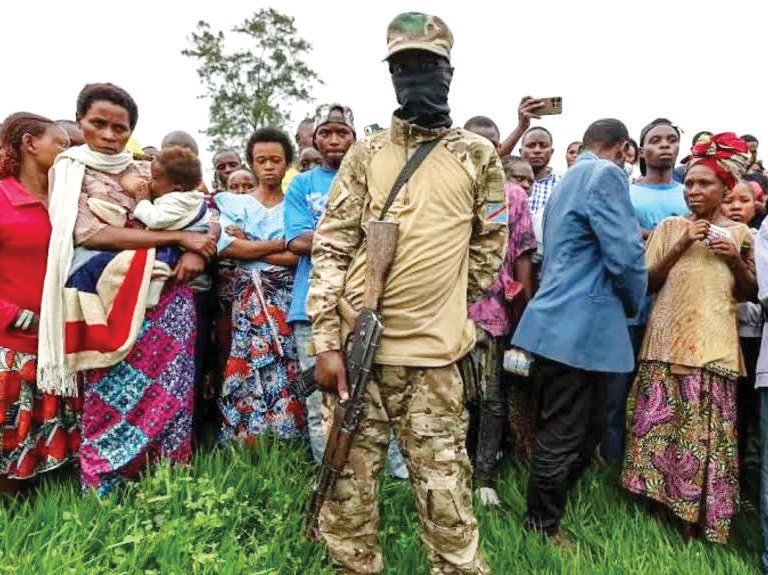
Like scores of other armed groups operating in the area, the M23 began as an outfit defending the rights of an ethnic group perceived to be under threat. But as its territory has expanded, mining has become a crucial source of income, paying for fighters and weapons.
- Advertisement -
Last April, it seized Rubaya, the town at the heart of the country’s coltan industry.
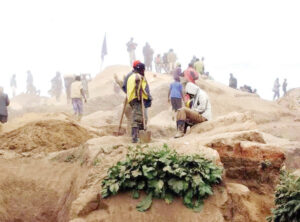
Mineral extraction in this region is not in the hands of multinational conglomerates – instead thousands of individuals toil in open pits that honeycomb the landscape, or underground, in extremely unsafe and unhealthy conditions.
They are part of a complex, and yet informal, network that sees the rocks removed from the ground using shovels, brought to the surface, crushed, washed, taxed, sold and then exported to be further purified and eventually smelted.
Once the M23 moved into Rubaya, the rebels established what a UN group of experts described as a “state-like administration”, issuing permits to the diggers and traders and demanding an annual fee of $25 (£20) and $250 respectively. The M23 doubled the diggers’ wages to ensure they would carry on working.
It runs the area as a monopoly making sure – through the threat of arrest and detention – that only its authorised traders are able to do business.
The M23 also charges a levy of $7 on each kilogramme of coltan. The UN group of experts estimated that as a result the M23 earns about $800,000 a month from coltan taxation in Rubaya. That money is almost certainly then used to fund the rebellion.
There is a question mark hanging over how the ore extracted from M23- controlled areas gets into the global supply chain.
Neighbouring Rwanda, which is seen as backing the M23, is at the centre of the answer, the UN experts say.

Theoretically, a traceability system – known as the International Tin Supply Chain Initiative (Itsci) – should mean that what goes into a phone handset and other electronics is sourced responsibly and avoids conflict financing and human rights abuses.
The US’ Dodd-Frank Act passed in 2010, and a similar piece of EU legislation, is aimed at ensuring that companies purchasing tin, tantalum, tungsten and gold – so-called “conflict minerals” – are not inadvertently funding violence.
But Itsci has come under some criticism.
Ken Matthysen, a security and resource management expert with independent research group Ipis, highlights that the dispersed nature of a lot of small-scale mines make it difficult for the local authorities to monitor exactly what is going on everywhere.
Itsci tags should be put on bags at the mine itself, to prove the origin of the minerals inside, but often they get transported to a collection point where it becomes harder to trace where the ore actually came from, Matthysen said.
He added that there is also a possible issue with corruption.
“There is even an accusation of the state agents selling tags to traders, because they don’t make a good living. So the traders then go around eastern DR Congo and they tag the bags themselves,”
In a statement to the BBC, Itsci said it covers 3,000 mine sites and that it works “at any mine, regardless of their size or remoteness, following the goal of ‘leaving no-one behind’… Excluding remote areas would be the opposite of responsible sourcing and would exacerbate potential risks.”
Itsci added that these remote communities have benefitted from its support. The scheme has also been praised for bringing “prosperity for hundreds of thousands of small-scale miners”.
In the case of Rubaya, Itsci suspended its operations there soon after the M23 entered the town.
Nevertheless, the group has managed to continue exporting coltan.
The UN experts map a circuitous route showing how it is transported to close to the Rwandan border. It is then transferred to “heavy-duty trucks” that needed the road to be widened in order to accommodate them.
Rwanda has its own coltan mines but the experts say that the uncertified coltan is mixed with Rwandan production leading to a “significant contamination of supply chains”.
The M23 was already involved in the coltan business before the capture of Rubaya – setting up roadblocks and charging fees to cross them, according to Matthysen.
“A lot of the trade of these minerals went through M23-controlled area towards Rwanda. So even then, Rwanda was profiting from the instability in eastern DR Congo and we saw the export volumes to Rwanda were already increasing,” he told the BBC.
Figures from the US Geological Survey show that Rwanda’s coltan exports rose by 50 percent between 2022 and 2023. Matthysen said this could not have all come from Rwanda.
In a robust defence of Rwanda’s position, government spokesperson Yolande Makolo reiterated to the BBC that there were minerals and refining capacity in her own country.
“It’s very cynical to take an issue like what’s happening in eastern DRC, where a persecuted community is fighting for its rights… and turning [it] into an issue of material benefit,” she added.
Rwandan President Paul Kagame has also dismissed the UN experts’ reports, pouring scorn on their “expertise”.
Much of the east of DR Congo has been blighted by conflict for many years, raising questions about who has been benefitting and whether armed groups are profiting from what is dug out of the ground there.
In order to highlight the issue and its connection to the smartphone industry, the Congolese government filed criminal complaints in France and Belgium at the end of last year against subsidiaries of the tech giant Apple, accusing it of using “conflict minerals”.
Apple has disputed the allegation and pointed out that since early 2024, because of the escalating conflict and the difficulties of certification, it stopped sourcing tantalum, among other metals, from both DR Congo and Rwanda.
Other companies have not been so clear, which means that as the M23 seizes more territory those small bits of tantalum from the mines that they control could still make their way into the devices that we have come to rely on.—BBC