

By Alick Ponje in Belém, Brazil:
Failing crops, intense floods and storms, and lost homes and lives are among the climate impacts battering poor countries such as Malawi, and they are demanding a shift from promises to tangible action.
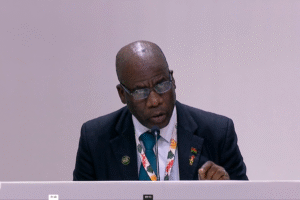
Chair of the Group of 44 Least Developed Countries (LDC), Evance Njewa from Malawi’s Ministry of Natural Resources, warned on Monday that millions of lives in LDCs remain at risk without adequate support.
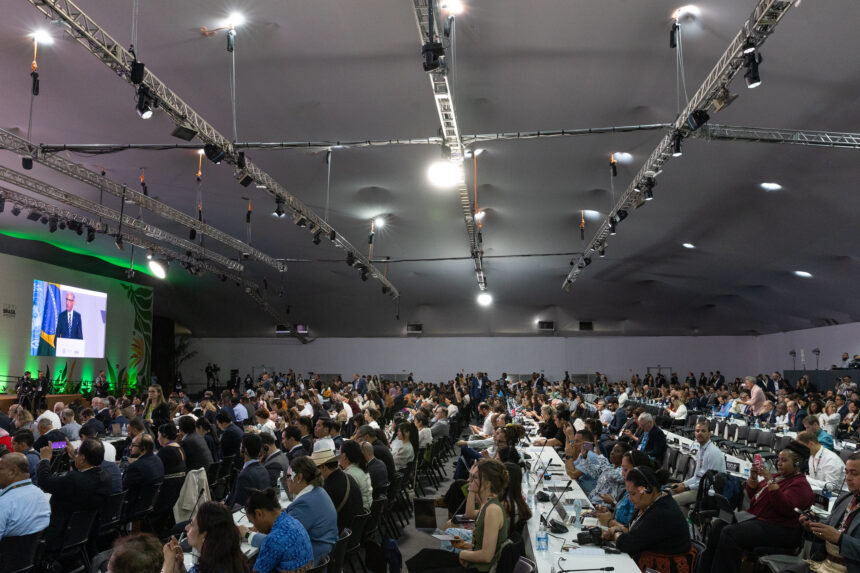
Njewa addressed the press on the demands poor countries are expected to present during what is billed as an intensive two weeks of negotiations on climate action at the 30th United Nations Climate Change Conference (COP30), currently underway in Belém, Brazil.
- Advertisement -

He said nations least responsible for the climate crisis are enduring its worst effects while still waiting for promised support.
- Advertisement -
“Ten years after the Paris Agreement, we are still waiting for promises made to turn into delivery. Belém must be the turning point,” Njewa said.
He added that developed countries, which have contributed the most to climate change through historical and ongoing greenhouse gas emissions, must fulfil their financial commitments.
“Climate finance is not charity; it is a legal obligation under the Convention and the Paris Agreement, reaffirmed by the [International Court of Justice],” he said.
However, while the ICJ advisory opinion affirms that states have a duty to make reparation for climate harm, it cannot legally compel countries to pay, as advisory opinions are not binding.
- Advertisement -
Njewa pointed to the $1.3 trillion Roadmap, which estimates the funding needed to support developing countries in mitigation, adaptation, technology transfer and capacity-building through 2030.
“The 1.3 trillion Roadmap must mark the start of genuine delivery and not be left as an aspirational report,” he said.
He said the LDCs expect fresh contributions to UN climate funds, a dedicated implementation track for the new climate finance goal agreed last year in Baku, Azerbaijan, and robust accountability to ensure developed countries deliver on their promises.
“Our countries did not light this fire but we are burning in its heat. And the smoke does not stop at our borders.
“Communities in LDCs are being displaced, crops are failing and lives are being lost. Funding to enable our countries to defend themselves against climate impacts is key,” he said.
The LDC Group chair then called for the Glasgow pledge, an agreement made at COP26 in 2021 in which developed countries committed to doubling adaptation finance for developing nations by 2025, to be succeeded by tripling adaptation finance to at least $120 billion per year by 2030.
He also warned that global pledges remain far from what is needed and that the LDC Group “is alarmed by the latest Nationally Determined Contributions (NDC) Synthesis Report”.
The report shows current pledges would take the world well beyond 1.5°C of warming.
“COP30 must deliver a credible global response to close the ambition gap, including a clear commitment to enhanced, 1.5°C aligned NDCs,” he said.
Ironically, the majority of LDC Group members, including Malawi, have not yet submitted updated NDCs, which are climate action plans outlining their measures to reduce emissions and adapt to climate impacts.
Asked later about the progress Malawi is making towards submitting its updated NDCs, Njewa insisted “work is being done” but fell short of providing a clear timeline.
Countries were originally expected to submit updated or new NDCs by February 2025, with a second deadline set for September 2025.
As of Monday, sites tracking progress on NDC submissions showed that only 109 of 192 states plus the European Union, which submits as one party, had done so.
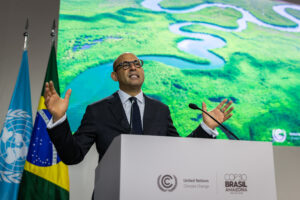
Meanwhile, speaking earlier at the opening of the conference, UN Climate Change Executive Secretary Simon Stiell said the emissions curve has been bent downwards thanks to previous agreements.
“But I am not sugar-coating it. We have so much more work to do. We must move much, much faster on both reductions of emissions and strengthening resilience,” Stiell said.
He added that lamenting is not enough and solutions are needed.
Stiell then pointed to the rapid growth of renewable energy, saying solar and wind are now the lowest-cost power in 90 percent of the world.
“Renewables overtook coal this year as the world’s top energy source,” he said.
An analysis from the think tank Ember shows that solar and wind generated approximately 5,072 terawatt-hours (TWh) in the first six months of 2025, whereas coal generated about 4,896 TWh.
On turning agreements into action, Stiell said countries must focus on accelerating the tripling of renewables, doubling energy efficiency and putting the Baku to Belém Roadmap into motion.
“We have already agreed to deliver at least $300 billion in climate finance, with developed countries taking the lead. We now need to put the Baku to Belém Roadmap to work. To start moving towards the $1.3 trillion,” he said.
On adaptation, he said that while a global goal has been agreed, “we now need to agree on the indicators that will help speed up implementation, to unleash its potential.”
According to climate change experts and lobbyists, COP30 comes at a critical time for the world’s most vulnerable countries, including LDCs such as Malawi, as climate impacts intensify and the window to meet the Paris Agreement’s 1.5°C goal narrows.
This story was produced as part of the 2025 Climate Change Media Partnership, a journalism fellowship organised by Internews’ Earth Journalism Network and the Stanley Center for Peace and Security.