





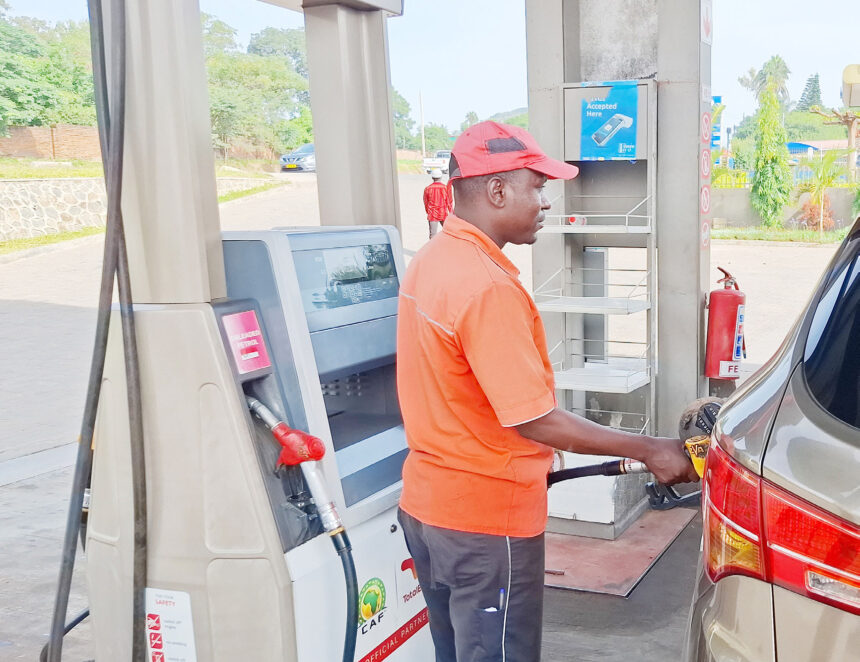
On January 20 2026, the Malawi Energy Regulatory Authority (Mera) increased petrol prices by 41.6 percent and diesel by 41.1 percent, triggering fear of a fresh wave of price increases that could undermine recent gains made in the fight against inflation.
There is also fear that the development threatens the country’s modest economic recovery.
Mera reintroduced the Automatic Pricing Mechanism (APM) after three years of fixed pricing, pushing the price of petrol to K4,965 per litre from K3,499 and diesel to K4,945 from K3,500.
This marks the second major fuel increase in four months, bringing the total rise in petrol and diesel prices to 96 percent and 80 percent, respectively, since September 2025.
The September price rise took place shortly before Peter Mutharika was sworn in as Head of State and Government.
- Advertisement -
The timing could not be worse for an economy that was showing tentative signs of stabilising.
Inflation had declined to 26 percent in December 2025 from 27.9 percent in November, marking the lowest level since January 2023.
Reserve Bank of Malawi Deputy Governor Kisu Simwaka had described the trend as a sign that inflation had turned the corner, potentially paving the way for a policy rate cut to support economic growth.
However, economists warn that the fuel price increase will likely reverse these gains.
- Advertisement -
- Advertisement -
United Kingdom-based Malawian economist Velli Nyirongo cautioned that higher fuel prices would feed directly into inflation, raising transport, food and production costs across the economy, disproportionately affecting households and small businesses and increasing poverty risks.
The immediate impact is already visible in public transport fares. Commuters who previously spent K2,000 a day to get to work now need over K3,000 or more, depending on the status of one’s place of residence [district, town, municipality or city] while food prices are expected to rise as transport costs surge.
The Human Rights Defenders Coalition described fuel as not a luxury commodity but a basic one, warning that any increase had a cascading effect on the cost of living.
Commodity prices had already started to go up following the previous fuel hike and this month’s increase in the sales tax.
The fuel price shock comes at a critical moment for government economic projections.
Finance Minister Joseph Mwanamvekha has projected economic growth of 4 percent in 2026, reflecting a significant recovery amid tight monetary conditions, high domestic debt and lingering food supply pressures.
However, the World Bank has a more conservative estimate, projecting growth of only 2.6 percent in 2026, which would keep Malawi among the slowest-growing economies in sub-Saharan Africa.
Both projections fall far short of the threshold required to transition Malawi to a middle-income economy by 2030 under the Malawi 2063 vision.
They also remain below the population growth rate, meaning per capita incomes could continue to decline, further impeding poverty reduction efforts.
The fuel price increase could undermine these already modest projections in several ways.
Higher transport costs will increase the price of essential goods, eroding household purchasing power and dampening consumer spending, which is a key driver of economic growth.
Businesses will face higher operating costs, potentially forcing them to cut production or lay off workers. The inflationary pressure could also prompt the Reserve Bank of Malawi to maintain, or even increase, interest rates, making credit more expensive and further constraining private sector investment.
Mwanamvekha has projected inflation to ease to 20.7 percent in 2026, but this forecast now looks increasingly optimistic.
With fuel prices feeding directly into transportation, food production and manufacturing costs, inflation could remain elevated well above the government’s target, keeping the cost of living high for ordinary Malawians.
The broader economic context makes the situation even more precarious. Wages, interest on loans, pensions and gratuities now swallow over 90 percent of domestic revenue, leaving almost nothing for development spending on roads, hospitals, schools or economic projects.
Public debt stands at K22.4 trillion, with 55 percent being domestic borrowing, sharply increasing interest payment obligations estimated at K2.27 trillion in the 2025-26 financial year.
Foreign exchange shortages continue to constrain the economy, making it difficult for businesses to import essential inputs. The weak Kwacha has made imports more expensive, contributing to inflationary pressures and limiting the government’s ability to stabilise commodity prices.
There are, however, some potential positives that can be drawn from the fuel price adjustment.
The move to an automatic pricing mechanism could help ensure sustainable fuel supply, ending the chronic shortages that plagued the country under the previous fixed pricing system.
Economists are calling for short-term mitigation measures such as targeted cash transfers to poor households, subsidised transport for essential workers and zero-rating of basic food items to prevent a humanitarian crisis.
Longer-term solutions require accelerating investment in renewable energy and more efficient transport systems to reduce dependence on imported petroleum products.
Strenghtening export performance and improving foreign exchange availability would also help stabilise the currency and reduce vulnerability to global oil price shocks.
The Centre for Social Concern warned that for a country already battling high inflation, food insecurity, unemployment and a weak currency, the increase in fuel price was not just a policy adjustment but a direct assault on household survival.
Therefore, the outlook for 2026 remains highly uncertain.
The question now is whether the government’s economic recovery plan can deliver relief before the pain becomes unbearable.