By Isaac Salima:
Almost 10 years since the launch of a 20-year master plan that the authorities tipped to revolutionise the transport sector in Malawi, the country’s rail transport rehabilitation remains a patchwork of unremarkable, not-so-promising construction works.
Largely, everything seems to be deteriorating and decaying – a trajectory that’s inconsistent with the ambition the government set out 9 years ago for Malawi to transform its railway sector.
When the government launched the strategy in December 2017, it proposed a number of ‘key potential investment projects’.
They included the upgrading of Nkaya- Chipata and Nkaya-Limbe- Makhanga rail line and establishing a new line from Kanengo through Salima to northern region and from Mbeya to Chilumba in Karonga.
- Advertisement -
For the 120km Limbe- Makhanga section, the plan said: “It is expected that Central East African Railways Limited (Cear) will bring [it] back as far south as Sandama [in Thyolo] into use for both freight and passenger by 2019,” the 327-paged document reads in part.
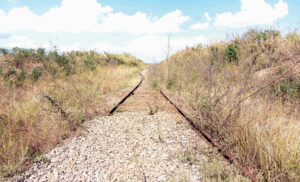
However, after a few months of promising rehabilitation activity, the works between Limbe and Makhanga collapsed around 2020 and the route the masterplan targeted is now a stretching belt of bush and plunder.
We toured the length of the rail from Nansadi station in Thyolo this week and found it overgrown with grass and shrubs in some places.
Out of use, it has now fallen to vandalism.
- Advertisement -
- Advertisement -
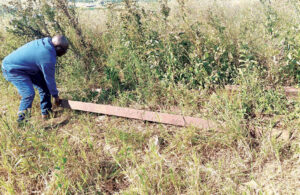
For example, for a distance of nearly 20km from Makande Prison in Thyolo, we found both the sleepers and, in most places, the rail itself stripped off.
A member of the community, Felix Chiminingo, told Malawi News, that the vandals have been stealing the items in broad daylight.
“They pose as officials from the construction companies. They put on their work suits to hoodwink people that they are working,” Chiminingo said on Tuesday.
We found some of the ripped off rails dumped near Malawi University of Science and Technology.
In Nsanje, government set out to rehabilitate the Marka- Nsanje railway. Records show that the project should have been completed by September 2021.
The project has not only been buffeted by allegations of corruptly-awarded contract – investigated by the Anti- Corruption Bureau in 2022 – but also forced changes of contractors.
It has also been subject of political staging by government officials.
In one case in September 2024, the then president Lazarus Chakwera travelled to the area to welcome a train Malawians were told had brought 1.2 million litres of fuel into the country from Beira in Mozambique.
The administration basked in the publicity then, touting itself as having broken 41 years of the railway being dysfunctional.
Like the Limbe-Makhanga project, this, too, promised as fruits of the master plan.
Almost two years since, Malawi is yet to receive another consignment of fuel from this route. And works on the project have stalled.
Once proven as a sure way of moving bulk commodities affordably, the iron wheels of railway transportation in Malawi seems to have not only derailed but also stuck deep in the mud.
Once a network covering nearly 800km, according to records, it is now just about 300km of functioning network – 197 kilometres between Limbe and Nayuchi and some 100km between Kanengo in Lilongwe and Mchinji.
A transport that previously connected people from Limbe to Beira, Nkaya to Nayuchi, Balaka to Salima and reached the neigbouring Zambia through Mchinji and tipped for expansion is all but collapsed.
Yet, the Ministry of Transport and Public Works insisted it is implementing the master plan to ensure the rail transport in Malawi is back to its potential.
The ministry’s spokesperson, Chikondi Chimala, said in an interview with Malawi News that government has intensified efforts to, for example, extend the rail network to the north of Malawi and connect it to Tazara line, a nearly 2,000-km railway that connects Tanzania and Zambia.
“Resource mobilisation for the implementation of project preparation activities is underway and it is expected that procurement of consultancy services for the feasibility study will be completed within the current financial year,” he said.
According to Chimala, the African Development Bank is willing to support the project’s feasibility study and the ministry is working with the Central Corridor Transit Transport Facilitation Agency (CCTTFA) to enhance the process.
CCTTFA is a multilateral agency which Malawi joined in 2003. Its mandate includes to encourage the improvement of infrastructure and supporting service facilities at regional ports, rail, lakes, roads and land border posts on transport networks that connect to the port of Dar es Salaam in Tanzania.
Chimala added that the rehabilitation of a 400-kilometre railway from
Nkaya to Mchinji and Marka Bangula is expected to be completed within the current 2026-2027 financial year. Economist Happy Chirwa did not sound optimistic. He said transportation sector is the hub of every country’s development and Malawi should have given more focus on rail transport considering its low cost of moving goods and how that could be beneficial for this landlocked country. “However, this is an opposite of what is happening in the country because we seem not to be moving, looking at the pace we are taking,” he said.