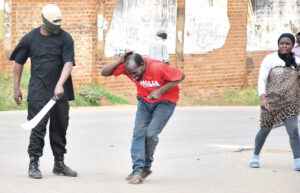
 The recent outbreak of political violence in Lilongwe has once again underscored the fragile state of our democracy as we prepare for the highly anticipated 2025 General Elections.
Several human rights organisations have already expressed alarm at the violent disruptions to protests planned by opposition political parties.
In a country that has made significant strides towards democratic consolidation since the return to multiparty politics in 1994, these incidents serve as a reminder of the persistent threats to democratic freedoms, particularly political expression and peaceful assembly.
A group of men who blocked access to Lilongwe Community Ground are reportedly linked to political factions.
There was an alarming display of violence, as the assailants, wielding machetes, attacked passers-by and anyone suspected of planning to participate in the protests.
- Advertisement -
This incident highlights two troubling trends: first, the increasing use of violence as a tool to silence political opposition; and second, the apparent failure of the State to ensure the protection of citizens’ constitutional rights to protest and express their political views.
The fact that a political protest, which should be a legitimate democratic act, was met with violence raises serious questions about the state of law and order in the lead-up to next year’s elections.
The government has responded to the violence with a call for peaceful, legal demonstrations.
While the stance on the right to demonstrate is theoretically supportive, the reality is more complex.
- Advertisement -
- Advertisement -
A protest that is met with violence, as seen in Lilongwe, indicates a failure of the State to create a safe environment for political expression.
Simply calling for peaceful demonstrations without addressing the underlying causes of violence may not be enough to prevent future incidents.
The role of the police in maintaining public order and protecting citizens’ rights is crucial.
However, the police’s response to the incident has raised further concerns.
Police spokesperson Peter Kalaya claimed that there were no reports of vandalism or injuries resulting from the attack.
This lack of immediate action or acknowledgment of the severity of the violence points to a potential lack of political will or capacity to confront politically motivated violence.
As others have said before, the police need to provide a stronger response in incidents of this nature, de-escalate tense situations and take legal action against those responsible for such violence.
State agencies and the government itself must foster a conducive environment for peaceful demonstrations, political association and freedom of expression.
They must create conditions that allow opposition parties and other groups to express their views without fear of retribution or violence.
The government must ensure that citizens can exercise their rights without fear of being attacked by counter-demonstrators or other violent actors.
It is a fact that if what happened in Lilongwe is allowed to go unpunished, it sends a dangerous message that intimidation and brutality are acceptable tactics in political contests.
Of course, it is also important to acknowledge that the Lilongwe incident is not an isolated occurrence but rather a symptom of deeper political polarisation in Malawi.
Ahead of the 2025 elections, tensions between political parties are running high.
Then there is the political blame game, which only fuels further animosity between the parties and increases the risk of violence as the elections approach.
The political landscape is becoming more fractious and rather than focusing on constructive dialogue, the parties appear increasingly locked in a battle of accusations and counter-accusations.
Such dynamics make it all the more critical for civil society, political leaders and the government to prioritise de-escalation and peaceful conflict resolution.
Dialogue remains one of the most effective tools to address political tensions and ensure that elections are free, fair and peaceful.
It is essential that all political players, including the ruling party and the opposition, engage in good-faith discussions to foster trust and reduce the likelihood of violent conflict in the lead-up to the 2025 elections.
Without such dialogue, the risk of more frequent and intense political violence only grows, jeopardising the country’s democratic progress.
If the 2025 elections are to be truly free and fair, the government must take stronger measures to protect the right to peaceful assembly, promote political tolerance and prevent political violence.
On the other hand, opposition political parties that defied a recommendation from the Lilongwe District Council not to go ahead with their demonstrations are also to blame.
It was possible to postpone the march to another day or even seek legal redress from the courts. We have seen this happen before.