



By Imam Wali:
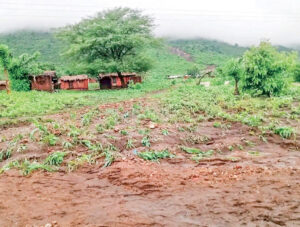
Early this year, violent floods wreak havoc in the area of Senior Chief Nankumba in Mangochi, displacing about 800 households in a single night.
For community members like Irene Justin, a mother in her 60s, the disaster was a catastrophic breaking point.
“The whole village was hit. We lost our crops, animals and houses. Last season, we suffered the effects of drought, and this season the floods washed away everything. We lived in a displacement camp with nothing to our name for several months, waiting for the situation to improve.” Justin recalls
- Advertisement -

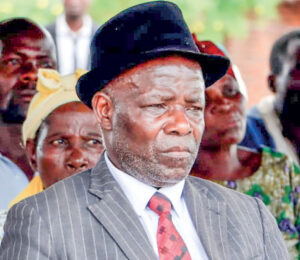
Senior Chief Nankumba admits that actions by locals directly fueled the disaster, pointing to the aggressive charcoal trade that stripped the landscape bare.
- Advertisement -
“In the past, we had vast forests here. The trees used to protect us. But we have cut them all down for charcoal. The only way we can reverse this situation is by planting more trees and taking good care of the ones remaining,” he said
This ecological collapse is echoing across Malawi. In Dedza, in the area of Group Village Headman Kasina, Traditional Authority Kaphuka, Phyless Maneno experienced an identical rude awakening on January 24, 2026.
Flash floods rushing down from the Dzenza Hills violently washed away her home and crops at midnight.
“We had no chance to salvage our food or household items. The crops we had just planted were washed away as well. This means hunger has entered our home. It is disheartening that some people have been cutting down trees carelessly along the hill.
- Advertisement -
Despite knowing the consequences, we have failed to take care of our environment, and now we are paying a hefty price.”
For any Malawian born in the early 1990s, the landscape of childhood has vanished. The lush, canopy-covered hillsides are now bare.
This ecological collapse is backed by grim statistics. According to Global Forest Watch, Malawi lost an average of 42,000 hectares of tree cover per year between 2001 and 2023. Other estimates put the loss at 250,000 hectares when mixed vegetation is included.
Deforestation now costs Malawi an estimated 7 percent of its total GDP annually.
Today the crisis is at our doorstep.
The Integrated Food Security Phase Classification report found that approximately 4 million people, about 22 percent of the analysed population experienced high levels of acute food insecurity.
Experts estimate that up to 85 percent of Malawi’s agricultural lands suffer from soil erosion. This degradation directly impacts the 70 percent of Malawians affected by severe land degradation.
The energy crisis fuels it further. With 96 percent of Malawian households relying on charcoal and firewood for cooking, pressure on forests remains relentless.
Historically, warning the public about environmental destruction was slow. Citizens relied on radio, television or praying and other gathering surroundings.
But Malawi has entered a fast-paced digital era aligned with global commitments. The UN Sustainable Development Goals (SDGs) directly call for this shift: SDG 13 demands urgent climate action, while SDG 9 calls for building resilient infrastructure and fostering innovation.
According to DataReportal’s Digital 2026 Malawi report, the country now has 2.40 million active social media user identities.
This digital mobilisation is fueled by a growing network footprint. Regulatory data shows national internet penetration has climbed to 36.9 percent, doubling from 18.9 percent.
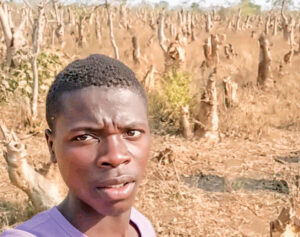
At the forefront of this digital green revolution is 24-year-old Masautso Divaison from Group Village Headman Jolofani, Traditional Authority Khongoni in Lilongwe. He completed Form 4 at Kasiya Secondary School.
Armed with a smartphone and a passion for conservation, Masautso has emerged as an environmental champion on TikTok and Facebook, capturing thousands of views with educational videos.
“I am deeply worried about the rate at which we are destroying our environment. Many of the people driving this destruction are active on social media. By reaching them with actual visual evidence, they can clearly see the catastrophic dangers of wantonly cutting down trees or setting bushfires,” says Divaison.
Unlike radio, TikTok’s algorithm pushes his videos to users in charcoal-producing areas who do not follow environmental pages.
In one clip that went viral, Masautso breaks down soil erosion using local language and visual transitions. His work is now being used to support ideas in the National Forest Policy and the Forest Landscape Restoration Strategy.
But this digital solution faces limits.
Regulatory data shows 90% of Malawians live under network coverage but only 1 million of 14 million registered SIMs are in smartphones.
Data bundles remain expensive and rural coverage is patchy.
“I lose viewers the moment their megabytes finish. If the internet was cheaper, this movement would reach every single village,” Masautso admits.
This digital divide directly undermines SDG 9, which calls for universal and affordable access to the internet in least-developed countries by 2030.
Despite this, Masautso’s advocacy has potential of jumping from mobile screens into local classrooms.
Tchauya Lemesi, a teacher at Chipalukwa Primary School in the area of Traditional Authority Kasumbu in Dedza vow to use Masautso’s videos during Environmental Science lessons.
“The messages are incredibly clear. The children will understand soil erosion better when they see it on a phone than when I draw it on a chalkboard. It is entertaining and educational at the same time.” Lemesi says.
In Lilongwe, Memory Phiri, a mother of three, says she forwarded one of Masautso’s clips to her village WhatsApp group.
“ I am hoping that the video clips will circulate in our community. And that people will see the essence of protecting the environment which if not protected has devastating effects,” she says.
James Banda, 32, from Neno has been burning charcoal to feed his family.
“I was cutting 10 bags per week. But after watching Masautso’s video, I am contemplating on changing my behavior and start planting more trees because it is disturbing to see with my own eyes what happens when we cut everything down.” he admits.
Environmental Rights Activist, Mathews Malata says this is the power of digital platforms.
“Research shows that digital platforms have significantly expanded access to environmental information and sustainability awareness. Unlike traditional media, social media allows for two-way engagement through comments, discussions, videos, and live interactions, making environmental learning more participatory and relatable,” he says
Malata added that short form content creators can simplify complex topics such as climate change, waste management, biodiversity conservation, and sustainable lifestyles into messages that are easy to understand and share widely.
According to Malata, educational content can help shape attitudes and influence behaviour by turning environmental issues from abstract concepts into practical actions that citizens can adopt in their daily lives.
“The rise of young content creators such as Mausatso demonstrates the power of digital platforms to turn environmental awareness into a community conversation. When credible and relatable information is shared consistently, social media becomes a catalyst for informed action and environmental stewardship.” he says
According to regulatory data, achieving Malawi 2063’s digital goals means hitting 65% internet penetration by 2030 and full connectivity by 2063. The plan relies on cheaper devices, shared towers and lower data costs.
If those infrastructure targets are missed, activists like Masautso will struggle to beam their messages beyond major cities, leaving the powerful intersection of technology and climate action restricted to urban spaces.
Yet, as Malawi grapples with severe climate shocks, Masautso’s digital crusade proves that ICT is no longer just for entertainment. For Phyless in Dedza and children in Chipalukwa it is becoming a tool for survival.