By Macdonald Thom:
Kasungu is a district that is synonymous with tobacco farming. Maize and groundnuts are also cultivated.
However, little is heard about the district’s involvement in fish production, as Kasungu is not one of the lakeshore districts in Malawi.
The closest Kasungu gets to being associated with fish is the fact that Bua River, which makes its way from Mchinji District to Lake Malawi in Nkhotakota District, passes through some parts of the district.
But fish is, soon, to become a common feature in the district.
- Advertisement -
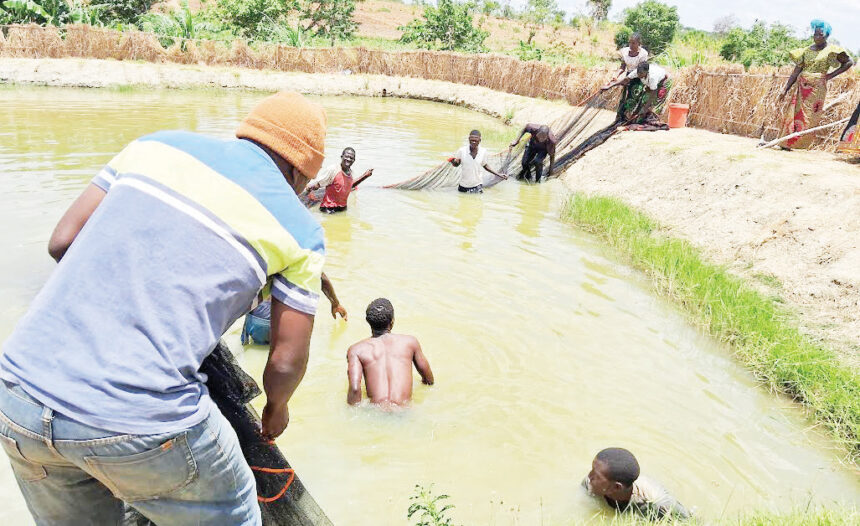
In a remote location to the eastern part of the district, some people are determined to venture into fish production.
The group, called Visoyo Fish Group, located in Zara Village, Traditional Authority (TA) Mdunga, has vowed to make fish farming, which it says is profitable, its members’ way of life.
“Fish farming is simple. The major work is on digging ponds. We started this in 2023 after NCA-DCA [Norwegian Church Aid and DanChurchAid] encouraged us to embark on this type of farming. We started digging a pond in October 2023,” says Carlos Longwe, chairperson for the group.
The group started with 40 members but 17 have pulled out.
- Advertisement -
- Advertisement -
Despite that, the remaining participants are not shaken. They are focused on their goal of improving their lives.
They are motivated by the fact that with the initial 2,500 fingerlings that NCA-DCA gave them, the population of fish in the pond is now around 10,000.
Having opened another pond, in which they put 3,000 fingerlings, they estimate to make a lot of money on what they describe as “small pieces” of land.
“This type of farming is different from crop cultivation. It is simple. On a small piece of land, you get a lot of money.
“If we were to grow maize on the land, we could harvest 50 or 60 bags per acre, meaning that we could raise less than K2 million but here it is 360 square metres and we can raise K5 million,” Longwe says.
In the fish ponds are Chambo species, Makumba and Chilunguni.
As group members prepare to start selling the fish, Longwe says they have already started searching for buyers.
“We have approached restaurant owners in Kasungu Town. We have also approached hotels. Once we start selling the fish, we expect our lives to improve. We will use the money to buy basic needs for our homes,” he says.
Aquaculture is one of the types of farming NCA-DCA is promoting under a project called Enhanced Market Access for Increased Income and Resilience among Smallholder Farmers in Mzimba and Kasungu.
The project, funded by the Government of Flanders from 2022 to December 2024, had, apart from aquaculture, targeted value chains such as horticulture, honey and high value crops production.
The project introduced farmers to drip irrigation kits in an incubator setup, good seed and seedlings, plant nutrition and pest control chemicals.
Eveless Kambeni, a host farmer at Naluzi incubator, which is in Kayazemphasa Village, TA Wimbe, in Kasungu speaks highly of the intervention.
“We started this incubator on December 18 2023. From that time, we have managed to sell produce worth K978,000. We have managed to buy 15 goats, one each for the 15 members we have. Currently, we have K170,000,” Kambeni says.
She reveals that their goal is to venture into dairy production once they generate enough money.
She, however, says in case they do not manage, they will buy fertiliser for the incubator and share some of it for use in their personal gardens.
Robin Pemba, an agronomist for NCA-DCA in Kasungu, says the project is being implemented in Chamama Extension Planning Area (EPA) in Kasungu and Euthini EPA in Mzimba with the aim of linking farmers to well-structured markets.
It is being implemented in partnership with Thanthwe Farms, the main off-taker of all the horticultural crops and Kwithu Kitchen, the main off-takers of honey.
“For fish farming, very few farmers are engaged in fish production. It is new. We are introducing this type of farming to Kasungu farmers. Most of them are used to growing tobacco, but we want to introduce them to a new value chain. Once they start selling the fish, they will be able to earn a living, make a lot of money.
“In the meantime, we are identifying markets for them,” he says.
NCA-DCA Country Director for Malawi Joint Country Programme (JCP), Stefan Jansen, says he is pleased that creativity in the formulation of the project made farmers adopt types of farming that are being introduced to them.
“We thought outside the box in promoting high-value crops such as hibiscus but also other commodities that are not necessarily on everyone’s mind. Apiculture is doing very well. We have also introduced fish ponds at village level in Euthini and Kasungu,” he says.
Through the project, Kwithu Kitchen has purchased a total of 3, 043 kilogrammes of honey from bee keeping farmers, generating over K9 million.
Thanthwe Farms has purchased 27,000 kilogrammes of high value crops, generating over K34 million for the farmers.