By Temwani Mgunda:
There is one feature that is quite dominant in Chilakalaka Village, Traditional Authority (TA) Chauma, in Dedza District and that is that almost every homestead has a variety of fruit trees planted within it.
The trees—comprising guavas, papaws, lemons, peaches and oranges— flourish either in backyard gardens or on any available space within the compound.
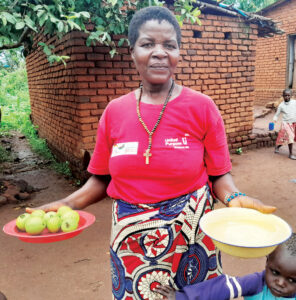
“I planted the trees in 2018 and started harvesting the fruits last year,” says Steveria Blazio, a 33-year-old mother of two from the village.
Blazio recalls that people started planting fruit trees around their homes in the village following a training conducted by GIZ Malawi Food and Nutrition Security Programme (FNSP) through its implementing partner Self-Help Africa (SHA). The training equipped participants—drawn from Livwazi Cooperative and FNSP Care Group—with knowledge and skills for fruit farming such as proper watering of trees, protecting trees from livestock encroachment and making compost manure, among others.
- Advertisement -
“The participants were expectant and breast-feeding women. I was pregnant then,” Blazio recounts.
“They advised us to grow fruit trees around our homes to have a constant supply of fresh and healthy fruits so that we can be eating the recommended six food groups throughout the year,” she added.
FNSP and SHA did not just train the participants in fruit trees farming; they also provided them with seedlings for fruit trees and other environment-sustaining trees such as acacia and msangu (Faidherbia Albida). Blazio received 14 seedlings out of which five were for fruits, three for lemons, one for peaches and another one for guava.
“I no longer worry about where to get fruits to supplement meals for my family. The guava tree, for instance, bore fruits three times last year alone,” she says.
- Advertisement -
- Advertisement -
Mitigating El Nino effects
GIZ Malawi embarked on a campaign urging people to grow fruit trees around their homes during the 2016-17 farming season as part of disaster response to the devastating effects of El Nino in Dedza and Salima districts, where FNSP implements food and nutrition interventions.
FNSP programme component manager Vitowe Batch says they received financial support from the German Development Cooperation to primarily assist the affected people with cash support as well as mitigate the effects of El Nino in the two districts through planting trees that would help maintain soil fertility and act as windbreakers.
Batch recalls that, at that material time, the general aim was to encourage people to practise climate-smart agriculture technics in the face of dry spells triggered by El Nino, but that FNSP’s chief goal has always been to ensure the nutritional status and resilience of people vulnerable to food insecurity—especially women of reproductive age and young children— remain secure in times of climate change-induced disasters.
“In view of this goal, we linked the El Nino disaster response to nutrition. As such, we included the growing of fruit trees around homes as part of FNSP’s integrated homestead farming approach that aims to scale up nutrition in rural areas,” she explains.
Batch further says, as a nutrition programme, FNSP insisted that priority in the fruit trees distribution exercise be given to households with an expectant or lactating woman or those with children under the age of two. She adds that fruit tree production incorporates backyard gardens and small livestock farming to ensure there is dietary diversity at household level.
“It is quite pleasing that after we provided training and support, the participants have come back to report to us that they are now harvesting the fruits,” Batch says.
Beyond nutrition
Much as FNSP’s objective is to secure rural nutrition resilience through the planting of fruit trees around homes, the households also alleviate the financial burden as they do not have to buy fruits anymore but produce them and, at times, can sell the surplus.
SHA field facilitator for TA Chauma, Frank Mwale, observes that while the aim of the fruit production initiative is to ensure households eat fresh and healthy fruits all year-round, it also saves time and money. He says that some households use the income realised from selling fruits for other household needs.
“The practice of growing fruit trees around homes has an impact on household resilience as financial and food insecurity problems are addressed concurrently, especially in the lean season,” Mwale explains, adding that some households have managed to buy eggs from income earned after selling fruits.
He notes that the initiative also promotes easy access to fruits at household level, noting that, in the past, many households relied on purchasing fruits from markets but that it was not easy to do that every day due to either low-income levels or long distances to markets.
“Consumption rates for fruits were, therefore, low,” Mwale says.
Nurturing new culture
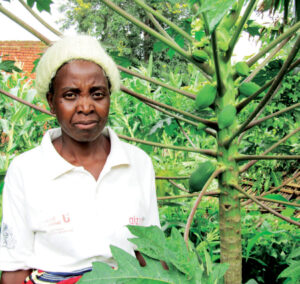
According to recent data sourced from SHA, FNSP distributed 18,129 fruit trees to project participants in Dedza District alone, but figures for the trees’ survival rate are yet to be determined.
However, SHA established that around 26 percent of project participants have already started consuming the fruits. These statistics, in a way, trigger thoughts about the sustainability of the drive.
Virginia Tsilizeni— chairperson for Livwazi Cooperative, where Blazio is a member alongside 33 other women—is optimistic about the initiative’s future, saying the realisation that they are enjoying the abundant benefits of growing fruit trees around homes makes her not envision any member abandoning the practice.
Tsilizeni emphasises that through the initiative, FNSP has nurtured a culture of planting fruit trees in Chilakalaka Village such that non-project participants are also growing them.
“Either cooperative members share the concept with others or non-programme participants observe on their own. As such, there is a spillover effect that has resulted in most people planting fruit trees within their respective homesteads,” she explains, observing that it is not costly for participants to grow the fruits because they use locally available resources.
Tsilizeni adds that, sometimes, participants share seeds from their fruit trees to be used as planting materials and that this arrangement provides sustainable accessibility of fruit planting materials within the community.
On her part, Batch says they trained government extension workers as part of ensuring the sustainability of the initiative.
“The idea of involving government partners— particularly agriculture extension workers—in training and implementation was to enhance capacity building at district level for sustainable development,” she recalls.
However, Mwale is of the view that there is a need to raise awareness among communities to promote fruit production from locally sourced planting materials as this will be sustainable in the long run. He further suggests that to improve survival rate of the trees and encourage participants, FNSP and SHA should promote existing indigenous knowledge such as use of goat dung to scare goats from destroying the fruit trees.