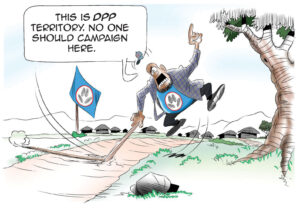
 The arrest of Democratic Progressive Party (DPP) Member of Parliament (MP) David Chikwanje on allegations that he incited violence against anyone wearing the regalia of governing Malawi Congress Party casts a spotlight on how dirty our politics can sometimes be.
While Chikwanje is innocent until proven guilty, the fact remains that the utterances—regardless of how they were made or in what format they came to the public—are undemocratic.
Due legal processes will need to be undertaken so that the courts can make an informed decision on the matter.
Court cases often uncover what most of us never knew; therefore, I cannot use this space to crucify the lawmaker, for I know very well that his case, like any other, is one where guilt is only pronounced by a competent court.
However, it is still important to consider the impact of the sentiments purportedly attributed to the DPP MP on the entire political arena.
- Advertisement -
It is uncalled for that while several stakeholders are preaching peace ahead of the 2025 General Elections, sentiments inciting political violence are emerging.
Politicians must shed the haughty belief that they can say whatever they like without facing the consequences.
Already, there are those who have declared certain areas no-go zones for rival political parties, as though they have autonomous control over these areas.
They issue threats to rival political parties, often implicitly, and continue to threaten violence should the rival parties appear in the areas to conduct political rallies.
- Advertisement -
- Advertisement -
The danger of creating no-go zones is that anyone can do so based on their own perceptions, precipitating unnecessary chaos across the country.
Politically motivated violence should be avoided at all costs because it can have far-reaching effects on society and governance.
In essence, political violence has been known to trigger perpetual conflicts in other countries, which they grapple with years after the first boundaries for where political parties can operate were established.
Things are even worse when violence is incited ahead of potentially contentious elections, such as those we anticipate in 2025.
It is obvious that the campaign period for these elections will be a heated one, as those vying for power seem so determined to clinch the hot seat that they will stop at nothing in pursuit of their goals.
The challenge has always been that in extreme cases of politically motivated violence—such as if what Chikwanje purportedly said were to be implemented—it could lead to loss of life, often with innocent civilians as the biggest casualties.
It is crucial that law enforcers do everything within their power and authority to curb political violence, regardless of who is perpetuating it.
It is ridiculous that people should live in a society where some individuals find satisfaction in creating instability and an environment of fear and uncertainty.
Where political violence is allowed to fester, trust in institutions and governance erodes and any mention of the rule of law becomes a political falsehood.
It may seem simple now because the flames of violence that some individuals are fanning have not yet escalated to raging fires.
However, as has been the case in other countries, there is always the possibility of things getting out of hand if no action is taken early enough to nip the cancer in the bud.
Already, social media is awash with recordings in which some people are threatening the lives of others simply because they do not subscribe to the same political ideologies.
It is practically impossible for everyone to belong to the same political party; otherwise, there would be no democracy in the first place.
Political party leaders must do everything possible to prevent political violence from taking root in our country.
They should preach peace wherever they are and avoid creating no-go zones for their rivals, for as long as they operate in Malawi, no one can create boundaries for Malawians.
We risk witnessing scenarios of radicalisation if politically motivated violence is allowed to thrive, as individuals and groups respond to violence with more violence, perpetuating a cycle that can be difficult to break.
Malawians have a history of co-existing regardless of their political differences and it would be tragic to see that unity disintegrate now because some individuals are prioritising their political interests by inciting violence.
There is no wisdom or satisfaction in creating societal divides, pitting groups against one another, and fostering a fragmented society where dialogue and reconciliation become challenging.
Let the unity that has always been synonymous with Malawians persist.
Whoever fans the flames of political violence must be dealt with according to the law, regardless of whether they are in government or not.