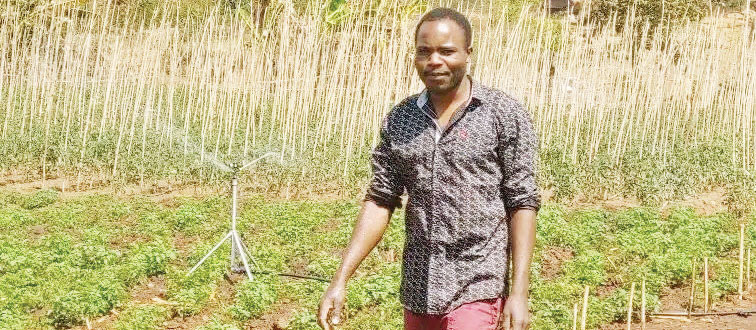
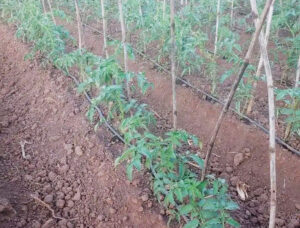
The verdant vegetables growing luxuriantly on Kumbukani Jossam’s field sway tenderly in an August morning breeze.
The farm is located in Dowa’s Traditional Authority Chiwere, an outlying stretch about half an hour drive from the capital Lilongwe.
As he sprinkles water onto the crops using a pipe extending from a solar-powered irrigation pump, the young father heaves a sigh of satisfaction at what he is producing.
“I chose farming after failing several times to make it to a public university,” Jossam explains.
In 2014, he scored 27 points in Malawi School Certificate of Education (MSCE) examinations, stayed at home for a year and attempted to train himself in fixing phones and radios.
- Advertisement -
Jossam had another go at MSCE examinations in 2017 after which he passed with 20 points.
He did not make it onto the selection list of students picked to pursue higher education in Malawi’s public universities.
“I then enrolled into a short course in phone and computer maintenance and networking fundamentals. I returned to secondary school and managed to score 17 points,” the young farmer recounts.
He was third time unlucky with selection to a public university.
- Advertisement -
- Advertisement -
So, now he wakes up at cockcrow to take care of the vegetables from which he hopes to make a killing.
Within the field, stand a 5,000-litre water tank and two solar panels. Vinyl garden hoses snake through the crops to dampen the beds before the sun returns to balance up the food making process.
A 10-by-six-metre fish pond lies on one edge of the garden with over 1,000 fingerlings burping and sliding through the water and planktonic algae which forms the base of the pond’s food chain and supports healthy levels of oxygen for the young fish.
Inspired by businessperson and philanthropist Napoleon Dzombe, who also comes from Dowa, Jossam saved money from his earnings at a shop where he was fixing phones.
“I then purchased a solar panel to help my parents in their irrigation endeavours. This solar-powered irrigation project is a vote of thanks to my parents. They struggled with farming to feed us and pay our school fees,” he says.
He recalls that for a long time, the family was using the time-consuming and inconveniencing watering cans to irrigate crops.
Refilling the cans multiple times was backbreaking. Using treadle pumps also proved tedious—as they require intense pedalling.
“That is no longer the case,” Jossam, in his late 20s, brags. “A search on the internet brought me to new and simplified ways of irrigation.”
He downloaded a document which detailed the process of installing a solar-powered irrigation pump and extended the lessons to his young brother.
Two years ago, the two siblings ventured into groundnuts farming and used the money realised from the activity to buy a solar panel for pumping water.
The initial attempt was not without hurdles.
“The 250-watt solar panel failed to sufficiently pump water for the whole field. The first batch of crops wilted before producing flowers.
“We purchased another solar panel set and that is the one we are currently using,” Jossam says.
Alex Kalumbu, an agriculture official from Mvera Extension Planning Area—where Jossam’s family lives—waxes lyrical about Jossam’s exploits.
“His enthusiasm and industriousness ought to be emulated by other young people who are struggling to find employment. He is a role model and we call him a ‘village champion’,” Kalumbu says.
He believes government can do its part by providing soft loans to young people in groups to act as a starter pack for various businesses.
Kalumbu has Jossam as a convenient example of the potential that youths have. He concedes some need a simple but effective push to make it.
Jossam himself is confident that the flourishing vegetables in his garden and the thriving fingerlings in the adjacent pond will soon start bearing fruits for his toil.
“As young people, we must learn to save and invest afterwards. It is possible to utilise the various skills that we have and turn them into money-spinning ventures,” he says.
He has seen several young people from his area flocking to towns and cities in search of piecework and admits that even a job as a domestic worker is not easy to come by.
Jossam dares the young people to consider directing the energy they would spend working for others for meagre pays to investments that can transform their lives.
“Farming is proving to be a profitable business. Sometimes it is just a matter of taking risks,” he sums up as he tugs off the whippy hosepipe to the day’s final zone to be irrigated.