By Arnold Munthali, contributor
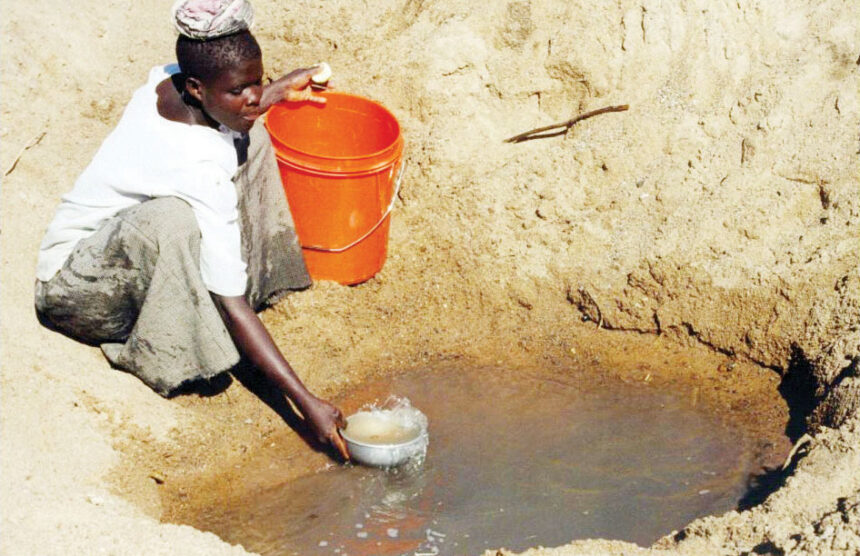
Pondi stream meanders along the peripheries of several villages at Mzokoto in Rumphi District.
The river has been their lifeline for quite a while, providing communities with water for cooking, washing and other household chores.
However, during the rainy season, the river transforms into a turbulent expanse of water, carrying both blessings and, more often than not, threatening their lives.
As Brenda Zgambo recalls, the river constituted their sole means of sustenance.
- Advertisement -
“Even when the river swelled during the rainy season, we still braved it to fetch water. We would bring the water home and allow the sediments to settle at the bottom of the container before using it.
“We were constantly exposed to the risk of contracting bilharzia and various diarrhoeal ailments,” Zgambo, who hails from Nkhowani Village under Traditional Authority Mwankhunikira in Rumphi, laments.
The disease burden of these ailments fell on Mzokoto Health Centre.
Charles Nyirenda, Vice Chairperson of the Health Centre Advisory Committee, says the health centre was overwhelmed due to waterborne diseases.
- Advertisement -
- Advertisement -
“We have had a lot of cholera cases because we didn’t have sustainable sources of clean water. The health centre fetched its water from Pondi stream, which is some distance away,” he says.
The area’s water challenges are by no means, unique.
According to Vincent Horowanya, Water Officer for Rumphi District Council, the district’s water challenges are not only due to the absence of sustainable technologies capable of supplying water throughout the year, but are also exacerbated by the hazardous topography.
“Rumphi is characterised by mountainous terrain, and the underground water is saline in numerous low-lying areas.
“We are exploring avenues to provide communities with potable water that is not saline and meets the standards set by the Malawi Government and the World Health Organisation,” Horowanya explains.
However, there is a change afoot with the installation of a solar-powered water distribution system at Mzokoto Health Centre.
The health centre and its surrounding communities benefit from a water, sanitation and hygiene (Wash) project being implemented by Unicef, with financial backing from the Bureau of Humanitarian Assistance through United States Agency for International Development (USAid).
Similar initiatives are underway in Blantyre, Chikwawa, Machinga, Mangochi, Nkhata Bay, Nkhotakota, Rumphi, Salima, and Zomba districts.
The project aims to construct Wash facilities at selected health centres in the mentioned districts, to enhance access to improved climate-resilient water supply services in both communities and healthcare facilities.
The water system at Mzokoto Health Centre serves about 60 households from Mvina, Nkhowani and Mphombo villages, as well as the congregants at Mzokoto CCAP Church.
Maggie Munthali, wife of the resident preacher, expresses “immense gratitude” to Unicef for providing the facility, which includes a water point within the church premises, adjacent to Mzokoto Health Centre.
“Unicef recognised the water problem we faced, particularly the dependency of the health centre on an electric-powered pump. Whenever there was a power outage, we were left without water.
“With the presence of cholera in our area, this posed a challenge. By defeating cholera and reducing the congregation’s risk, the burden on the hospital will decrease,” Munthali says.
Village Head Mphombo Kalua is equally delighted with the installation of the solar-powered water system, although he expresses concern about the underutilisation of the water.
“We have come a long way. Previously, the only available water point of portable water was at the health centre. People would go there by dawn or late in the evening to avoid long queues. The water supply is abundant, but the demand is low,” he says.
Horowanya acknowledges that the project has had a positive impact, saying it has reduced the disease burden for Mwazisi Health Centre.