The International Monetary Fund (IMF) has tipped Malawi and other developing economies to consider lowering barriers to entry in utility markets, establishing financial supervision and regulatory frameworks in order to stabilise debt and foster economic growth.
It further highlights lowering restrictions on foreign exchange transactions and cross-border capital flows as critical to the cause.
This is coming at a time Malawi’s debt level is rated as unstainable, seen at K7.9 trillion at end December 2022, representing 69.9 percent of gross domestic product (GDP).
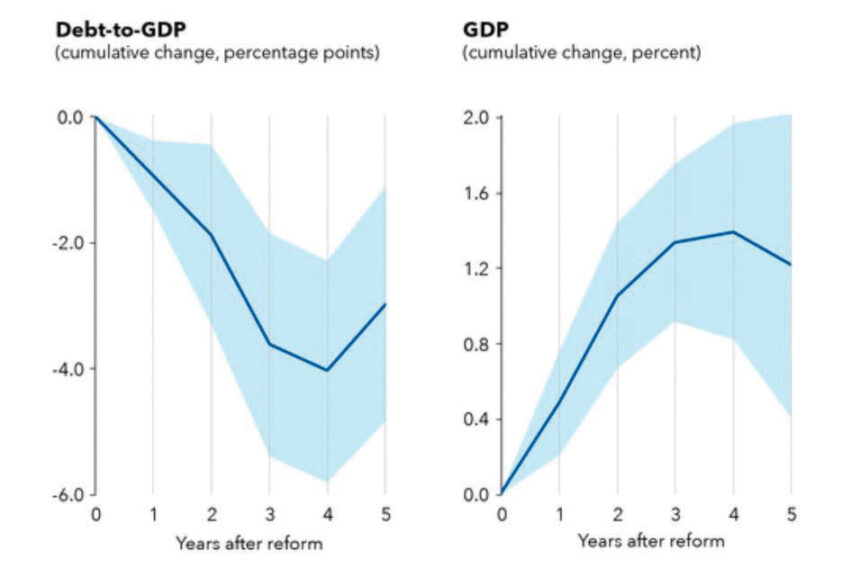
In a blog, IMF senior economists Gabriela Cugat and Carlo Pizzinelli hold that major changes in regulations are associated with a three-percentage point reduction in the ratio of debt to GDP.
It further notes that the decline takes place not only by increasing GDP, but also by improving public finances through higher tax revenues and lower borrowing costs.
- Advertisement -
“The typical first step toward stabilizing debt is to reduce new borrowing through fiscal consolidation or to decrease the total outstanding through debt restructurings. However, debt-to-GDP ratios can also be cut by increasing the denominator: economic output. One way to accomplish this is with improved market functioning.
“There is considerable scope for governments to use market reforms as a policy lever to revitalise growth and reduce debt burdens in developing economies. Enacting changes in regulations that aim at improving how markets work, for example by increasing competition or establishing appropriate regulatory frameworks, can boost economic output,” the blog reads.

In a recent interview, Secretary to Treasury Macdonald Mafuta Mwale said the government has come up with initiatives to manage the debt, including debt restructuring.
“The government is also extending the tax base to engage domestic revenue collection, apart from reviewing tax incentive schemes and waiver and system automation and digitisation.
- Advertisement -
- Advertisement -
“The government is also maximising grants and other non-debt creating flows from bilateral and multilateral and other philanthropic organisations. The government is also diversifying the economy to stop over reliance on smallholder agriculture and move to other investments like mega farms,” Mwale said.
This is happening at a time a team from the IMF is in the country to assess performance of the country between January and June on a staff-monitored programme entered last year.
A recent review of the programme found Malawi’s performance in the period ended December 2022 as mixed.
Malawi is looking for a possible Extended Credit Facility programme with the Bretton Woods’ institution after the last programme was cancelled in 2020.