By Mike Mataka:
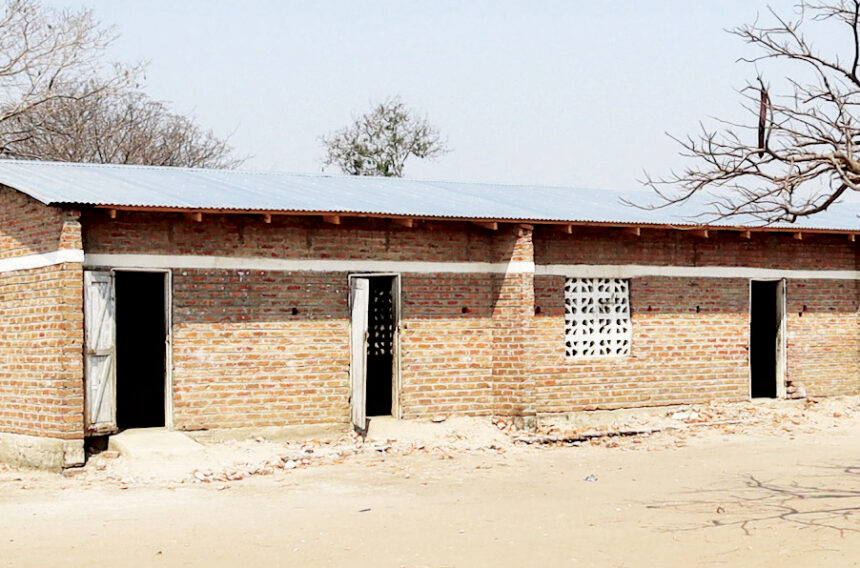
Nthemba Primary School in Zomba, once a symbol of neglect and despair, is now experiencing a new lease of life, thanks to the intervention of Hindu Social Group, which responded to a Times TV special report that exposed the school’s struggles.
Just months ago, the school was struggling. More than 900 learners were forced to learn under trees and in roofless classrooms after Tropical Cyclone Freddy destroyed one of the main blocks in 2023.
There were no desks, no books and no clear future for the children who, nevertheless, refused to give up on their education.
That picture is now changing. Hindu Social Group has reroofed the damaged block with new iron sheets and repaired the school’s only borehole, giving learners both safe water and safe shelter.
- Advertisement -
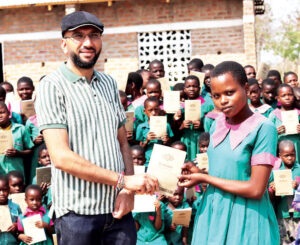
Coordinator Mahel Acharya, who was deeply moved after experiencing the challenges first-hand, said the work is progressing in phases.
“After bringing back the roof and renovating the borehole, we are now entering phase two — plastering walls and cementing floors,” he said.
During a recent inspection visit, group members also delivered 30 bags of cement for ongoing works and provided 5,000 exercise books for learners, a gesture meant to encourage children to stay motivated and take pride in their studies.
Acharya said the group believes that education is the key to unlocking opportunities.
- Advertisement -
- Advertisement -
“If children are given equal opportunities for quality education, they have the potential to transform not just their own lives but also their community and the country as a whole,” he explained.
The support has been welcomed by community leaders.
Village Headman Mwangata applauded Hindu Social Group for what he described as “coming to the rescue” of Chingale’s children.
He pledged to mobilise community members to protect the renovated infrastructure.
Head teacher Christopher Maganga also expressed his delight, noting that the improvements have already had a visible impact on learners, teachers and community members.
“The renovation of the roof has excited learners and parents. We have seen higher attendance in the first week of the academic year, and even some pupils who had transferred to other schools are now returning,” he said.
For Nthemba, what was once a story of abandonment has become a story of renewal. The renovations are giving children not only safe classrooms but also restored dignity, hope, and a renewed belief that their dreams are possible.
However, before all this, there was a story; a story of desperation.
Down memory lane: July 3, 2025
At the very edge of Zomba District, in Traditional Authority Mlumbe, where the dusty Lirangwe– Chingale Road carves a lonely path between hills and valleys, stands Nthemba Primary School, a place that seems frozen in time.
Opened in 1964 by Catholic Church missionaries, it remains one of the last outposts of primary education before the district fades into Blantyre.
However, what was once a beacon of hope for generations now sits in the shadow of despair.
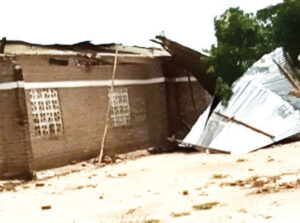
From a distance, the school seems deserted. The paint has long peeled off the cracked walls, weeds snake through the cement and one of the three blocks stands roofless, gutted by Tropical Cyclone Freddy in March 2023.
Come closer, and you see not silence, but the faint echo of ambition fighting against all odds. Beneath a tree, children sit cross-legged in the dirt, scribbling with dull pencils as their teacher writes on a wooden board balanced on rocks. This is a classroom. This is where dreams are supposed to take flight.
There are 934 learners enrolled at Nthemba Primary School. Among them, 508 are girls, struggling not just for education but for dignity in a setting that fails them daily. With only two classroom blocks left, each day is a logistical nightmare.
Standard 6 doubles as a storage room, housing dangerous piles of iron sheets ripped from the blown-away roof. Broken pieces of wood still dangle from the trusses, ready to fall with the next strong gust, turning the very place meant to protect young minds into a death trap.
Inside the roofless classroom, the sun bears down. Temperatures hover around 30 degrees Celsius in this valley along the Shire River, and the concrete walls trap the heat like an oven. Learners crowd into the few shaded corners, beads of sweat rolling down their brows as they squint at the chalkboard.
But they stay. They are desperate to learn. Among them is 14-year-old Rahim Yusuf, a Standard 7 learner with a soft voice and a burning dream.
“I have always wanted to be a teacher but I don’t know if it will happen. When it rains, we don’t come to school. If the rains start while we are here, we run home. There is no roof. When it’s windy, dust fills the classroom,” Rahim said.
But how long can hope survive in these conditions?
At Nthemba, every child sits on the floor. There is not a single desk or chair, not even one. The older girls struggle most, their needs forgotten in a system bursting at the seams. There are just four usable classrooms for nearly a thousand learners, meaning that an average of 234 learners cram into a space designed for 60.
The head teacher, Christopher Maganga, watches this chaos unfold daily.
“It’s not only difficult for learners, but for us teachers too. We have 12 teachers but only one house. The rest stay far away, some over five kilometres from here. Many teachers come late, exhausted before the first lesson begins,” Maganga said.
Maganga points to the ruins of the classroom block that was destroyed by Cyclone Freddy.
“Sometimes, I think twice before entering these classrooms. We are just waiting for tragedy now. If nothing is done, we will lose more than just buildings; we will lose lives,” he added.
The environment at Nthemba does not just frustrate learners and teachers, it disheartens parents, too.
Paul Maganga, a parent and chairperson for the Parent-Teacher Association (PTA), has watched the situation decay into what he calls a “tragedy in waiting”.
“Education standards are going down at the school with the current situation. Most of the time, learners shun classes as they are not attracted to the school environment. Our learners are breaking, and not making the future here, and, as parents, this is a worrisome development.” Maganga said.
For him and many other parents, the battle to inspire hope in their children has become an uphill one.
“Even ourselves, as parents, find no reason to encourage learners to go to school, as we see this as a death trap; the walls of the school are on the verge of collapsing. This is a tragedy in waiting. It’s a ticking bomb,” he warned.
The lack of resources is staggering. Standards 5, 6 and 7 have no textbooks. The 62 learners in Standard 8, who just sat Primary School Leaving Certificate of Education examinations shared only five textbooks.
Yes, five textbooks for 62 learners. And what happens to their dreams?
In a world of hashtags and trending causes, Nthemba does not appear on anyone’s radar, yet it stands as a glaring contradiction to Malawi’s bold development ambitions.
Malawi 2063 vision talks of building an inclusively wealthy, self-reliant nation. Sustainable Development Goal 4 commits to equitable, quality education for all by 2030.
But here in Chingale, those commitments ring hollow.
The school’s sanitation situation is equally appalling. Four toilets for 934 learners, two for boys and two for girls. That is 234 learners per toilet. The girls often avoid using the facilities, especially during menstruation, leading to increased absenteeism and embarrassment.
The emotional and academic toll is evident. Since Cyclone Freddy hit, the school’s performance has nosedived. Many children have dropped out, their parents questioning the value of sending them to a crumbling school. And yet, every morning, others still show up, clinging to the only hope they have: education.
There is no electricity. No library. No fence. Single borehole. Just a shell of a school, and the relentless courage of children who refuse to let go of their dreams.
We must ask: Where is the urgency? Where is the outrage and indeed where is the Constituency Development fund? If education is not prioritised, then what remains a priority for the district that once was the capital city?
Nthemba Primary School is not just a school in crisis. It is a mirror reflecting the broader failures in our education system, and a cry for help from a generation that refuses to be ignored. These children are not just statistics or Sustainable Development Goal targets; they are future teachers, nurses, police officers and leaders, if only we would see them, hear them, and act.
At that time, all they were asking for was shelter, safety and a chance to learn. A roof. A book. A desk. A future.
Now the road to the future is becoming clearer, thanks to the Hindu group.