By Kingsley Jassi & Benadetta Chiwanda Mia:
Growth in private sector credit has emerged, a path the Reserve Bank of Malawi (RBM) hopes will accelerate the much-needed productivity.
Records show that the annual credit flow was higher by 48.7 percent in September over August, adding K257.7 billion into the industry, although credit stock declined by 13.3 percent to K2.2 trillion compared to the previous quarter.
However, government borrowing—comprising the Central Government and State-owned enterprises—took up most of the money available for lending in Malawi’s banking system during the third quarter of 2025, rising by K941.5 billion to hit K8.2 trillion.
Net credit to the Central Government alone increased by K900.6 billion to K7.6 trillion, reflecting sustained fiscal pressures and limited access to alternative sources of financing.
- Advertisement -
As a result, total credit from the banking system to the domestic economy rose by K1.2 trillion to K10.6 trillion in the quarter under review, driven largely by sharp expansion in lending to the public sector.
Meanwhile, private sector credit presented a mixed picture as, on annual basis, growth accelerated to 48.9 percent in 2025 quarter three, up from 26.3 percent in the previous quarter, suggesting strong underlying demand for credit.
However, on a quarterly basis, outstanding private sector credit declined by K257.7 billion to K2.2 trillion, an indication of reduced borrowing across several major loan categories.
At a meeting with commercial banks on Friday, RBM Governor McDonald Mafuta Mwale acknowledged that credit growth would help in achieving the objective of rejuvenating productivity.
- Advertisement -
- Advertisement -
“Shifting our economy to a sustainable path requires this exact focus; empowering the private sector as the primary engine of production and export growth,” Mafuta Mwale said in a statement.
The central theme of the meeting was ‘The Collective Effort to Advance Malawi’s National growth agenda’.
The RBM governor commended banks for increasing lending to core productive sectors of late.
In its recent quarterly Financial and Economic Report, RBM has since lowered its 2025 Malawi economic growth forecast to a moderate 2.7 percent, from the earlier projected 2.8 percent.
This is on account of reduced 1.8 percent growth of the industry from an earlier projection of 2.4 percent, mainly in manufacturing, trade and mining.
“The moderation in growth in these industries was on account of persistent shortages of foreign exchange, which continue to affect importation of raw materials and intermediate goods and services; prolonged power outages and disruptions in fuel supply; and increased operating costs for businesses,” the RBM report reads.
Meanwhile, the forex scarcity persists as foreign reserves were lower in the third quarter at $511.8 million (just two months of import cover) from near $560 million (2.2 months of import cover) the previous quarter and $560.3 million the corresponding quarter in 2024.
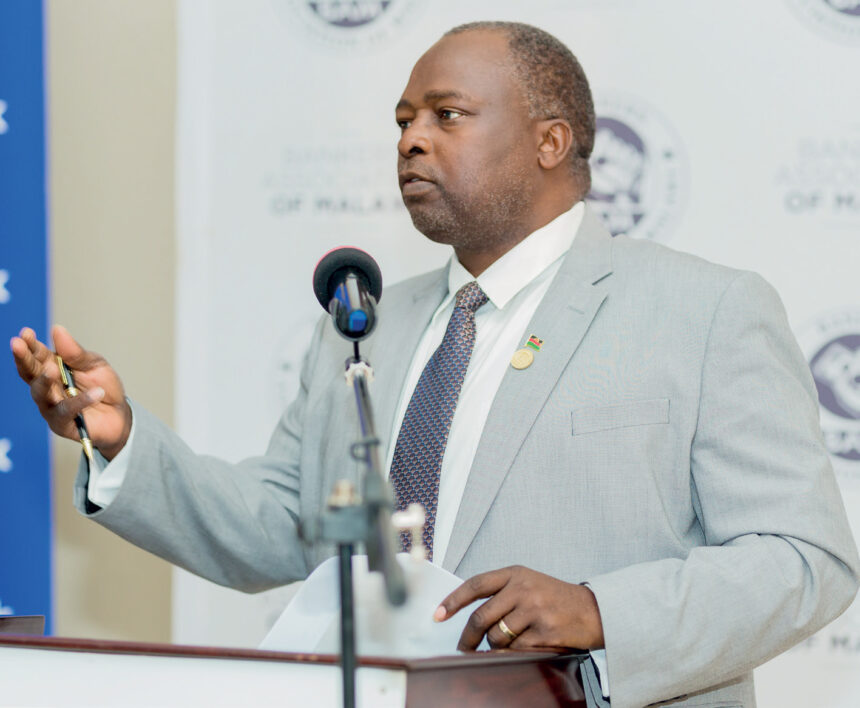
Bankers Association of Malawi President Phillip Madinga said in an interview last week that there was a need for stakeholders to collaborate in unlocking private sector credit.
He admitted that banks have depended on lending to the government, which does not use the resources for productivity, at the expense of the real sector.
“That will require that we work with the central bank as well as Malawi [Confederation of] Chambers of Commerce [and Industry] because they’re very critical in terms of how we can work with the private sector,” Madinga said.
At 2.7 percent, the economy will have grown faster than 1.9 percent in 2024 and this performance will be driven by the financial sector growth of 5.9 percent, information and communication at 5.8 percent and construction at 5.6 percent.