By Deogratias Mmana:
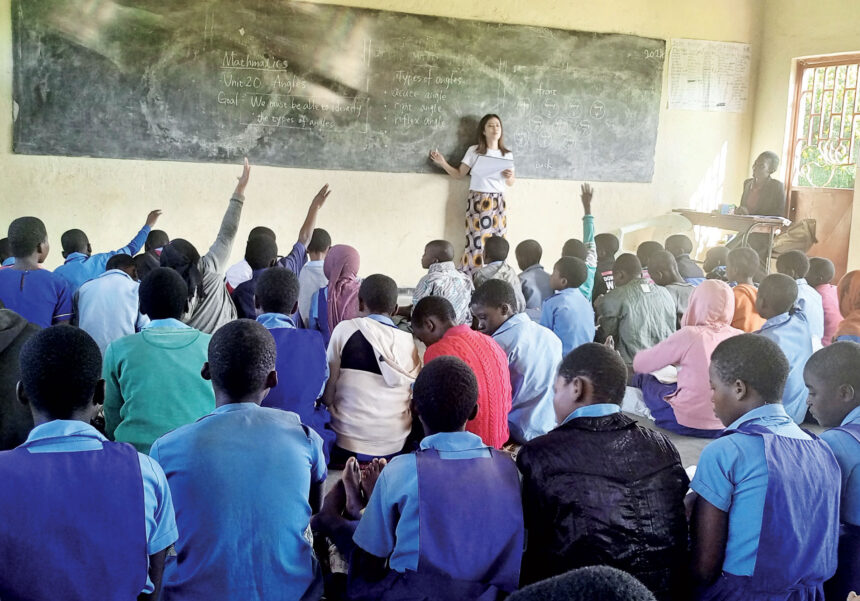
It is time for Mathematics at Kabuthu Primary School under Kabuthu Education Zone in Lilongwe.
The teacher, Haruna Oishi, 23, from Japan, has put the learners in groups. They confer among themselves before answering questions from her.
Since Oishi came to the school in November 2023, learners have enjoyed mathematics because of her participatory approach in the subject. She is also patient with the learners. She speaks to them calmly so that they are able to follow her.
Malawi is the first country for Oishi to work as a volunteer under the Japan Overseas Cooperation Volunteers (JOCV) programme which was inaugurated in 1965 and introduced in Malawi in 1971.
- Advertisement -
“I was trained as a teacher. The teachers and learners here are friendly. I like to use a participatory method in my lessons because learners should take part in the lesson. They also share experiences and knowledge,” Oishi, who is expected to be at the school for two years, explains.
She is not alone. There is also Chizuru Eto, who supports teachers in the entire zone with expressive arts.
“I came to Malawi in July 2023 and will return home in March 2025,” the 32-year-old volunteer says.

Kabuthu Zone Primary Education Adviser Ephrida Ndau says the volunteers will be available for two years and that already, their availability has shown impact.
- Advertisement -
- Advertisement -
“The one operating from the teacher development centre [TDC] supports all teachers in the 14 schools in the zone with expressive arts skills. Both volunteers encourage teachers to use participatory methods,” Ndau says.
She supports that kind of teaching and learning.
“We believe this maximises participation of learners. They share experiences in groups and they learn better when they talk to one another,” Ndau explains.
When he recently visited Kabuthu and Nthabza primary schools in Kabuthu Zone, Japan International Cooperation Agency (Jica) President Akihiko Tanaka said he was impressed to see that learners were active.
He also commended the community for supporting the volunteers.
“They [the volunteers] told me that they are enjoying life here together with the people, teachers and children,” Tanaka said.
He added that Malawi is the largest recipient of Japanese volunteers in the world.
The JOCV programme focuses on human capital development in developing countries at grass roots level by deploying qualified Japanese nationals who are aged between 20 and 69.
Jica Chief Representative in Malawi Kazuhiro Tambara says the volunteers serve in Malawi for a maximum period of two years and are deployed to governmental agencies in cities and rural areas, government-owned companies, duly registered local and international non-governmental organisations and development agencies like the United Nations.
Tambara says currently Malawi is hosting 27 volunteers. He adds that since the inception of the programme in 1971, 1,929 volunteers have been dispatched to Malawi.
They are in the fields of primary and secondary school education, special needs education, health, environmental management, youth activities, community development and football coaching.
In primary school education, the volunteers teach science, mathematics and expressive arts. In the same primary school education field, the volunteers are deployed to work at TDCs as advisers for a particular subject in a particular zone.
In secondary education, the serving volunteers teach information and communications technology.
Tambara says the presence of the volunteers in Malawi has had a huge impact on the communities.
“Since these volunteers work with people on the ground, they are able to impart Japanese skills and methods of tackling issues in those they work with.
“For example, in primary schools, the Japanese volunteers have been able to introduce easy methods of teaching learners to master multiplication tables in mathematics.
“In the health field, particularly in day-to-day hospital operations, the volunteers have been able to introduce quality health management systems that have brought about efficient methods of dealing with patients and hospital resources,” Tambara explains.
Japan is this year celebrating 60 years of bilateral relations with Malawi and one of the achievements is the deployment of the volunteers for the past 53 years.
The Ministry of Foreign Affairs says the Asian country continues to immensely contribute to Malawi’s socio-economic development.
“Japan has been a strategic development partner for Malawi over the past years of Malawi- Japan relations and this has resulted in tangible outcomes,” the ministry’s spokesperson John Kabaghe said recently.