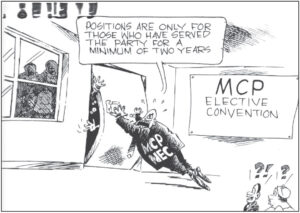
 Governing Malawi Congress Party (MCP) faced a challenging period leading up to its elective convention, which concludes today.
Following a High Court ruling that the party’s National Executive Committee (Nec) had no authority to establish new eligibility criteria for convention candidates, the party scrambled to find a way to circumvent the judgement and still prevent the 20 barred individuals from contesting.
It was a chaotic time for the country’s oldest political party.
Ultimately, political pragmatism prevailed and the party withdrew its appeal to the Supreme Court to allow the convention to proceed.
Despite this, there were suspicions that the appeal withdrawal was part of a ploy to prevent the barred 20 from competing.
- Advertisement -
However, possibly fearing legal repercussions, MCP reversed its decision and permitted all interested candidates to stand.
In the end, the party proceeded with the convention and elected its new Nec members. MCP must take away several lessons from its pre-convention turmoil, which fortunately did not mar the event.
While the party has long emphasised ideals such as loyalty and obedience, these should never be used to undermine democratic processes.
It seems MCP has not fully learned from its legal battles which rocked the party before coming into power.
- Advertisement -
- Advertisement -
Before the 2019 elections, MCP was deeply divided. The issue was a reluctance to accept that dissenting views are a part of democratic governance.
Ultimately, voters have the final say, as illustrated by the convention elections where individuals who presumed they were favourites have been unexpectedly defeated.
Whoever advised MCP to allow open contestation for positions did well.
As the court ruled, it is up to delegates to reject candidates, not for a committee of interested parties to decide who should stand for election.
Other political parties considering blocking individuals from contesting should remember that delegates must be given the ultimate authority to choose their party’s Nec members.
Some individuals who view themselves as more integral to their political parties than others have learned harsh lessons at the convention.
There were those who never imagined losing because they considered MCP their personal party and thought no one else could unseat them.
Some even led efforts to bar others from standing, believing they owned the party.
However, as President Lazarus Chakwera stated at the convention’s opening, the party belongs to its members, not to a select group.
If they had previously believed otherwise, they must now realise they are not irreplaceable and can be removed from the Nec without hesitation.
Another lesson for MCP is the importance of strategic planning for positions.
Every political party has key figures who need to be represented in the Nec.
It is unwise for all prominent members to compete for a single position, which could result in the loss of their presence in the Nec.
For instance, the role of Secretary General, won by former Youth Director Richard Chimwendo Banda, saw a strong contest among key figures.
Unfortunately, those who lost will be absent from the Nec, which is a loss for the party as well.
MCP needs these individuals and a proper strategy should have been in place to ensure their inclusion in the Nec in some capacity.
While the party may argue that allowing open contestation reflects democratic principles, effective political strategy requires more.
Congratulations are due to those elected to the MCP Nec. It is noteworthy to see individuals like Jessie Kabwila, who had been relatively quiet, regaining support from delegates.
That is the nature of politics—it can be unpredictable.
Those who lost should engage in serious self-reflection, particularly those who served in the previous Nec. They must have made mistakes.