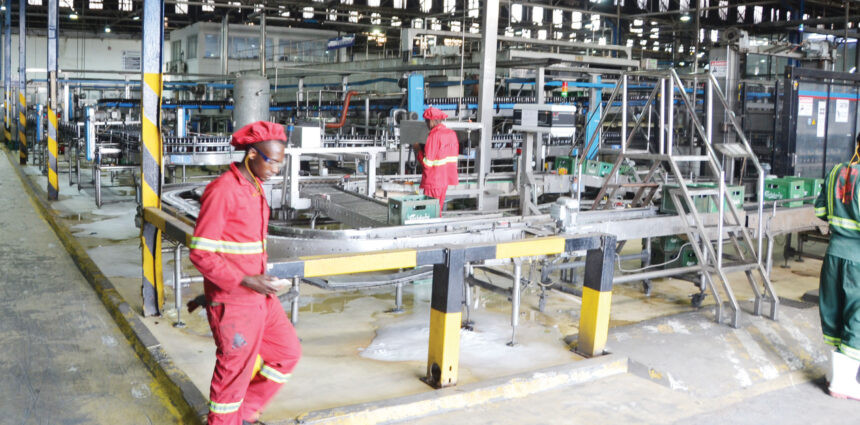
Industry captains under the Malawi Confederation of Chambers of Commerce and Industry (MCCCI) are optimistic that the manufacturing sector is poised to grow by 4.4 percent in 2024.
However, the Economics Association of Malawi (Ecama) rates the projection as a tall order as the environment remains volatile.
The figure is contained in a recent Financial and Economic Review published by the Reserve Bank of Malawi.
In the review, the central bank indicates that in the manufacturing sector, the growth forecast for 2023 was adjusted down to 0.4 percent during the November 2023 estimates from 1 percent.
The downward revision was primarily attributed to challenges associated with the availability of foreign exchange, which continued to compromise the industry’s ability to import necessary raw materials.
- Advertisement -
“The decline in agricultural production in 2023, as highlighted above, further exacerbated the industry’s challenges by causing a shortage of domestic raw materials.
“However, the industry is projected to grow by 4.4 percent in 2024, thriving on the expected improvement in the availability of foreign exchange following the acquisition of the IMF Extended Credit Facility (ECF) program; consistent power supply from the rehabilitation of Kapichira power plant; better fuel availability and enhanced agricultural production from mega farms,” the report reads.

In an interview Tuesday, MCCCI President Lekani Katandula said better power supply, forex availability and improved agricultural production can be catalysts for growth.
He said Malawi should also be looking to build on this through appropriate incentives in the next budget to promote local production such as investing in technical training to improve local productivity.
- Advertisement -
- Advertisement -
In a separate interview, MCCCI Director of Business Environment Madalitso Kazembe said the estimates make sense as growth of the sector hinges strongly on availability of foreign exchange, power supply and agricultural production.
However, she was quick to point at persisting challenges such as foreign exchange scarcity, lack of access and high cost of finance, level of taxes and cost of electricity.
“In order to grow this sector an Industrial Development Fund or Special purpose vehicle should be implemented to provide patient capital specifically targeting investments in manufacturing.
“Maximum demand tariff for electricity should be reviewed and only be applicable when businesses are operating at maximum capacity and ensure consistent supply of foreign exchange,” Kazembe said.
But Ecama Vice President Bertha Chikadza said underdevelopment in the extractive and manufacturing industries would stifle growth chances.
“The mining sector is not fully exploited despite having great potential. Its contribution to the economy also remains minimal due to lack of investment and limitations caused by bottlenecks in the mining sector governance frameworks.
“We, as a country lack speed in implementation. There are a lot of policies and suggestions, and maybe applications for exploration of minerals,” Chikadza said.
The review further projects that the country’s Gross domestic product will grow by 3.2 percent in 2024 from an estimated 1.5 percent in 2023.