By Dumbani Mzale, contributor:
Precedence has it that Malawi politics is fraught with vengeance, relentless castigations, mudslinging, mockery, backbiting, character assassination, slander, defamation and insults, just to mention a few.
Besides, political witch-hunting has been at centre-stage for so long in Malawi politics and the fact has been the order of the day since the dawn of democracy.
Former president the late Bingu wa Mutharika, who served the country from 2004 until his death in April 2012, was no stranger to controversy.
On several occasions, he was entangled in a mesh of verbal attacks and scorns, once he lost his cool at the podium.
- Advertisement -
Mutharika, who won a resounding second term in office in May 2009, told foreign donors on May 5, 2009, to “go to hell”, accusing them of plotting with local groups to topple his government.
The United Kingdom and other donors cut aid to Malawi in 2010, criticising his economic policies.
“I will not accept this nonsense anymore… If donors say this is not democracy, to hell with you; yes, I am using this word, tell them to go to hell,” he charged.
At some point, Bingu exchanged verbal tirades with tobacco buyers and fired at the clergy, civil society and the media.
- Advertisement -
- Advertisement -
In 2011, his administration even ordered the expulsion of a South African and three British buyers, and that was unprecedented.
Bingu’s successor Joyce Banda had her share of dramatic political scenes which are well documented.
In June 2020, Banda christened her successor Peter Mutharika ‘a drunkard’.
Banda was seemingly irked and was in retaliation mode following Peter Mutharika’s shocking and offensive slurs that Banda was a ‘prostitute’.
Mutharika said this at his home village of Goliati in Thyolo during a whistle-stop tour ahead of his re-election bid in the court-sanctioned polls in June 2020.
Banda had remarked at her Njamba rally earlier that Mutharika was a heavy drunkard. In his response, Mutharika said Banda was bitter because he stopped her from ‘exporting her prostitution to China’.
Mutharika’s remarks against Banda later angered female human rights activists including international organisations which accused him of harassing Banda, let alone putting into disrepute the office of a former female president and also stripping her of her dignity.
Malawi’s first democratically elected president Bakili Muluzi also left the political podium for retirement ‘verbally unclean.’
He was on record on several occasions attacking his political opponents and his own former Cabinet minister Brown Mpinganjira. The latter was accused of being a ‘skirt chaser’.
After he fell out with his own vice president the late Justin Malewezi, Muluzi went to town telling Malawians that Malewezi had failed to develop his own district for ten years he was vice president.
He even went on to publicly poke fun at Malewezi’s poor health condition.
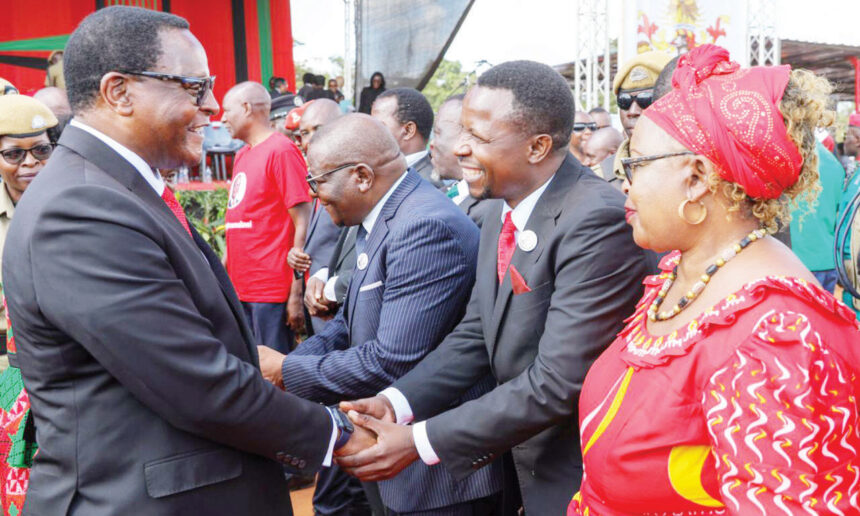
Almost four years into his political tutelage, Malawians today testify to the fact that President Lazarus Chakwera has demonstrated a unique character against all his predecessors.
Chakwera has repeatedly stated that he holds no grudges against anyone in the world and that his only mission is to unite Malawians and develop the country.
I listened keenly to the statement the President made when he addressed groups of businessmen and women at Sanjika Palace on January 25, 2024. They were all categorised as Blantyre vendors and were 600 in total.
“I have no enemy and, in fact, you are all my friends,” the President said.
He was greeted with chants of contentment and joy from the vendors who included tailors, airtime sellers, minibus drivers, minibus touts and second-hand car dealers.
As an icing on the cake, many political commentators contend that Chakwera is living by his promise to build a new Malawi on the foundation of a democratic developmental State.
Tellingly, Chakwera sees no gain in political castigations as that would deviate him from his Super Hi 5 tenets of ‘prospering together, uniting Malawi, ending corruption, the rule of law and servant leadership’.
When he finished inspecting development projects in Lilongwe recently, Chakwera delivered a strong vernacular statement to Malawians and augured well with his conviction of smart politics devoid of badmouthing.
“Ndikudziwa kuti ndale za kuno ku Malawi zimakhala zaphokoso, koma ineyo zolongolola sindimatha ayi. Ndikudziwa kuti ndale za ku Malawi zimakhala zotukwanana ndi kunyozana, koma ineyo zotukwana ndi kunyoza ena sindimatha.
“Ndipo ndikudziwanso kuti ndale za ku Malawi zimakhala zosekelerana pamaso koma mutasungirana mpeni wakuthwa kumphasa, koma ineyo chibadwire sindinapangepo mchitidwe wachifwamba.
“Komanso ndale zathu kuno ku Malawi zimakhala zofuna kuyambanitsa anthu, ngati mmene anthu amafunira kundiyambanitsa ine ndi a Vice President, kapena ine ndi nduna zanga, koma ineyo zimenezo sindipanga nawo chifukwa zoyambana ndi anthu sindipanga nawo.”
“[I know that Malawian politics is full of noise, but I do not subscribe to that. I know Malawian politics is about castigating each other but I am not capable of doing that.
[I know Malawian politics is about smiling at someone while plotting evil behind their back. I have never done that since I was born.
[And our politics thrives on pitting people against each other, like some people want to pit me against the vice president, or with my Cabinet ministers. I don’t do that.]”