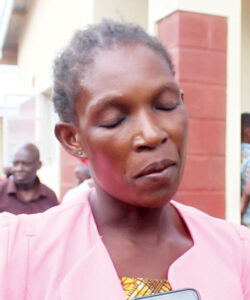
From 10 metres or so, 36-year-old Pilirani Mwimva from Mtambalika Village, Traditional Authority Njema in Mulanje District, looks celebratory.
It is only when one engages her in conversation that the truth comes out.
The first thing one notices is that she can barely keep her eyes open.
“I keep my eyes closed as an escape route. Bad things happened in March this year and I try as much as possible to pretend that I am dreaming—only for the truth to hit back at me with a vengeance. I am always hoping that property, including household items and bags of maize and sweet potatoes, I lost to cyclone-induced floods was only lost in a bad dream.
“That, somehow, I will have them back when I open my eyes. I did not only lose household items; our house collapsed, such that we have spent the better part of this year at a cyclone survivors’ camp. So, excuse me, I do not mean to be rude when I close my eyes. I am just trying to escape from a bad memory that brings me back to a painful reality,” Mwimva points out before escaping into closed eyes again.
- Advertisement -
She is one of the people who were affected by Tropical Cyclone Freddy, which made landfall in Malawi on March 11 this year, affecting the majority of districts in the Southern Region.
Since then, Mwimva has been having daydreams and nightmares.
“I have also been nursing a bad memory of events of that night, when, at 2am, we realised that water had made its way into our house and was soaking us. We ran outside the house for our lives. I have had many memories of life, yes, but this one [on Cyclone Freddy] overshadows them all,” says Mwimva.
She adds that, as someone who saw herself harvesting up to 40 bags of maize at the end of the 2022-23 rain-fed agriculture season, she saw her hopes fade into despair and, now, pain.
- Advertisement -
- Advertisement -
“I am hurting inside. I harbour a bad memory of the night of March 13 this year, when Tropical Cyclone Freddy manifested its ugly face right in my own house. When we went to bed around 9pm on March 13, I was hopeful that I and members of my household would head to our maize field at the crack of dawn. After all, the maize crop was promising, with almost each and every maize plant having two cobs.
“Our [me and household members’] plan was to be back home by 7am so that we could have breakfast. I remember that we planned to have sweet potatoes and soya porridge for breakfast that day but everything disappeared— as if into thin air,” she explains.
Hers is a six-member household.
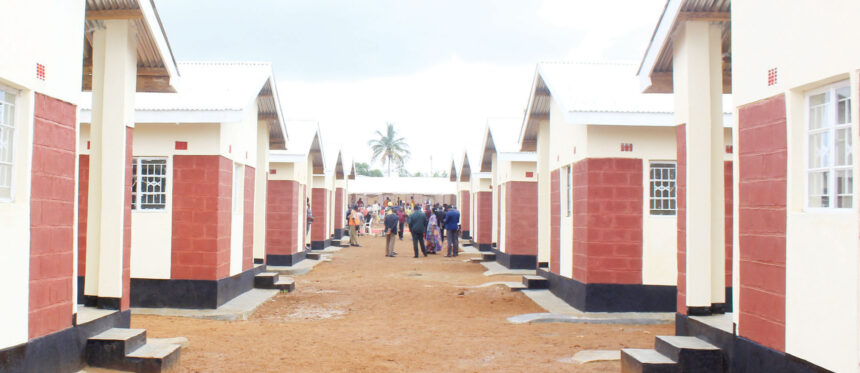
Fortunately for her, after spending months at a cyclone survivors’ camp, she is now a proud owner of a newly constructed house.
The house has been constructed in Mtambalika Village under Tigwirane Manja, an initiative that State President Lazarus Chakwera launched in the aftermath of the cyclone.

about to hand over keys to a new house owner
Cyclone recovery goodwill ambassadors, namely former president Bakili Muluzi and Joyce Banda, visited Mtambalika Village on May 26 this year, when they laid a foundation stone in the village, setting the pace for construction of 10 houses after Mosaic Global pledged to bankroll the initiative.
One of the houses has been given to Mwimva, who, with eyes closed, cannot stop to thank well-wishers who have come to her rescue.
“Never, in my wildest imagination, did I think that I would one day own an iron-roofed house, replete with a cement flour, pit latrine, quality bathroom and other things. I am happy that I have also been provided with a bag of maize and soya pieces as well as K10,000 with which I can buy curtains,” Mwimva indicates.
According to Lands Minister Deus Gumba, his ministry has been ensuring that cyclone survivors are allocated land that is safe.
“My ministry has also ben ensuring that those that have received houses have the necessary documents. This is because President Lazarus Chakwera wants cyclone survivors to be living comfortable lives. He is committed to ensuring that the people who were affected are taken good care of,” he points out.
Gumba adds that the government is satisfied with the quality of the houses built.
“The President is promoting quality housing, which is in line with Malawi 2063 vision goals,” the minister says.
Mulanje District Council Chairperson Thokozani Namoyo indicates that the cyclone affected 25,000 households in the district.
“People in traditional authorities Njema and Juma were among the worst affected. As at now, some people are still at Namchidwa camp, where the roads are still impassable up to now,” he explains.
Mulanje Limbuli legislator Daudi Chida concurs with the council chairperson on the extent of the damage.
“We, therefore, urge the authorities to bail out people who are still in camp A week ago, rains started falling, which means people who are in camps are not sleeping at night. They are spending nights on their feet because the ground at the camps is wet. This is not good,” the lawmaker says.
On her part, Banda says, as former presidents, they will not tire from reaching out to people that were affected by the cyclone.
“That is why, in coordination with well-wishers, we are constructing houses in Mulanje, Phalombe, Zomba, for example. This is just phase one.
“My appeal to cyclone survivors is that they should embrace food diversity and start growing crops that do not require fertiliser. That way, they will be food secure,” Banda explains.
Muluzi agrees, saying the worst affected cyclone survivors require both good housing and nutritious foods.
The former president indicates that they want to be as much helpful to the government and cyclone survivors as possible.
“We [Muluzi and Banda] are not mapurezidenti opuma [we are not retired presidents]; ndife mapulezidenti akale [rather, we are former presidents]. This means we can contribute actively to relief and other efforts because we have energy.
“In this vein, I have talked to other well-wishers, who are ready to start constructing 1,000 more houses in January next year. This is part of our continued commitment to the cause,” Muluzi reveals.
As for Mwimva, who is smiling after that one bad memory shook her world from March 13 this year, she now hears raindrops pattering the rooftop of her house— even as other survivors less than five kilometres away are sleeping on their feet.
For them, what has been a long wait for a sunny day continues.