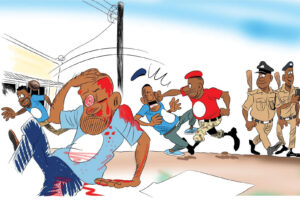
 As we move closer to the September 2025 general elections, the atmosphere is expected to become tenser, with incidents of politically motivated violence in various places.
We have seen that happening before and there are all indications that nothing has really changed.
What was supposed to be the case was police doing their job by arresting all those involved in political violence without looking at their party affiliations.
But our police has always been very partisan when it comes to dealing with political violence and only acts when it is members of a governing party that have been attacked.
A few weeks ago, supporters of opposition Democratic Progressive Party (DPP) were attacked in Lilongwe by thugs suspected to be supporters of governing Malawi Congress Party (MCP).
- Advertisement -
Then recently, Alliance for Democracy was also a victim of political violence when its materials were destroyed by individuals yet to be arrested in Mponela, Dowa.
Our police, which is known for ignoring complaints from members of opposition political parties, has once again chosen to turn its eyes and ears away from the issues.
The danger with such conduct is that it has the potential of exacerbating the violence when victims start responding through their own means.
During the DPP era, political violence was the order of the day, to the point that some individuals were captured on camera wielding pangas to threaten those who were planning to hold demonstrations against that time’s government.
- Advertisement -
- Advertisement -
No single arrest was made and so single statement was issued by the police on how they were handling the matter.
It is the same situation with current incidents.
Because the perpetrators are suspected to be members of MCP, or simply because what they did might have pleased the governing party, the police have once again chosen to ignore them.
It is sad that as a country, we have a security agency that panders to the sensibilities of politics.
Elsewhere, political violence is treated as such and whoever engages in it faces the law without looking at their political affiliations.
But in Malawi, because politicians have overbearing powers over any public officer, issues of police acting professionally are non-existent.
In fact, they are often used by politicians to crack down on the politicians’ purported enemies.
You cannot have a partisan police and expect security to be optimal in your country.
In fact, people often take the law into their own hands because they know the police will not help them even when they report cases to them.
And this is likely going to intensify in the run-up to the next general elections.
There are locations which are considered no-go zones for some political parties, and have been hotspots of politically motivated violence in the past.
There was a time the Lhomwe belt was considered an area where that time’s opposition MCP could not freely hold political rallies.
Some areas of the Central Region were also considered no-go zones for DPP.
That has been allowed to fester, giving those who designate the areas with such conditions more impetus to act with impunity.
As campaign for the elections hots up, the no-go zones scenarios are likely to repeat themselves.
Had we a non-partisan police, all that would not be happening, because they would immediately crack down on those who give boundaries to political parties because that is purely illegal.
They would provide security to everyone regardless of their political affiliations, understanding that governing parties come and go while their job as law enforcers stands.
A professional police would contribute to security by arresting anyone involved in political violence, thereby sending a message that no one is above the law.
Those who attacked DPP and Aford supporters in Lilongwe and Mponela will likely do that again because they know the police will not go after them.
Political party leaders are also contributing to political violence by failing to condemn the conduct of their supporters who attack their purported opponents.
They are supposed to strongly speak against the so-called no-go zones conditions because they will also need to travel across the country to campaign ahead of the elections.
In a democratic dispensation such as ours, everyone must be allowed to hold rallies wherever they want, with the police professionally providing security.
They are not paid by politicians or political parties, but by Malawian taxpayers who deserve their services even if they belong to opposition political parties.