 There is something quite perplexing about the way social media is used in Malawi, especially when one compares it with how people in other countries engage with similar platforms.
In our context, social media has become a space that is often misused.
Instead of being harnessed for positive engagement, we spend an overwhelming amount of time sharing trivial content, indulging in pointless arguments and spreading fake news along with outright misinformation.
The platform that could have been a tool for constructive discourse and civic responsibility has instead become a breeding ground for carelessness and disorder.
When you look at how people elsewhere in the world use social media, you will notice a striking contrast.
- Advertisement -
In many other countries, social media is used in a more mature and responsible way.
Citizens engage in thoughtful discussions, they critique one another with prudence and decency and they contribute towards the advancement of collective goals that serve the broader society.
Social media in those places becomes a tool that complements democracy, rather than one that threatens it.
During this election period in Malawi, we have witnessed an alarming level of stupidity on social media.
- Advertisement -
- Advertisement -
It is deeply concerning that some of the individuals responsible for this are people who, by virtue of their positions or experiences, ought to be positive opinion leaders.
These are individuals who should know better, yet they have allowed themselves to become vessels for confusion and division.
Because social media platforms are generally less regulated and are not as closely monitored as traditional media, it becomes easy for every Jim and Jack to flood them with whatever content they wish.
This includes messages that have the potential to cause serious unrest, particularly during sensitive times such as national elections.
The lack of moderation creates a free-for-all environment where rumour and speculation thrive. In the process, truth becomes the first casualty.
From the very first day of voting, which was on September 16, social media was already awash with falsehoods and misinformation.
Individuals who felt they could say and do as they pleased, without any fear of consequences, took it upon themselves to mislead the public.
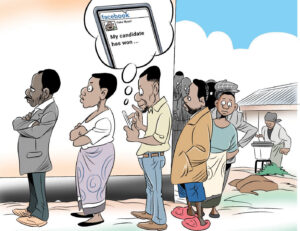
Political party loyalists flooded platforms such as Facebook, prematurely declaring their preferred candidates as winners even before a single vote had been counted.
This was not just irresponsible, it was dangerous.
In that moment, everyone suddenly became an election expert or a journalist. People were reporting what they believed to be facts, often without verifying the sources of their information.
Social media turned into a chaotic environment where emotions ran high and reason was nowhere to be found.
Some individuals went as far as posting their so-called tallied results before any official communication had been made by the Malawi Electoral Commission (Mec).
These posts were accompanied by celebratory messages, which were premature and against electoral laws.
Some party leaders also joined in this wave of delusion. Without any credible basis, they publicly declared their parties victorious.
Such declarations were not founded on facts but rather on illusions and unfounded optimism. This kind of behaviour only serves to mislead supporters and escalate tensions.
As a people, we must learn to exercise responsibility. We need to realise that freedom of speech comes with the duty to use that freedom wisely.
It is important to strike a balance between our democratic rights and the responsible use of social media platforms.
Nobody wants to see a situation where access to social media is restricted or shut down altogether, simply because it is being used recklessly.
We all know that in any election, particularly when it is closely contested, every candidate and their supporters believe they have a chance of winning.
That is to be expected. However, it is crucial to understand that only one candidate can emerge victorious.
No matter how loudly one shouts on social media, it is the official results announced by Mec that are legally binding.
False claims will not change the outcome. They will only serve to stir unrest and, in the worst-case scenario, lead to violence that may harm innocent people.
This election should serve as a wake-up call to us all. It has demonstrated in a very stark manner how dangerous it can be to put smartphones in the hands of those who are not prepared to use them responsibly.
If we do not change our behaviour, we shall continue to use tools meant for development to tear ourselves apart. The time to reflect is now.