








By Arnold Munthali, contributor:
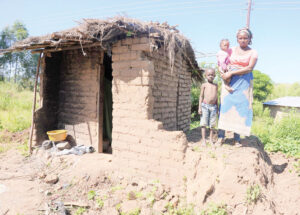
Jacqueline Dickson is striving to rebuild her life after Tropical Cyclone Freddy wreaked havoc on it. She is aware of the uphill battle, yet no one can question her tenacity.
The cyclone exacerbated conditions for vulnerable households such as Dickson’s. She is a mother of two children, aged five years and one year. Her story of a narrow escape from death echoes across regions devastated by the cyclone.
“I was making nsima (a traditional Malawian porridge). I noticed one of the walls was soaking wet, with water leaking onto the bucket where I stored the maize flour.
“Sensing imminent danger, I scooped up my sleeping baby and rushed out. Just after I got out, the wall collapsed onto the bucket, shattering it. The sleeping mat and everything else in the bedroom suffered substantial damage. We couldn’t salvage anything from the house,” Dickson, a resident of Grace Village in Mang’omba area under Traditional Authority (TA) Kapeni, Blantyre, recounts.
- Advertisement -
Upon reaching the Mang’omba camp, Dickson received a bucket, a blanket, a pot, and five plates, cups, and spoons.
These were supplied by the Farmers Union of Malawi (FUM), via the KFW-funded Multi-Sectoral Nutrition Programme, which includes an Early Childhood Development project, and were distributed through Unicef on behalf of the Government of Malawi.
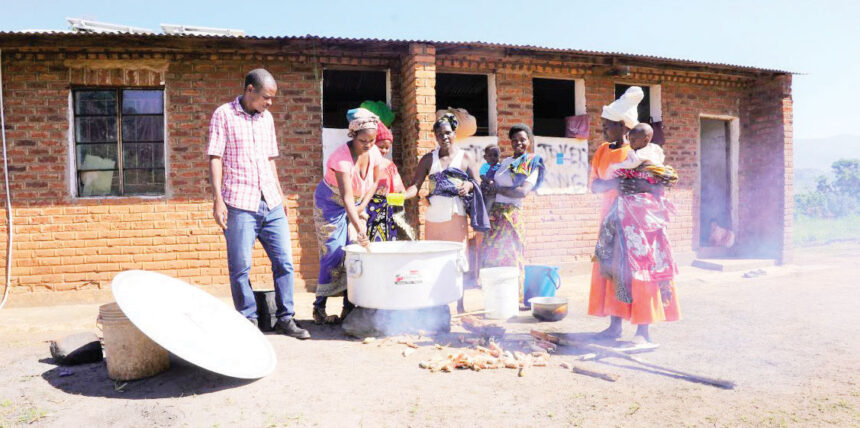
Mackson Ching’amba, FUM’s nutrition facilitator in TA Kapeni, explains that the project aims to support children under five, pregnant women and lactating mothers.
The focus is on promoting exclusive breastfeeding, child and maternal nutrition, good hygiene, sanitation, and early childhood development.
- Advertisement -
- Advertisement -
“Messages are disseminated via care groups through promoters and cluster leaders,” Ching’amba states.
He adds that the items aid affected families in regaining stability when they leave the camp.
Within Mang’omba, Cyclone Freddy impacted 716 households (representing 4,413 individuals), of which 159 (translating to 337 camps) were displaced to various internally displaced people (IDP) camps.
Among these displaced individuals, 54 were pregnant women and 196 were lactating mothers
By mid-April, a decision was made to decommission the camps. However, six families, including Dickson’s, remained at Mang’omba due to a lack of accommodation alternatives.
Dickson had to return to her partially restored home and rebuild her life from scratch.
Her husband temporarily moved in with relatives while seeking new livelihood opportunities as they work on rebuilding their lives. Their maize field, unfortunately, was washed away by the floods.
“I left the camp on April 14 and returned home. The government provided us with maize flour to start. My aunt also gave me a mat and a mosquito net for my children,” she says.
Phillip Msonkho, a promoter for Mang’omba, who provides advice on good nutrition to prevent malnutrition, advocates for a diet comprising six food groups and promotes hygiene and sanitation. He mourns that the cyclone has disrupted people’s lives.
However, he emphasises the importance of people returning home as it allows them to decide their diets.
“People have the freedom to choose food that fulfils their nutritional needs in their households. In camps, their diet mainly consisted of soya pieces, making it challenging to maintain a balanced diet.
“The challenge of providing balanced meals for some children was significant, so we advised their parents to prepare porridge enriched with bonya (small fish) or groundnut powder,” he says.
Mphatso Chikwama Banda, another promoter from Stella Village, reiterates his observations.
She notes that during the camp period in her area, no child suffered from malnutrition. However, she expresses apprehension about future risks in the absence of planning.
“Despite having no cases of malnutrition, we could encounter such situations moving forward. Even before the cyclone, people were already dealing with food shortages, and the disaster only intensified these difficulties. Many people’s crops of groundnuts and maize were destroyed.
“While some have managed to plant sweet potatoes, these alone won’t be sufficient for the nutritional needs of the children. We still require assistance, and the importance of convening our care groups to strategize for the future is paramount,” Banda adds.
For Dickson, amidst the devastation, the fact that she is alive is of utmost importance.


