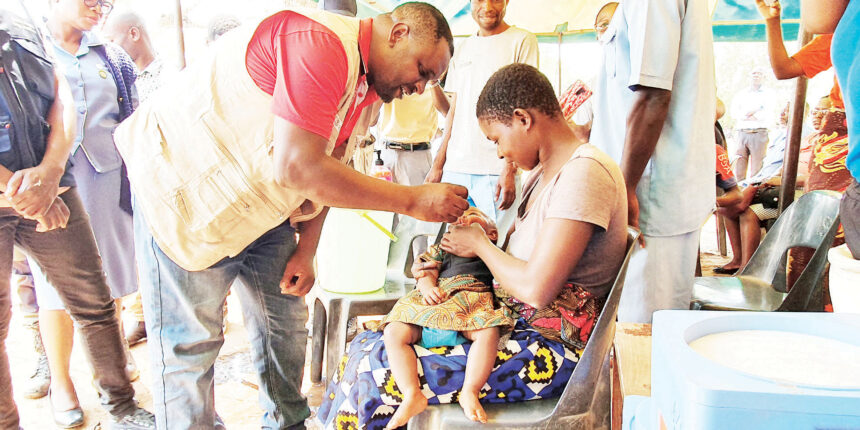
What is relationship between the ‘Warm Heart of Africa’ moniker and vaccine apathy?
That is the question I posed to 20-year-old Andrew Pizo, a small-scale trader at Songani Trading Centre in Zomba District.
“They both apply to Malawians,” he says, flashing a smile on his face.
Pizo said people from around the world call Malawi “the Warm Heart of Africa” because of the kind nature of its people.
“At the same time, Malawians have become known as people who are averse to vaccines, a good example being Covid ones,” the standard 8 drop-out points out.
- Advertisement -
He cannot be far from the truth.
According to Ministry of Health spokesperson Adrian Chikumbe, it was not easy to convince some people in the country to get vaccinated for Covid, a problem blamed on misconceptions and myths.
Health rights activist Maziko Matemba concurs with Chikumbe on the observation that Covid vaccines did not sell as hot cakes.
“Misconceptions were one of the factors that contributed to this,” he indicates.
- Advertisement -
- Advertisement -
However, this has not been the case with the polio vaccination campaign, which started on Wednesday and ends on September 16.
Take, for instance, Pizo’s home district of Zomba, one of the areas where Covid vaccines did not attract many customers.
By the first day of the polio vaccination campaign this week, hordes of parents and guardians has rushed to vaccination centres.
Zomba District Health Office (DHO) spokesperson Arnold Mndalira says the exercise has started on a good note.
“We, actually, vaccinated 142,720 children on the first day of the exercise. “This means we have reached 30 percent of the targeted 472,687 children in the age range of zero to 15 years.
“The reception of the polio vaccine has been impressive and we believe that, come Saturday, we may reach our target,” Mndalira said.
He further explains that they have engaged those on border posts along Lake Chilwa to ensure that every child entering the country from Mozambique gets the vaccine.
“We have an understanding with local leaders and health officials in bordering villages in Mozambique, where they are also administering the vaccine to ensure that all children, aged zero and 15 years, that are moving between the countries receive the vaccine as they are required to produce evidence that they received the vaccine,” Mndalira indicates.
In Blantyre, the reception has been equally impressive.
Blantyre District Council Chief Preventive Health Officer Penjani Chunda indicated, when the district launched the polio vaccination campaign in Traditional Authority (TA) Chigaru, Mdeka, that recent polio cases registered in the country might have spurred community members into the realisation that prevention is better than cure.
“The fact that one polio case was recorded in February 2022 followed by three more cases in 2023 could be enough reason for people to immunise their children.
“What we want is that every child aged between zero and 15 years should get the polio vaccine. We are hopeful that we will reach out to close to 90 or 100 percent of our target because, in previous campaigns, we managed to reach our target.
“Looking at the work we have done on the ground, we are expecting to beat the target, which
Chunda said vaccines would be available in places such as schools and healthcare service facilities, among others. “Because the targeted children are found in different places, we have arranged school, health facility, church and market outreach activities,” Chunda points out.
On his part, Mpemba Ward Councillor Mussa Chikwakwa says he has observed community members’ change of attitude towards vaccines, citing the massive turnout at polio vaccination centres.
“I think one of the factors that has influenced community members to embrace the vaccine is the engagement of opinion leaders such as religious, political and traditional leaders, among others.
“It could also be that people have realised that the polio vaccination exercise is an opportunity for them to deal with the polio scare,” he posits.
Mussa also suggests that the support of other stakeholders has made the job easy.
In the case of Blantyre, the United Nations Children’s Emergency Fund, Initiative for Community Development Services (Incos) and the World Health Organisation supported the launch of the initiative.
Incos Executive Director Kennedy Mwalwanda points out that it is important for all stakeholders to get involved in the task of mobilising people and getting children vaccinated.
“On our part, for example, we have been mobilising community members, including caregivers, and sensitising them to the importance of encouraging people to vaccinate their children so that, together, we can defeat polio,” he stresses.
With all these strides, Principal Secretary for Health, Samson Mndolo, cannot be blamed for hailing progress made, so far.
He can even manage to share his expectations.
“Our expectation is to reach each and every child of less than 15years of age to ensure that they are protected from the virus. We will continue to engage various stakeholders and partners in polio response,” he explains.
Malawi recorded its first polio case of a three-year-old girl in Lilongwe on February 17 2022 after Africa was declared free from wild poliovirus in 2020.
And that is how the alarm bells started ringing