Dr Saulos Klaus Chilima was, whatever way one looks at him, a man fit for the purpose of advancing the cause of private and public sector development.
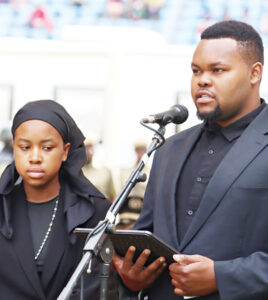
Close friend and former colleague at Airtel Malawi Dr Mathews Mtumbuka put it in context in his eulogy at Bingu National Stadium Sunday.
“Once, when the postpaid system was down at Airtel and I was on my way to Mangochi with family members, he phoned me to inform me about the problem as he believed that, as a leader in the engineering [department], I had to be there in times of crisis.
“When I was at the Clock Tower [in Blantyre], he phoned again, subtly asking: ‘Where exactly are you?’” Mtumbuka said, describing him as a hands-on man who wanted the best out of people he worked with.
Mtumbuka also recollected that when he worked throughout the night at one point, Chilima called him every now and then [from mid-night, 1am, 2am, 3am, 4am and, “before I knew it, it was 6am. He followed up on me throughout the night and, like me, never slept that night”.
- Advertisement -
That is a picture of how Chilima was in his private sector days.
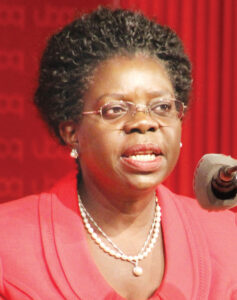
As for his work ethic in the public sector, Secretary to the President and Cabinet Colleen Zamba put it well.
“He was good at time management.
“Earlier this year, at a Cabinet retreat, [he availed himself of the meeting before the scheduled time but] some Cabinet ministers were late. He [Chilima, in a mark of a true leader] apologised to the President [Lazarus Chakwera] on behalf of the Cabinet ministers who were late and, then, promised the President that that would never happen again,” Zamba said.
- Advertisement -
- Advertisement -
Then, behind the scenes, Chilima softly reminded the Cabinet ministers about the importance of such meetings; a leader who was ready to take the whip for errant sheep that were the Cabinet ministers that availed themselves of the meeting late.
Who, then, was Saulos Klaus Chilima, the Vice President of the Republic of Malawi who is being mourned by millions of people in and outside the country?
Chilima’s life journey started in Ntcheu District on February 12 1973.
Before he became Impi to Inkosi ya Makosi Gomani V, he was born Ngoni.
As such, becoming Impi was so natural a move that he fit into it automatically.
A devout Roman Catholic, Chilima married the love of his life Mary, with whom he has two children, first-born Sean and Elizabeth.
Before serving as incumbent President Lazarus Chakwera’s vice— which he became after being sworn in on June 28 2020 after Chakwera emerged victorious in the June 23 2020 court-ordered presidential election— he served in the same capacity under Peter Mutharika.
This was after Mutharika won the presidential election of May 20 2014.
As such, Chilima was first sworn in as Vice President of the Republic of Malawi on May 30 2014.
On June 28 2020, he became the first Malawian to be sworn in for his second term under a different administration— namely that of the Malawi Congress Party (MCP), which joined hands with political parties such as Chilima’s UTM, People’s Party, People’s Transformation Party, Umodzi Party, Alliance for Democracy, Malawi Forum for Unity and Development, Freedom Party, among others.
Since the Malawi Electoral Commission could not accommodate the Tonse Alliance’s symbols as it [Tonse] did not contest in the May 21 2019 presidential election, MCP symbols were used in the 2020 presidential election.
Well of knowledge
Known for preaching the message of mindset change, Chilima tapped his knowledge from the academic circles.
This is because he held a PhD in Knowledge Management from the University of Bolton (from 2011 to 2015) a Master’s Degree in Economics (2003 to 2005) as well as a Bachelor’s Degree in Social Sciences, Computer Science and Economics from the University of Malawi (Unima) after being in class from 1990 to 1994.
Private sector growth champion
Throughout his life, Chilima trod where some people feared to get, be it academically and workwise.
No wonder, he became the first Malawian to head Airtel Malawi.
Before scaling to such a height in the telecommunications sector, he held senior positions in the sales and marketing sections of such firms as Leasing and Finance Company, Unilever Malawi, Coca-Cola and Carlsberg.
At Airtel Malawi, he is accredited with increasing the customer base from 357,000 in 2006 to 2,800,000 customers by the time he left the company to join politics.
In 2006, internal surveys put the employees’ job satisfaction rate at 50 percent. By the time he left the job of his own volition, the job satisfaction rate was at 80 percent.
Indeed, he coordinated the successful rebranding of Celtel to Zain in 2008 as measured by total market awareness of 52 percent (as of April 2010) and mobilisation of employee buy-in.
He was there, too, where Zain transitioned to Airtel.
According to the Malawi Government website, he served as Airtel Malawi Limited Managing Director from 2010 to 2014, during which he managed the business— which by then had a turnover of $160 million, 231 employees and was serving 82 percent of the Malawi population.
From 2002 to 2006, he served as deputy sales and marketing manager for Southern Bottlers Malawi Limited.
While there, he ensured that the company was ticking all the boxes in terms of meeting sales, marketing and general staff welfare parameters.
He surely put to good use knowledge from the Extraordinary Leadership Development Programme which Louis Allen Worldwide conducted in Bahrain in 2008.
Not just that; he put knowledge obtained from the High Performance People Skills for Leaders Programme which London Business School conducted in 2008 to optimal use.
These were not the only refresher courses he took; other wells of knowledge he tapped from included the Celtel Advanced Management Programme which London Business School conducted in 2007; the Coca Cola Distribution and Trade Marketing Field Experience that took place between August 2005 and January 2006.
It took him to Kenya and Australia, where experienced were shared and best practices promoted.
Seeking more knowledge, he grabbed the chance to pursue the Supply Chain Management course that Wits Business School offered in September 2004 with both hands.
The course inculcated time management and other skills in participants— skills he lived throughout his life by, according to Archbishop George Tambala of Lilongwe Archdiocese, for instance, “not missing the 6am mass whenever he had the chance to attend”.
His steadfastness at church was replicated at work and at family levels.
No wonder, his departure has left a chasm that even tears cannot fill.