By Madalitso Wills Kateta:
At a vegetable garden in the area of Traditional Authority Maoni in Phalombe District. Stanley Banda, 27, straightens up from weeding his vegetables and wipes sweat from his face. He has heard of “millions of dollars” and “rare earths” on the radio and at public meetings.
He has heard local leaders and government officials say a ‘rare earths’ mine is coming to the area. What he has not heard about is how any of it will change his life.
“They say this mine will bring jobs and development to the area, giving us hope that we are going to live better lives.
“Years are now passing and all we hear about is big money. Yet little is known on how the big money will trickle to the community,” Banda says.
- Advertisement -
Banda’s concerns are being raised across the three traditional authorities affected by the Songwe Hill Rare Earths mining project. It is also the central question facing Malawi as it tries to turn its minerals into foreign exchange, create jobs, and hasten its development aspirations.
Rare earths are not actually ‘rare’. They are a group of 17 metals with names most Malawians have never heard of: neodymium, dysprosium and praseodymium. What makes them valuable is what they do. A teaspoon of neodymium makes magnets that make phones vibrate, dysprosium keeps wind turbine magnets from overheating while praseodymium strengthens the alloys in electric vehicle and fighter jet motors. Without these metals there is no green energy transition, no smartphones, no modern transport and defense systems.
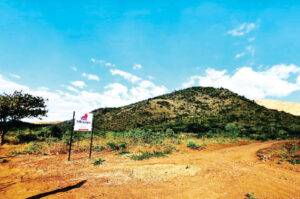
That is why global demand for rare earths is projected to triple by 2035, according to the International Energy Agency, and that is why the Songwe Hill project matters. Exploration of Songwe Hills covering an area of about 20 square kilometers stretching across TA Maoni, TA Nazombe and Paramount Chief Kaduya started some 16 years ago by Mkango Resources.
In 2023, the Malawi Environmental Protection Agency approved the Environmental and Social Health Impact Assessment (ESHIA), the project becoming the country’s first major rare earth mine which at full scale, is projected to create 1,200 direct jobs and 10,000 indirect jobs and is expected to bring in about $120.6 million per year in royalties, dividends and other taxes.
- Advertisement -
- Advertisement -
For a country in a forex crisis, that is a significant investment. During his recent visit to the site, Minister of Mining Thoko Tembo, described the project as “one of Malawi’s most promising mining investments”.
“Exploration and research activities are nearing completion and the government is working to ensure the right regulations and legislation are in place so that both Government and mining investors are guided by the law,” Tembo said.
But in the surrounding communities, the mood is different. It is not anger, it is uncertainty. A two-week investigation in Phalombe found a growing gap between what is written in project documents and what communities say they understand. The ESHIA was approved in 2023, yet three years later, many residents say they have never seen it to understand its contents.
“The Mining Development Agreement and the ESHIA are in English. We have been advocating that these important documents be translated in local languages so that people should understand what is really at stake,” says Josta Namonde, an activist with Songwe Mining Action Group.
Namonde argues that is why a farmer like Banda only vaguely understands the venture. The technical language, the legal terms, the maps — all of it is locked behind documents most villagers cannot read.

Rodger Kumalile Phiri, Executive Director of Art and Global Health Centre Africa (ArtGlo), says the consultation record ‘appears thin’ given the scale of the project.
“The communities feel they have been left out. Those involved in the consultation were a few stakeholders that don’t even understand much of what is at stake. The broader community indeed feels it was left out in the ESHIA consultation, and even those that were involved do not have adequate information on what is contained in the approved ESHIA, ” Phiri says.
Phiri said that the information gap has consequences as some community members now suspect that ‘some stakeholders have been bribed by the mining company’, and whether true or not, the suspicion shows how lack of information erodes trust, and according to Symon Thipa, Programme Coordinator at Ufulu Wathu CBO, which works with ArtGlo to educate communities, the demand is simple: show us the ESHIA report.
“The ESHIA was approved, yes. But many people do not know what is contained in the report and we feel that communities have a right to understand what is in the report because this project will directly affect their lives,” Thipa says.
Many families feel that the mining project is not abstract. For generations they have grown crops on the fertile land that sits within the project’s infrastructure footprint, and while land acquisition is often the most sensitive part of any mine, they want to understand how much land will be taken, how much will they be compensated with and where will they go when mining commences.
“People need the MDA and ESHIA in a language they can understand, telling them how much land is to fall under the project and how much money they will receive in compensation including the potential environmental impacts,” Thipa adds.
While the Malawi Mines and Minerals Act, and international best practice, require Free, Prior and Informed Consent — FPIC — for projects affecting local communities, lawyer Kakekeni Kaphale, an expert in mining law, says the law also provides for adequate compensation and that resettlement plans must be approved before ground is broken, however, Phiri argues FPIC cannot happen if information is not accessible.
“The challenge with the ESHIA was that it did not involve all community members but only a few stakeholders in the governance structures,” he says. “It has resulted in confusion where different stakeholders were not seeing each other eye to eye,” said Phiri.
Namonde puts it more bluntly: “The mining company says ‘consultation was completed’, but in the broader community they believe no one was consulted. They say consultation was only done with the higher authorities.”
Perhaps this is why the Office of the Ombudsman is investigating several mining operations in Malawi over complaints of exclusion and poor consultation. The probe will test whether companies meet legal requirements for public participation and whether grievance mechanisms work in practice.
Mkango Resources, the developer behind Songwe Hill, disputes the claim that communities were left out, maintaining that it met all MEPA requirements. In an email response, the company’s spokesperson Alex Lemon said Mkango has conducted ‘years of stakeholder engagement’ as part of the ESHIA process.
“Consultations ran from national level to the project area and potential access road communities, with separate meetings for women and vulnerable groups,” Lemon said. “Consultations were held in the appropriate local languages. Mkango has a formal grievance system and remains committed to satisfying Malawian laws and regulations, as well as the rigorous international standards required of us.”
For many Malawians, the fear is not new. It started with the Kayelekera uranium mine in Karonga where jobs came, money came, and then both left. Communities were left with an environmental liability and little lasting benefit. Different stakeholders now warn that without a stronger local mining law and real transparency, Songwe could follow the same path.
Namonde says to avoid the resource curse, three things must happen — publish the ESHIA and MDA in Chichewa and Lhomwe, ensure compensation and resettlement are done fairly and transparently and fund independent environmental monitoring so that communities can verify what the company reports.
“Rare earths can power the world’s green transition, but if Malawians don’t understand the project, the transition will happen to them, not with them,” Namonde says.
Back on his dimba, Banda is not opposed to mining. He wants what most Malawians want: opportunity, but for him an opportunity without information feels like a risk.
“If these are our minerals, they should make us understand how our minerals will benefit us,” Banda says.
With rare earth prices rising and the government pushing mining as a path out of the forex crisis, that sentence matters. Songwe Hill could be a turning point for Malawi’s economy, but it could also be another project where the promise is big and the community benefit is small. The difference will come down to one thing: whether the people living on top of the minerals are treated as partners, not spectators.
For now, in Phalombe, communities are still waiting — for documents in a language they can read, for answers in meetings they can attend, and for proof that development includes them.