Maize hoarding continues to be one of the most persistent and damaging problems affecting Malawi’s food security system.
Year after year, the same patterns repeat themselves. Traders buy maize from desperate farmers at low prices, hoard it in anticipation of shortages and wait for prices to rise so they can sell at exorbitant rates.
Unfortunately for them this season, the strategy has not worked as expected, exposing deep flaws and injustices within the maize market.
In recent days, we have witnessed traders thronging the National Food Reserve Agency (NFRA) depots, eager to offload their maize stocks.
This sudden rush is not driven by patriotism or concern for national food security, but by fear. Traders know very well that the window for making abnormal profits is closing fast.
- Advertisement -
With the harvesting season approaching, households will soon rely on their own maize, drastically reducing demand on the open market.
What they had hoped would be months of scarcity driven price hikes has simply not materialised.
These traders had positioned themselves to benefit from hunger. They were waiting for prices to skyrocket, banking on desperation among consumers.
However, few people are buying and the anticipated price surge has failed to happen. This has left traders stuck with large quantities of maize they can no longer sell at inflated prices.
- Advertisement -
- Advertisement -
Their response has been predictable. They are rushing to NFRA in the hope that government will absorb their stock.
The real tragedy in this situation is that most of this maize was likely bought directly from smallholder farmers.
These farmers, often under pressure from poverty, debts or immediate household needs, sold their produce at low prices soon after harvest.
Traders then stepped in, not adding value or improving storage systems for national benefit, but simply waiting for scarcity to push prices up.
This practice amounts to exploiting farmers’ vulnerability, reaping where they did not sow and profiting from both the farmer’s desperation and the consumer’s hunger.
Compounding the situation is the distribution of relief food by government and its partners.
As relief maize reaches vulnerable communities, traders have realised that their market is shrinking even further.
People who might have bought maize are now receiving assistance, leaving traders with no buyers. This has triggered panic selling, hence the sudden stampede to NFRA depots.
I have always maintained that there is enough maize in this country. The problem has never been absolute scarcity; it is poor management, weak regulation and unchecked greed.
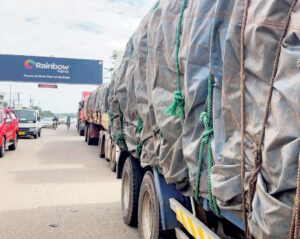
One only needs to look at our borders to confirm this reality. Truckloads of maize leave Malawi every day, destined for neighbouring countries, while back home, we complain that supplies are insufficient.
This contradiction exposes a system that prioritises private profit over national interest.
Even more troubling is the fact that the forex generated from maize exports often does not meaningfully return to benefit Malawians or the national economy.
We lose maize, we lose food security and we gain very little in return. Meanwhile, local prices remain volatile, farmers remain underpaid and consumers remain vulnerable.
Maize is not just another commodity. It is a political crop, a social crop and a survival crop. Its availability and price stability have direct implications for national stability.
Any government that ignores this reality does so at great risk. Authorities must therefore be serious and deliberate in ensuring that maize primarily benefits Malawians and Malawi.
This means strengthening border controls, regulating exports, monitoring trader behaviour and enforcing policies that protect both producers and consumers.
At the same time, farmers must benefit from their toil. It would be unjust to address hoarding and speculation only to push prices so low that farmers make losses.
Government has a responsibility to set and enforce fair farm gate prices, ensure timely purchases and invest in storage and market access systems that reduce farmers’ dependence on exploitative middlemen.
The current situation should serve as a lesson. Hoarding maize and betting on hunger is not only morally wrong, but economically risky.
Malawi does not lack maize; it lacks discipline, coordination and political will in managing it.