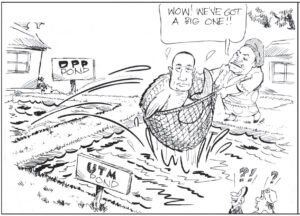
 Governing Malawi Congress Party (MCP) has been insisting that it is determined to proceed alone in the upcoming 2025 General Elections, which are expected to be highly contested.
Perhaps realising the difficulty of regaining the trust of potential partners after its treatment of UTM in the Tonse Alliance, MCP seems keen to test its ability to go to the polls independently.
Meanwhile, opposition Democratic Progressive Party (DPP) appears to be gaining traction, actively seeking electoral agreements with various political parties.
DPP has recently shown interest in forming alliances with UTM, Alliance for Democracy (Aford) and possibly United Democratic Front (UDF).
People’s Party (PP), despite its leader Joyce Banda’s claims of running solo in the 2025 elections, has not completely severed ties with MCP.
- Advertisement -
An alliance involving DPP, Aford and UTM seems likely, as they share a common goal of ousting MCP from power. However, reaching a formal agreement may require significant effort.
As previously noted, the mere fact that these three opposition parties have a mutual adversary does not guarantee electoral success.
Nevertheless, they may be able to galvanise substantial support and approach the elections with renewed vigour, reminiscent of the 2020 presidential poll.
For the second consecutive time, the elections will be determined by the ‘50 percent plus one’ voting system. No single party is likely to secure all the necessary votes alone.
- Advertisement -
- Advertisement -
By insisting on a solo campaign, MCP might be banking on the possibility of a rerun, hoping that if it secures the most votes, others will be inclined to partner with it.
However, even if MCP finishes first but fails to achieve the required majority, there is no guarantee that the smaller parties will choose to support it.
Alternatively, MCP might be emphasising its solo intentions to maintain ultimate bargaining power, meaning any party wishing to form an alliance would have to accept a subordinate role to the governing party.
This assumes that the so-called smaller parties, which may be inclined towards alliances, will gravitate towards MCP.
The informal agreements emerging among some opposition parties are not something MCP can dismiss lightly.
There is potential for significant collaboration and the governing party may one day find itself surprised by a united opposition.
At present, it is clear that MCP, regardless of its narrative or campaign efforts, cannot win the 2025 elections without forming partnerships.
There are indications that UDF and PP may choose to collaborate with the governing party.
Such a combination would be striking, given that both parties have sharply criticised MCP in various high-profile forums, including Parliament.
However, in politics, there are no permanent enemies. This is evident in UTM’s shift in attitude towards DPP, which it fiercely opposed before the 2019 elections, now viewing the former governing party as the lesser evil.
This shift is understandable. Few would return to a partner perceived to have committed serious betrayal.
The only challenge arises if a leader opposed to UTM allying with the DPP is elected at the party’s convention.
As previously mentioned, many UTM members appear resistant to the prospect of Vice President Michael Usi assuming leadership.
Yet, politics can be unforgiving. As the country’s second-in-command, Usi has ways of mobilising support among delegates to the party’s convention if he chooses.
MCP will undoubtedly be watching UTM’s developments closely, particularly how Usi might lead the party if he secures leadership.
This could involve reversing any decisions made by UTM secretary general Patricia Kaliati and her colleagues about exiting the Tonse Alliance.
Usi has public resources at his disposal, which he is likely using for political manoeuvring while managing State affairs.
UTM members and officials opposing him must consider their next steps if Usi gains authority at the convention.
Should he win, he may either directly support MCP by endorsing President Lazarus Chakwera, the party’s torchbearer, or adopt a façade of independence, knowing he would ultimately need to support MCP in a rerun.
A great deal of political manoeuvring is occurring in the country and the dynamics of alliances are more complex than they might appear.
Something significant is brewing beneath the surface, beyond what is readily visible.