
By Emmanuel Simpokolwe:
It had always been Mary Mzokomera’s wish to learn how to read and write. When the girl enrolled at Kaphatenga Primary School in Standard 1, she thought reading and writing would be easy for her.
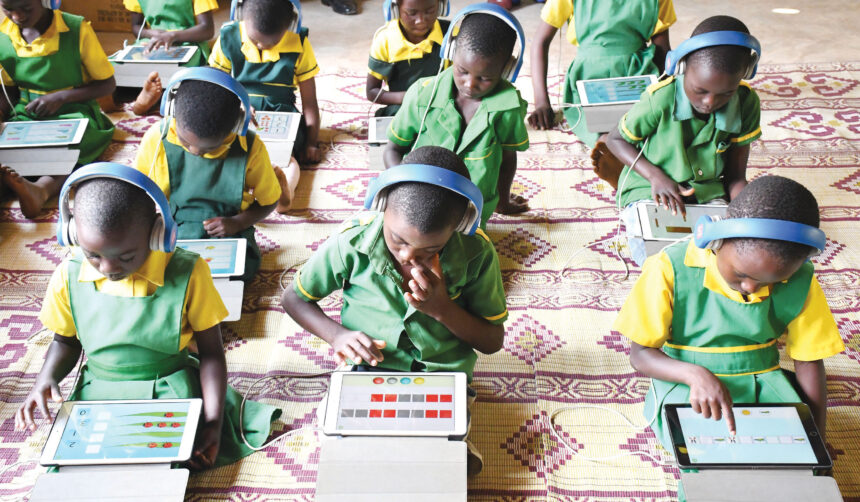
On the contrary, the going was tough. She struggled, until the time she reached Standard 2. At that stage, she was exposed to a new mode of learning: using iPads and tablets.
Now in Standard 3, Mary can read and write owing to the use of the two gadgets.
“Learning using these gadgets is easier and exciting. It makes everyone eager to come to school to learn using the iPads and tablets,” she says.
- Advertisement -
Controlling noisy learners is one of the hassles teachers, especially from junior classes, used to experience daily.
However, as testified by the learners at Kaphatenga Primary School, using iPads and tablets has helped ease the struggles.
Mary is one of the many primary school learners in rural areas who are using tech devices in learning.
Volunteer Services Overseas (VSO) has been implementing the Unlocking Talent (UT) project, which focuses on digital education.
- Advertisement -
- Advertisement -
The goal of the project is to improve learning outcomes in literacy and numeracy using education technology (EdTech). This is done through learning centres established in selected schools across Malawi.
The duty of teachers in these learning centres is just to make sure that each learner has an iPad or tablet with headphones to easily follow the instructions from the gadgets. Teaching and learning literacy and numeracy in early-grade classes has been simplified.
With the tablets and iPads in their hands, about 40 Standard 2 learners at Kaphatenga Primary School are often seen busy listening and, a routine which has become impactful.
The school’s Head teacher Davie Jana says most of the learners who use these iPads do much better than those who did not have a chance to use the gadgets.
“Before we started using the tablets the pass rate was about 70 percent, but this time, it has risen to 91 percent,” Jana says.
Chief Education Officer for Salima District Council, Joyce Hussein, says the project is being implemented in 17 schools in several zones in the district.
She has, so far, seen tremendous improvement in the acquisition of literacy and numeracy skills among early grade learners.
“We have seen that learners are very much interested in handling the iPad. This is a remote area, so for the learners to be able to operate an iPad, it is an exciting thing and adds value to their education,” Hussein says.
In the sub-Saharan Arica Region, learning poverty is at 90 percent, and Malawi is at 87 percent, which represents a 13 percent gap in terms of reading with comprehension.
VSO, with funding from the Federal Republic of Germany, has been implementing the UT project in 15 of the 34 Education Districts in Malawi since August 2019.
The project has so far provided digital learning access to 154,248 learners in 338 Primary Schools and trained 4967 teachers in utilising EdTech as a lesson delivery mode.
The project has since been handed over to the Ministry of Education.
VSO Malawi Project implementation lead, Moffat Njati, says through the project, they have constructed 178 learning centres across the country, fully equipped with iPads and tablets and solar charging equipment.
According to Njati, this has helped a lot in terms of retention and motivation to learners, besides helping to introduce EdTech.
He states that this has proven to be an important and innovative way of improving learner outcomes in literacy and numeracy at the foundation level in Primary Schools.
“This has also convinced the Ministry of Education to look at EdTech as the go-to intervention. That is why out of the evidence gathered from the UT project, the ministry has decided to scale up the use EdTech to all Primary Schools in Malawi under the Building Education Foundation through Innovation and Technology (Befit) programme.
“This is a six-year programme aimed at helping learners to be able to access lessons through a calibrated teacher on the tablets,” Njati says.
Minister of Education Madalitso Kambauwa Wirima has since appealed to development partners to support innovations that can ease digital learning among learners.
Wirima says the government is committed to ensuring that the programme reaches more learners even before the targeted year of 2030.
“We have identified some resources from our development partners and also allocated some funds, through the national budget, that are going into the programme,” she says.
In his State of the Nation Address, which he delivered recently, President Lazarus Chakwera said through the Befit programme, the government had distributed about 68,000 tablets to 498 primary schools and trained 689 officers and 2,600 teachers.