By Brenda Kayo:
As the first rays of sunlight break over Lilongwe, 39-year-old Ellard Jackson shoulders two empty buckets and begins another journey he never imagined would become part of his daily routine.
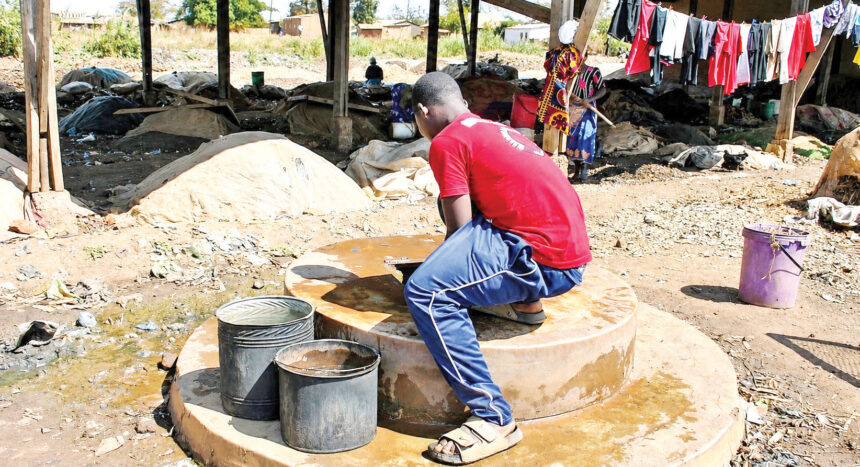
He heads to a water source hidden behind a cluster of houses in Mtandire Township.
The water is stagnant, murky and filled with floating debris. Nearby, a line of women patiently waits to fill pails and buckets.
Jackson pauses before lowering his bucket into the dirty water.
- Advertisement -
“This is not the kind of water anyone should drink. But our taps have been dry for days. My children cannot survive without water, so we take this home, boil it if we have enough charcoal and pray that it does not make us sick,” he laments.
Persistent water shortages are forcing many residents of Lilongwe to rely on unsafe streams, shallow wells and other contaminated sources to meet their basic needs.
In areas such as 25, 36 and 49, Kawale, City Centre and Lumbadzi, taps can remain dry for several days.
Residents never know when water will return. Whenever rumours spread that water is flowing in a particular area, people rush there with buckets, basins and drums, hoping to collect enough before the supply disappears again.
- Advertisement -
- Advertisement -

Health expert Maziko Matemba warns that untreated water exposes communities to diseases such as cholera, typhoid and diarrhoea.
“This is not the time we should be talking about water scarcity when the government has been preaching about access to clean water for all by 2030,” Matemba says.
For people like Jackson, the danger of contaminated water feels less immediate than the certainty of dehydration.
“You cannot tell your child to wait another two days for clean water. When they cry because they are thirsty, you give them whatever water you have,” he says.
Not far away in Area 49, salon owner Faith Tembo unlocks the doors to her small beauty salon. Plastic buckets stand neatly arranged near the entrance, but they are empty.
Inside, mirrors line the walls, hairdryers hang silently and chairs wait for customers who may never arrive.
“A salon cannot operate without water. We wash customers’ hair before styling it. We clean our towels and equipment every day. When there is no water, customers simply leave,” Tembo says.
She adds that business has declined significantly as customers seek salons in areas with more reliable water supplies.
“This business feeds my family. Every day I lose customers because of water is a day my children go without something they need,” she says.
The crisis also affects families and school-going children.
In Area 36, Funny Soko begins every day long before dawn. At three o’clock in the morning, she joins dozens of neighbours after hearing reports that water may be flowing in another part of the township.
Sometimes the rumours are true. Oftentimes, they are not.
“If we are lucky, we collect enough water before sunrise,” she says. “If not, we walk to a nearby well. My children help me carry buckets instead of preparing for school.”
She says what hurts her most is watching her children grow up believing the struggle is normal.
“They ask me why other places have water while we do not. I never know how to answer,” Soko says.
In Lumbadzi, George Phiri says the shortage has stolen his time and peace of mind.
“We pay our water bills every month expecting a service. But instead of relaxing after work, I spend my evenings searching for water,” Phiri says.
The burden is particularly heavy for women and girls. They spend hours walking long distances carrying heavy containers on their heads.
Time that could have been spent earning an income, studying or resting is instead consumed by the search for water.
Young girls sometimes miss school to help their mothers collect water, while women return home exhausted before beginning household chores.
Lilongwe Water Board (LWB) acknowledges the challenges residents are facing.
According to the board, the city currently requires approximately 157,000 cubic metres of water a day against an available production capacity of about 125,000 cubic metres.
The growing population, rapid urban expansion and increasing demand have placed pressure on existing infrastructure.
“We recognise the hardships our customers are facing and sincerely regret the inconvenience caused by intermittent water supply,” LWB spokesperson Chisomo Chibwana says.
Chibwana further says to manage the available water fairly, the board has introduced controlled water releases from Kamuzu dams, reservoir recovery operations during off-peak hours and pressure management across the distribution network.
She adds that the board is relying on the completion of the third water treatment plant, which is expected to increase daily production by about 50,000 cubic metres and improve supply across the city.
“We ask residents to use water responsibly whenever it becomes available,” she says.
However, many residents insist those assurances cannot erase the challenges they face today.
Every empty bucket represents another household waiting for water. Every child carrying a bucket instead of books represents time lost from school. Every business forced to close because of dry taps reflects the economic cost of the crisis.
And every family collecting water from polluted sources faces the risk of disease simply to meet a basic need.