Malawi’s aspiration to turn the mining sector into the next big thing continues to be riddled by glaring disparities between plans and amount of investment made.
The government is limping in its drive to creating an enabling environment for the industry to thrive.
The private sector is also elusive. It is, apparently, passive in channelling the required resources into the mining industry—which is among three priority sectors (others being agriculture and tourism) to propel economic growth for Malawi.
Low public investment and bureaucratic tendencies leading to failure to swiftly negotiate deals with potential investors continue to cripple take-off chances for most mining and minerals exploration activities.
These, notwithstanding the lack of a direct synergy with other feeder-industries including the energy and ICT, have been singled out among key bottlenecks.
- Advertisement -
Malawi has several high economic value minerals whose potential needs harnessing.
They include uranium, phosphates, bauxite, kaolinitic, coal, kyanite, limestones, rare earths, graphite, sulphides, titanium minerals, and vermiculite.
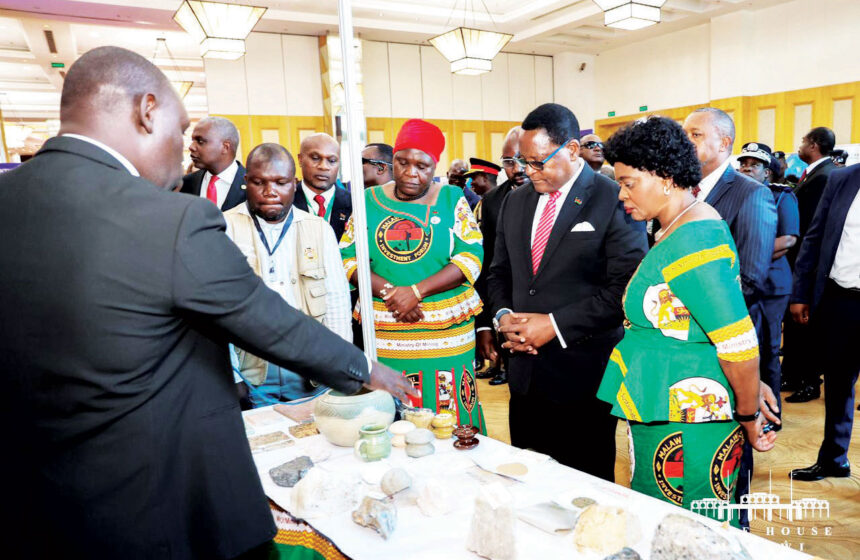
Last week, stakeholders had a candid talk on prospects at a two-day inaugural Malawi Mining Investment Forum 2024 in Lilongwe.
The consensus was that more needs to be done if Malawi is to awaken the sleeping giant.
- Advertisement -
- Advertisement -
Addressing the forum, President Lazarus Chakwera reiterated his aspiration of making the industry a key forex earner and contributor to national economic growth and development.
“We hope that by 2030, Malawi will be transformed because the forex that we are lacking today will be available in abundance as a result of the mineral exports that will be happening.”
Looking back, it is clear that the mining sector has registered static growth despite being touted as a potential money spinner.
Malawi’s mining sector accounts for just less than one percent of Gross Domestic Product (GDP).
In fact, in the past half a decade, the sector has registered no growth, stalling at around 0.7 percent.
But the government says plans are underway to scale-up the industry’s contribution to GDP to between 10 and 15 percent by 2030 in line with aspirations embedded in the Malawi 2063—the country’s long-term development blueprint.
This means that within the next six years, Malawi should be swift in ironing out all bureaucratic impingements, creating an enabling environment to woo more investors and scaling up power supply.
It has taken the government close to four years to set up the Mining Authority and to establish a State-owned mining company which should steer the development of mines. And since 2020, it is only now that the country is hearing of conclusive steps towards having Mining Development Agreements between the government and investors.
Such delays have a cost. The country has forfeited huge sums of foreign exchange.
For example, if all the four mining projects were in motion Malawi could be getting $901 million annually ($415 million from Kasiya, $243 million from Kanyika, $127 million from Kayelekera and $116 million from Songwe Hill).
While most previous deals were not done in the best interest of the country and its citizenry, it does not guarantee a long-winding road to having fresh ones in place.
For about three years, the country was unable to put together about K500 billion for setting up the mining company.
Growth for the sector requires speed and accuracy.
Also, the county has faced myriad challenges which, if not addressed, could continue to impinge the sector’s growth and development.
Persisting low energy supply coupled with other macroeconomic bottlenecks including high cost of borrowing, currency instability and elevated inflation should be addressed for Malawi to attain its aspiration.
Public-Private- Partnerships remain a sure way.