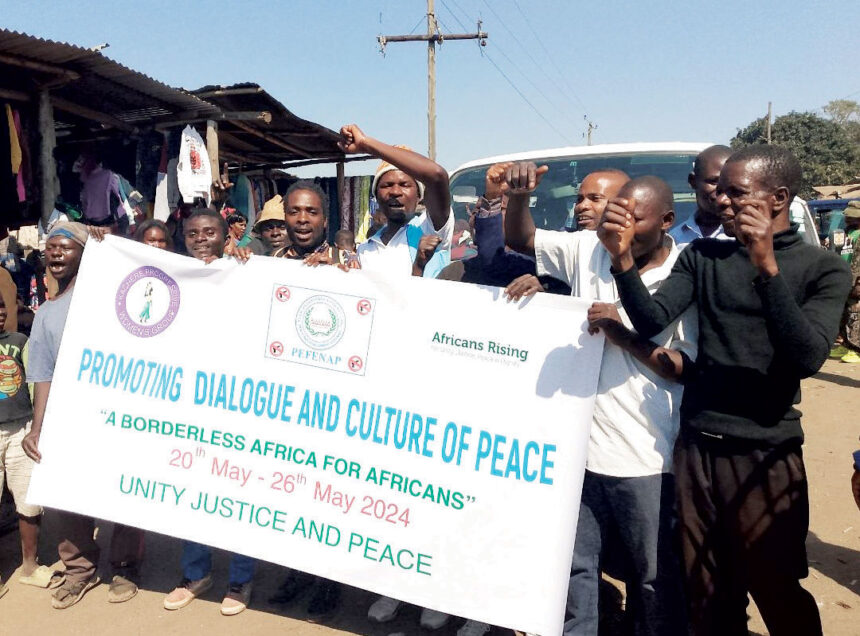
When, at last, African governments remove physical boundaries to facilitate the free movement of people, one Malawian who will be on top of the world is already known: Gregory Khanyanga.
Last month, he led Limbe vendors in marches that were premised on one thing: Prompting the Malawi Government to join forces with him and others in pressing other governments to clear what he describes as “Africa’s physical borders”.
“Artificial borders that separate African peoples are hindering development efforts, especially because Africans who engage in trade face myriad obstacles, including prohibitive taxes and customs duties,” he says.
Khanyanga, who is People’s Federation for National Peace and Development (Pefenap) Programmes Officer, hastens to say the African Continental Free Trade Agreement, which culminated in the establishment of a free-trade area, may not bear the desired results if “artificial boundaries” remain.
This is happening at a time the world has already touted the African Continental Free Trade Area (AfCFTA), describing it as fraught with potential.
- Advertisement -
The bank says the area offers countries the opportunity “to boost growth, reduce poverty and broaden economic inclusion”.
“Implementing AfCFTA would lift 30 million Africans out of extreme poverty and boost the incomes of nearly 68 million others who live on less than $5.50 a day; boost Africa’s income by $450 billion by 2035 (a gain of 7 percent) while adding $76 billion to the income of the rest of the world; increase Africa’s exports by $560 billion, mostly in manufacturing.
“[It would also] spur larger wage gains for women (10.5 percent) than for men (9.9 percent); boost wages for both skilled and unskilled workers—10.3 percent for unskilled workers, and 9.8 percent for skilled workers. Under AfCFTA, extreme poverty would decline across the continent—with the biggest improvements in countries with currently high poverty rates,” the World Bank says.
The Bretton Woods institution then narrows down the benefits in terms of the region countries find themselves in in Africa.
- Advertisement -
- Advertisement -
It indicates, for instance, that West Africa would see the biggest decline in the number of people living in extreme poverty—a decline of 12 million (more than a third of the total for all of Africa), with Central Africa registering a decline of 9.3 million.
“Eastern Africa would see a decline of 4.8 million. Southern Africa [where Malawi is] would see a decline of 3.9 million. Countries with the highest initial poverty rates would see the biggest declines in poverty rates,” the bank points out, indicating that in Guinea-Bissau, the rate would decline from 37.9 percent to 27.7 percent.
It further projects that in Mali, the rate would decline from 14.4 percent to 6.8 percent while in Togo, it would decline from 24.1 percent to 16.9 percent.
“Of the $450 billion in income gains from AfCFTA, $292 billion would come from stronger trade facilitation— measures to reduce red tape and simplify customs procedures. Tariff liberalisation is important, but by itself it would boost the continent’s income by just 0.2 percent.
“Adding trade facilitation to the mix— including measures to reduce red tape, simplify customs procedures and make it easier for African businesses to integrate into global supply chains— would boost the income gains by $292 billion,” the bank says.
However, Khanyanga says African businesses would struggle to integrate into global supply chains if African leaders maintain “artificial borders which negatively affect Africa’s prosperity by suppressing cross-border traders and other Africans who conduct business from one African country to another”.
Pefenap has, in collaboration with Africa Rising, been asking African governments to erase the borders so that people can conduct intra-country business “freely”.
As part of their efforts, they have been organising meetings, marches and sensitisation meetings to advance their agenda.
Last month, when the two entities organised marches in Limbe, Blantyre, informal sector players turned up in droves.
The activities were part of the Borderless Africa–Free Movement Campaign. This is a product of the All-African Movements Assembly (AAMA), which was held from August 29 to 31 2022 in Arusha, Tanzania, bringing together over 600 members of Africans Rising.
Other participants included members of pan- African social movements, activists, human rights defenders, advocates and key stakeholders from 55 countries across the continent and the diaspora.
However, Khanyanga observes that Africa is far from becoming open to Africans.
“However, for Africa to develop, it [Africa] must become one. This can happen if Africans join hands in removing bottlenecks to, for instance, trade. As at now, a Malawian vendor who wishes to order things from Botswana, which is a Southern African Development Community member state, needs to have enough Malawi Kwachas, exchange the money with someone who has United States (US) dollars and purchase items in a currency acceptable by the people of Botswana. This ends up eroding the value of the Malawi Kwacha, especially if the US dollar and Botswana Pula are stronger than the local unit.
“When importing the goods, the vendor has to pay customs duty, most of which is exorbitant, to the Malawi Revenue Authority. The goods are then subjected to other local taxes, making the attainment of prosperity through trade difficult. We must change the status quo,” Khanyanga says.
He says he feels for small-scale traders and other informal sector players in Malawi and the rest of Africa.
“These people suffer the most from policies premised on restricting entry into other African countries. Most importantly, these people are Africans. Remember that the Borderless Africa initiative is led by Africans,” Khanyanga said.
On his part, African Rising Coordinator Prince Akpa says they are in solidarity with the people of Malawi, and those of 11 other countries that held activities early last month.

He says the Borderless Africa–Free Movement Campaign seeks to achieve an Africa where Africans can move around their own continent without the current restrictions in place.
Akpa says the goal is to see positive trade, integration and development outcomes.
Recently, Cross-Border Traders Association of Malawi President Steve Yohane lamented experiences that traders face at the border.
He cited duplication of efforts by, for instance, the Malawi Revenue Authority, Malawi Police Service, Department of Immigration and Citizenship Services and other government agencies, a development he says makes “cross-border transactions cumbersome and painful”.
Yohane also points out that Malawian cross-border traders face challenges outside the country, meaning that they are a hunted species wherever they go.
Surely, cross-border traders could benefit from the borderless Africa initiative.
However, hoping is one thing—and convincing African leaders to play ball yet another thing.