
When, in 2003, the Bakili Muluzi administration split Mwanza into two districts, namely Mwanza and Neno, there was one desktop computer at Mwanza District Council.
That meant people from all departments, be it finance, development planning, among others, were scrambling for one dirty and overused desktop computer that had seen its better days.
Fast-forward to 10:30am on Friday, April 4, 2025. This is the moment Information and Digitalisation Minister Moses Kunkuyu arrived at Mwanza District Council offices to preside over activities marking ‘World Postal Day’.
Apparently, Malawi did not hold activities marking the day in 2024, such that this year’s event was dubbed ‘World Postal Day 2024’.
When Kunkuyu arrived at the council offices in the district, which is synonymous with citrus fruits such as tangerines, grapefruits and lemons, he was promptly “reminded” that the theme for World Postal Day was “150 Years of Enabling Communication and Empowering People Across Nations”.
- Advertisement -
By this time, Kunkuyu must have known what the theme was; however, he did not know that he would “soon” be doing something that would mark a milestone for Mwanza District Council officials and residents alike.
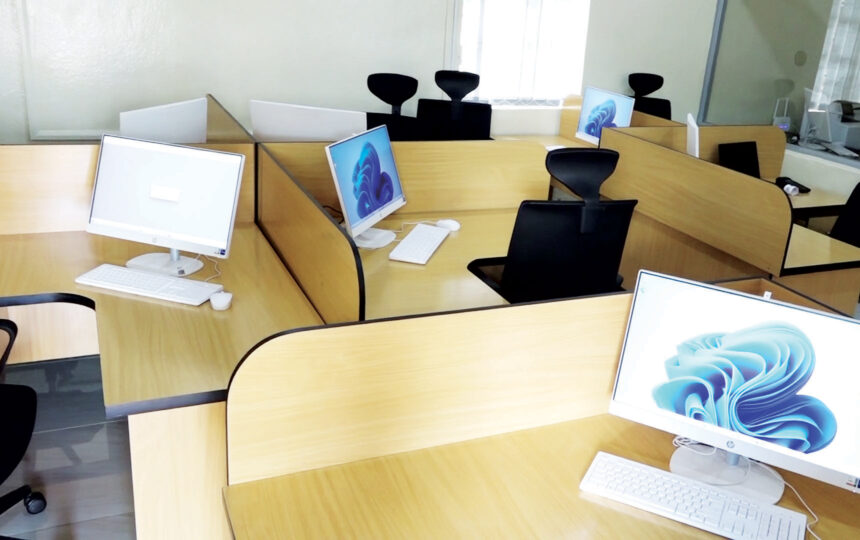
That deed he did at 10:41am, when he officially handed over an information communication technology (ICT) laboratory to Mwanza District Council officials and, by implication, Mwanza residents.
Not only did Kunkuyu hand over the ICT laboratory, which the Malawi Communications Regulatory Authority (Macra) renovated; he also handed over equipment, notably 11 Uninterrupted Power Supply (IPS) gadgets with the capacity of 390 watts; 11 office chairs; one desk; 10 office cubicles; a printer; binding and laminating machine, among other things that were purchased by Macra and, through the Ministry of Information and Digitalisation, given to Mwanza residents as their modern-day gift.
Out of these, however, it is one thing that has not been listed above that has marked the boundary between the Mwanza that was divided into two districts in 2003 and the post-April 4, 2025 Mwanza. That thing is, the donation of 11 desktop computers to the council.
- Advertisement -
- Advertisement -
The desktop computers, like the other items, were purchased by Macra and handed over to the people of Mwanza through the Ministry of Information and Digitalisation.
The items will, no doubt, benefit thousands of people.
When the National Statistical Office (NSO) released Population and Housing Census results in 2018, Mwanza, which covers an area of 2,259 kilometres square, had 138,015 people.
Among these people, according to NSO, are the Chewa (59.3 percent), Ngoni (30.4 percent), Lomwe (4.2 percent), Mang’anja (2.3 percent), Yao (1.4 percent), Sena (1.1 percent), Tumbuka (0.5 percent), Tonga (0.1 percent), Nyanja (0.1 percent), Nkhonde (0.1 percent), others (0.5 percent).
In short, the renovated laboratory and items it has been stocked with stand to benefit multitudes.
Eric Nyekanyeka, who is the director of public works, ensured that everything worked according to plan.
This means, from 10:41am on Friday, April 4, 2025, Mwanza District Council no longer had one desktop computer; there are now 12.
This means officials from different departments at the council can enjoy their privacy while ensuring that there is improved service delivery.
No wonder, one after another, council stakeholders were all praises to President Lazarus Chakwera’s administration, Kunkuyu, the Macra board—which was represented by Alekeni Menyani—Macra Director General Daud Suleman, among others.

laboratory is the hub of economic activity
Leading the chorus was Khudze Ward Councillor-cum-Mwanza District Council Chairperson Emmanuel Kapawe.
“Never, in our wildest imagination, did we think that we would have a structure as modern as this, replete with ICT equipment. Nyumba imeneyi ndi mchombo wa chuma komanso ntchito za luso lamakono [this renovated ICT laboratory is the hub of economic activity and modern technologies],” Kapawe said.
He, therefore, said the facilities would help improve service delivery and enable residents to follow up on goings-on at the council secretariat.
Kapawe added that the facilities would benefit “students, youths and members of the business community”.
He said they would ensure that “the K156 million that has gone into the project” does not gone down the drain through facilities’ misuse or abuse.
He assured stakeholders that the facilities would be put to good use.
Inkosi Kanduku echoed the sentiments.
“Before the donation of the desktop computers, Mwanza District Council had one computer. This means those who were working in, say, the Finance Department could do their thing on the computer and then give a chance to those from other departments to do their thing.
“This ran counter to the spirit of e-ticketing, which we introduced here in Mwanza. We had an e-ticketing system, yes, but we did not have the corresponding digital equipment. As such, it was difficult to follow up on issues such as ‘How much revenue has the council collected today?’ This is now a thing of the past as we will now be in a position to follow up on revenue issues at the touch of a button. We will now be on council officials’ neck on public service issues,” Kandudu pointed out.
He added that the initiative would supplement the Connect A School initiative, which Macra is implementing in rural area-based schools.
Last year, work—under the Connect A School Initiative— started at Thawale Community Day Secondary School in the district.

As for Mwanza Central lawmaker Nicholas Dausi, he said the renovated ICT laboratory and gadgets that had been provided would enable Mwanza District Council officials to streamline their services with those that are offered at the Central Government level.
“For instance, the data centre facilities will enable officials to seamlessly connect to Ifmis [Integrated Financial Management System]. Indeed, the ICT facilities will ease revenue collection tracing. Things cannot get any better than this, more so because we already have the Kunenekude Laboratory Project. I am sure that positive things will also happen in Nsonjole. This is the way to go,” Dausi explained.
Taking his turn, Courier Association of Malawi President Lewis McJessie said they were happy that, as service providers, they made a contribution towards the renovation of the ICT laboratory and the restocking of it, saying this was an indication that they were partners in development.
Sector players pay licence and other fees to be granted the right to be operating in the country.
“As we commemorate the vital role that postal and courier service providers play, we pledge to continue providing essential services.
“In this digital age, postal and courier service providers have adapted to changes as one way of improving efficiency,” McJessie said.
Postmaster General Angel Banda said the Malawi postal sector had given Mwanza District Council officials and residents “a boost” through renovations at the ICT laboratory and stocking of enabling gadgets in it.
“This emphasises the full engagement of the postal world with people.
“We, as postal service providers, are also happy that Malawi has an enabling environment for operations. We commend Macra for the work it is doing,” Banda said.
When his turn to address the audience came, Menyani surprised people when he said “World Postal Day is more than a commemoration”.
After all, people had gathered outside Mwanza District Council offices, which are located a stone throw from Mwanza Police Station, to ‘commemorate’ the day.
But people’s apprehension was short-lived, especially because Menyani immediately elaborated on what he meant.
“When the world is advancing, digitally, World Postal Day is more than a commemoration; it is also about celebrating the future—the future of telecommunications.
“World Postal Day is more than a commemoration; it [the day] is about giving government offices tools they need to thrive. Every connection made through a lab [laboratory] will ripple through not only Mwanza but the world as a whole,” Menyani said.
“We are at a defining moment. It is high time the postal services sector fully embraced digital methods of doing things, which is why we have National Postal and Courier Guidelines,” he added.
Then came the moment when Kunkuyu—who had earlier ‘broken’ Mwanza District Council’s ‘marriage’ with one desktop computer and ushered in an era of multiple desktop computers—had to elaborate on the government’s position on digitalisation.
“The President [Lazarus Chakwera] wants to turn Malawi into a digitally powered nation. That is why he ensured that Malawi has a Ministry of Information and Digitalisation. He [the President] is turning Malawi into a digitally powered nation, starting from the rural community.
“Right here, in Mwanza, the current administration is constructing Thawale laboratory. Network towers are being set up across the country. The laboratory here is more than a room full of computers; it symbolises the government’s commitment [to the cause]. The computer laboratory is not just [some] technological space but hub for skills’ development,” Kunkuyu said.
He, then, urged Mwanza District Council officials to be ready to teach others about the goings-on in the ICT laboratory, saying, by having the facility, they had become pioneers.
Today, the laboratory facilities at Mwanza District Council are no longer characterised by some wan sense of emptiness; rather, the place is robustly hospitable.