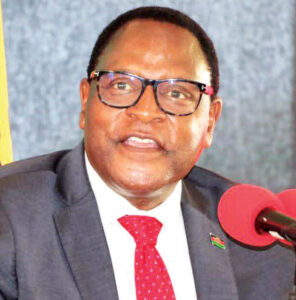
On February 14 this year, President Lazarus Chakwera stood in Parliament to deliver a State of the Nation Address (Sona).
In the Sona, Chakwera claimed that, having been in power for 1,684 days, his administration had managed to deliver many development projects across the country.
Unlike previous Sonas, where presidents highlighted development projects sector by sector, Chakwera opted to do things differently by presenting the projects district by district.
For Salima, Chakwera claimed that his administration had implemented a number of development projects in all five constituencies, represented by lawmakers Kaphamtengo Yona, Enock Phale, Gerald Kapiseni Phiri, Christopher Manja and Mwawa Mike Ngombe.
Among other things, the Malawi leader claimed that his administration had revamped Salima Sugar Company Limited, which is currently producing 21,000 metric tonnes of sugar and employs over 4,200 people.
- Advertisement -
A tour of the company in Salima revealed that people were busy working in both fields and the factory.
Salima Sugar Executive Chairman Wester Kosamu said operations of the company had improved in recent years, creating job opportunities for Malawians.
According to Kosamu, initially there were between 100 and 120 people from India working at the company.
He said that when they took over the company, they ensured that Malawians took over these jobs.
- Advertisement -
- Advertisement -
Kosamu also said the company had created job opportunities for women.
“We have also developed good working relationships with cane growers to the point that, when they don’t have enough inputs such as fertiliser, we provide them on credit.
“We have also developed good working relationships with traditional leaders and community members in Salima, to the extent that incidents of burning cane fields are a thing of the past because they know it is their company,” he said.
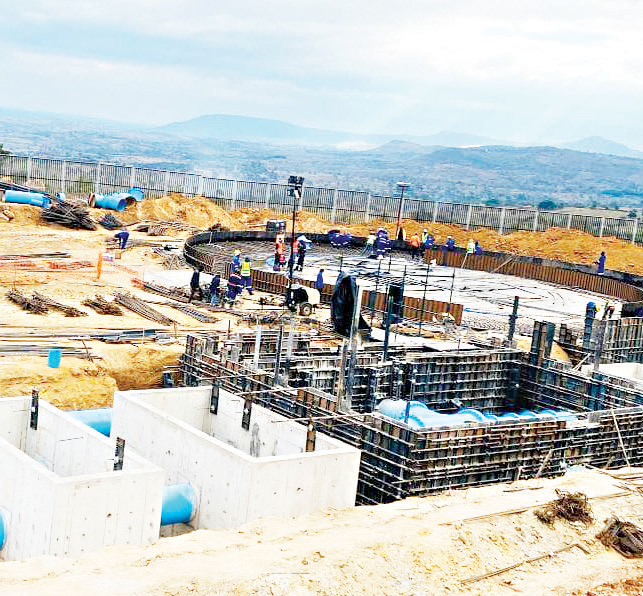
Also in the Sona, Chakwera claimed that his administration had commenced the Salima-Lilongwe Water Supply Project, which is expected to benefit over 1.5 million people in Salima, Dowa, Ntchisi and Lilongwe.
The Daily Times visited the site at Lifuwu in Salima, where earth-moving equipment was clearing the site for construction of tanks with a capacity of 100 million cubic metres.
Construction works were also noted at Katengeza, Mvera and Chezi in Dowa District.
The Malawi leader also said in the Sona that his administration is constructing the 60-kilometre Kaphatenga-Benga M5 Road, having completed the Lifyozi Bridge.
A visit to the Kaphatenga– Benga stretch revealed that contractors were busy working on the road.
Another claim made by Chakwera in the Sona was that, since 2020, about 285,125 beneficiaries had redeemed their Affordable Inputs Programme (AIP) subsidies.
However, figures obtained from the District Commissioner’s office revealed that a higher figure of 344,072 people had benefitted from AIP.
According to the figures, a total of 100,463 farmers benefitted in the 2020-21 farming season, 104,083 in 2021-22, 73,533 in 2022-23, 37,404 in 2023-24, and 29,589 in the 2024-25 growing season.
Chakwera further claimed that his administration had disbursed K3.7 billion in National Economic Empowerment Fund (Neef) loans to 5,529 beneficiaries, along with facilitating financing access for an additional 6,994 MSMEs to scale up operations.
Chakwera added that a total of K338.8 million in Neef fertiliser loans had been disbursed to 1,300 people.
The Daily Times tracked down Maupo Stambuli, a businessperson in Salima who sells soya, maize and rice.
He said he received a loan of K30 million, which enabled him to buy a plot and build a fence around it.
According to Stambuli, Neef business loans are preferable due to their softer interest rates.
Stambuli said that, looking ahead, he plans to apply for a K100 million loan to expand his business and increase profits.
Another claim made by Chakwera was that his administration had rehabilitated the Lifidzi Irrigation Scheme in Salima.
When we visited the site, we learned that the authorities planned to reinforce the 100-by-100-metre earth dam with a depth of two metres. C
The idea is to reinforce the sides with concrete to increase water retention and help farmers irrigate 540 hectares.
In the Sona, Chakwera also indicated that his administration had built eight schools, added 56 new classrooms and recruited about 290 primary school teachers on a permanent basis, leading to 5,020 new enrolments.
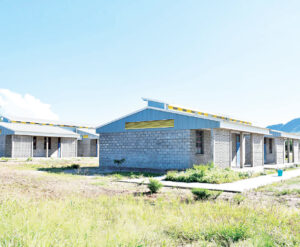
We visited one of the newly built schools, Mkanga Community Day Secondary School, in the district.
The school has modern facilities, including classrooms, a laboratory, an administration and storage room.
It also has a borehole and latrines to promote hygiene, a girls’ changing room to provide clean, private facilities, and two teachers’ houses to encourage educators to work in rural areas.
According to Director for Education, Youth and Sports in Salima, Alfred Hauya, the other new schools are Khotekhote CDSS, Kachulu CDSS, Demera CDSS, Chinguluwe CDSS, Michulu CDSS, Linthipe CDSS and Pemba CDSS.
Hauya added that, in addition to the new schools, the authorities had also built about 95 classroom blocks at various existing schools.
Chakwera further said that about 37,753 households had received food support worth K4 billion.
“We have implemented social cash transfers to 11,814 households, reached another 20,041 beneficiaries through climate smart cash, supported 106,744 people through the post-cyclone initiative and provided support to a further 9,960 through the El Niño Lean Season response,” Chakwera said.
We travelled to Maonga Hotspot in Jaziele, in Traditional Authority Salima, where community members have constructed swales under the Climate Smart Enhanced Public Works Programme, which helps reduce soil erosion and conserve water.
Under this initiative, people work 30 days a month and are paid K48,000 in four instalments a year.
Esther Nkhoma testified that, through climate-smart agriculture, community members have been constructing swales and planting vetiver grass and trees to reduce cases of soil erosion.
She said that with the money received, she had bought chickens and goats which help her with manure.
Chakwera further explained that through the Malawi Youth Games, a national programme involving both primary and secondary schools, 2,000 talented athletes were identified out of 20,000 participants.
“And every Malawian should be proud that Salima Secondary School Boys Football Team won bronze in the African Schools Football Championship,” he said.
Salima Secondary School won bronze during the 2022- 23 inaugural Confederation of African Football African Schools Championship in Durban, South Africa.
For winning bronze, the school received prize money of $225,000 from the Patrice Motsepe Foundation.
Salima Secondary School qualified for the continental showpiece after winning silver medals in the inaugural 2022 Caf Schools Championship Cosafa Qualifier, which was held at Bingu National Stadium in Lilongwe, and received $75,000.
Salima District Education Sports Officer Joseph Kaunda said the school was asked to identify four projects to benefit from the prize money. They chose cooking pots, sports equipment, a perimeter fence and rehabilitation of the football pitch.
According to Kaunda, the electric cooking pots have already been installed and are in use at the school.
He added that they expected to receive the sports equipment soon.
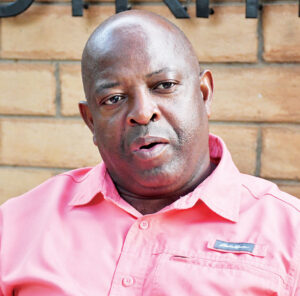
Salima District Commissioner James Mwenda said that, over the past few years, Salima has experienced significant development, as outlined in the Annual Investment Plan.
He said the development projects had been implemented through various funding windows, such as the District Development Fund (DDF), Constituency Development Fund (CDF) and the Governance to Enable Service Delivery (Gesd) Project.
For example, Mwenda said that through Gesd, they had built a maternity wing, staff houses and a septic tank at Mmema Health Centre, in addition to rehabilitating two staff houses.
He added that through Gesd, they had constructed an administration block at Linthipe CDSS, a classroom block, modern toilets and a teacher’s house.
According to Mwenda, Gesd also enabled the construction of a modern community ground in Salima, which is near completion.
He said that through DDF and CDF, the district had managed to build police units, grain banks, classroom blocks, administration blocks, market sheds, traditional courts and many other developments.
Mwenda praised the close cooperation among various stakeholders in the district.