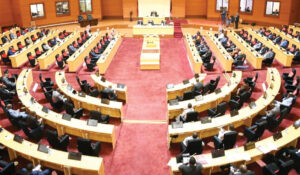
The approval of the Constitution Amendment Bill in Parliament marks a significant moment because it formally places the Constituency Development Fund (CDF) within the Constitution.
This change provides the fund with a clearer legal basis, although it also brings renewed attention to long-standing debates about how CDF should be governed and what role Members of Parliament (MPs) ought to play in its operation.
At first, the amendment may appear to be a step towards improving accountability.
It seems to define what MPs can do in relation to the fund and many people might assume this finally settles the confusion of past years.
The amendment presents oversight as the official role of MPs, which sounds simple enough.
- Advertisement -
Oversight usually involves monitoring how something is run, checking whether money is used properly and ensuring responsible officers follow existing laws.
Minister of Justice Charles Mhango mentioned that MPs will continue in their oversight role over the fund.
He also mentioned that the Public Finance Management Act remains the main guide for all duties, responsibilities and approvals connected to CDF.
His comments appeared intended to assure the public that the amendment does not place MPs back into day-to-day management.
- Advertisement -
- Advertisement -
Even so, a closer reading of the amendment and the discussions surrounding it reveals a possible risk.
Oversight and management may begin to blend once again, not openly but gradually and indirectly.
Oversight is supposed to involve observing and checking, not running or controlling. However, during parliamentary debates, some of the expressions used made the boundary less clear.
Terms such as governing, managing and using the fund appeared in the conversation, creating room for misunderstanding.
This confusion is important because the country has faced this problem before. For many years, MPs directly managed the. They selected projects, decided how funds should be spent and handled many operational duties.
This situation attracted complaints about weak accountability and fears that MPs were becoming too involved in administrative decisions.
Eventually, the matter was taken to court. The court ruled that MPs should not manage CDF because doing so created a conflict of interest.
MPs were making laws, supervising government activities and, at the same time, running public funds at constituency level.
The court explained that these overlapping roles weakened the principle of separation of powers, which is vital for good governance.
Following the judgement, MPs were removed from direct management and their role was restricted to oversight.
Because of this history, the new amendment must be approached with care. On one hand, it appears to strengthen oversight by writing it into the Constitution.
MPs represent the people and their involvement in monitoring can help communities demand better service delivery.
On the other hand, the amendment introduces a possibility, whether intended or not, for MPs to slowly regain influence over management.
This concern becomes more apparent when considering the minister’s comment that government will soon design new rules, processes and procedures for managing the fund.
Depending on how these rules are written, they could either support the court’s earlier reasoning or allow MPs to influence management decisions through indirect means.
If the rules do not clearly prevent MPs from becoming involved in daily operations, the difference between oversight and control may become weaker.
If that happens, the country may end up facing the same difficulties that the courts tried to resolve.
The amendment claims to focus on oversight, but if the language is too loose, MPs may find ways to influence decisions on which projects are chosen or how funds are allocated.
Such influence could be defended as oversight, even though it would closely resemble management.
This is why the situation requires careful attention from the public and civil society groups.
Oversight must remain oversight, meaning the process of checking, questioning and ensuring accountability.
It should not become a route for directing, approving or controlling the fund. If MPs begin to shape decisions under the excuse of monitoring, CDF may once again be exposed to political pressure.
There is also a risk that community needs may be overlooked in favour of political interests.
If MPs gain informal control over project choices, CDF funds might be used to reward supporters or strengthen political influence instead of addressing development needs. This was exactly the sort of situation the court judgement sought to prevent.
At the same time, removing MPs entirely from the process would not be realistic. MPs are elected representatives and communities expect them to keep a close watch on how projects progress.
The challenge is to find the right balance that allows MPs to act as watchdogs without letting them behave as managers.
In the end, the amendment is neither wholly positive nor wholly negative. It brings clarity in some areas but creates worries in others.
The main issue is how the amendment will function in practice, especially once new rules and procedures are introduced.
The country must protect the principle that public money should be handled by professional officers who can be held accountable, while MPs maintain a supervisory role.