By Wanangwa Tembo:
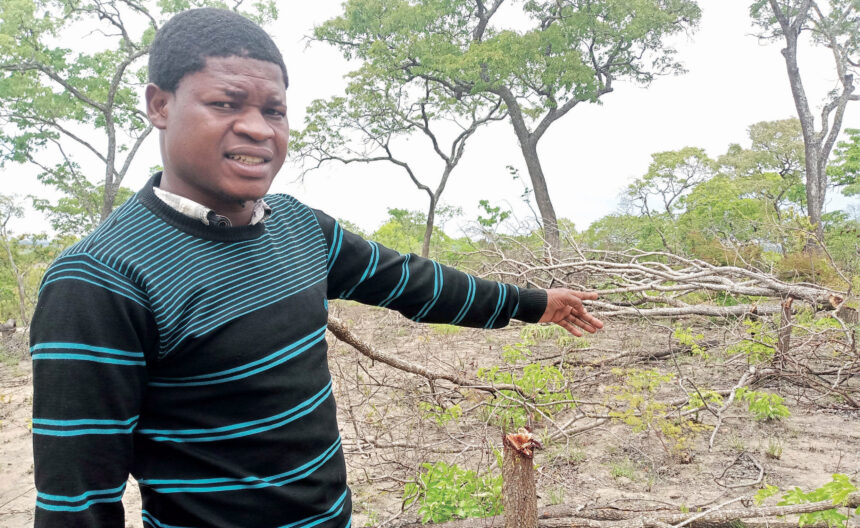
On the edges of Chawa Forest Reserve in Traditional Authority Simlemba in Kasungu District, the signs of long-term environmental stress remain etched into the landscape.
Tree stumps punctuate parts of the once-dense woodland, indicating evidence of years of pressure driven by poverty, land scarcity and weak tenure security because, for communities living around the reserve, forest degradation was not born of disregard for nature, but of survival.
At a glance, the 523-hectare Chawa Forest sits at the intersection of poverty, population growth and climate stress, a situation that has always left communities and authorities worried.
“Forests like Chawa regulate water systems, stabilise soils and buffer communities against climate extremes.
- Advertisement -
“When forest cover declines, the effects are poor harvests, water scarcity and increased exposure to disasters. Therefore, protecting the forest is central to climate resilience and food security,” explains Kasungu District Forest Officer, Fletcher Mhone.
He adds that the implications of such man-made environmental stress extend far beyond biodiversity loss.
But hope is returning among the communities and authorities through Better Preservation, Restoration and Regeneration of Chawa Forest Reserve and its Diverse Ecosystems Project – a K1.6 billion initiative that Kasungu District Council is implementing with funds from the European Union (EU).
The Council is working with 5,000 households living around the reserve to tackle the root causes of deforestation, while restoring ecological integrity.
- Advertisement -
- Advertisement -
The project is an integrated intervention, designed to address land governance, livelihoods and community ownership.
The intervention is part of the larger €60 million EU-funded ‘Greening and Growing Malawi: Ulimi ndi Chilengedwe M’Malawi (Uchi) Programme’, which aims to transform Malawi’s food systems by integrating environmental restoration, agricultural growth, nutrition and participatory action research.
Uchi’s greening component alone targets the restoration of 100,000 hectares, registration of 66,570 land parcels, and support to 80,000 households nationwide.
“Communities around Chawa Forest have depended on the forest because alternatives were limited,” says Nicholas Sichali, the Project coordinator, and he continues: “Our approach is to address poverty, insecure land tenure and lack of diversified incomes so that conservation becomes a viable and shared choice.”
According to Sichali, the project is designed to be implemented in about 54 months, combining land tenure security, participatory forest management, soil and water conservation and livelihood diversification.
The council is implementing all project components, while the nature-based enterprise component is being delivered by the Circle for Integrated Community Development (Cicod).
During the current phase which has run for about six months, implementation has focused on preparatory and institutional strengthening activities which has been a deliberate strategy to ensure long-term sustainability.
Planning and coordination meetings were held, alongside sensitisation sessions for the district development structures, including Area Development Committees (ADCs) and Village Development Committees (VDCs) to clarify roles, responsibilities and implementation modalities.
“We deliberately invested in early coordination and awareness,” says Director of Planning and Development, George Mtengowadula, adding: “Strong local institutions and informed leadership are critical for sustainable environmental outcomes.”
In parallel, the project has undertaken identification and delineation of four degraded catchment hotspots, characterised by severe gully erosion, deforestation and declining soil fertility.
These hotspots have been prioritised for targeted soil and water conservation interventions
Chawa Forest Reserve has also been demarcated into three block management units, with corresponding Block Management Committees established to strengthen local-level forest governance.
A central pillar of the project is customary land tenure security, long recognised as a key driver of sustainable land and forest management.
Over the project period, the council intends to register 6,100 land parcels; develop 20 participatory land-use and forest management plans; establish 20 Village Natural Resources Management Committees; and conserve at least 1,000 hectares under conservation and agroforestry technologies.
“So far, we have carried out sensitisation activities targeting stakeholders and community members, including ADC, VDC members and surrounding households on land tenure, land user rights and good land governance,” says Sichali.
“We have successfully conducted some activities mainly focusing on awareness and sensitisation. So far, the groundwork has been firmly established,” he adds.

Sichali notes that land tenure security gives households the confidence to invest in sustainable agriculture, instead of expanding into forest reserves, and he observes that when people are confident about their land rights, pressure on protected areas reduces.
The project is also promoting appropriate soil and water conservation measures to enhance ecosystem management and climate adaptation.
Preliminary activities include the establishment and strengthening of Catchment Management Committees in group village heads Jumbo, Chiwinga and Manjondo, and promotion of conservation practices aimed at reducing erosion and improving land productivity.
To strengthen community resilience, the project is promoting nature-based enterprises that generate income without degrading forest resources, a component led by Cicod, working closely with community groups around the forest.
These ventures will include honey production and production of baskets made from bamboos, with Cicod ensuring that the nature-based enterprise groups are established and trained, with support provided in production, packaging, distribution and marketing of forest-friendly products.
“We want households to earn from conservation, not destruction. When income is linked to a healthy forest, protection becomes a shared interest,” Sichali says.
He further describes the intervention as not just an environmental project but, rather, a well packaged approach to land governance, livelihoods, climate resilience and inclusive development, which are all aligned with Malawi’s national priorities.
Sichali envisions the project’s broader impact being manifested through increased household income, improved year-round food security among forest-dependent communities, increased forest cover, reduced encroachment and sustained absence of bushfires.
Watson Jali, a land conservation specialist, says these measures are critical in a changing climate.
“Healthy catchments reduce runoff, protect water sources and improve resilience for farming communities,” he said.
Similarly, GVH Manjondo and his fellow traditional leaders have all welcomed the project, saying apart from addressing deforestation, it will help to mitigate the longstanding problem of land disputes.
“Land issues are among the most common problems we handle as chiefs. This initiative will ease pressure on us because when land is registered, every household knows its boundaries. There will be official reference points, and conflicts will reduce,” Manjondo says.
According to Kasungu District Land Registrar, Clifton Nsaluyokoma, about 6 100 land parcels will be registered under the exercise, targeting customary land and allowing residents to receive certificates that guarantee permanent ownership.
“Once people have certificates, their land will be protected from encroachment or illegal grabbing,” Nsaluyokoma says.