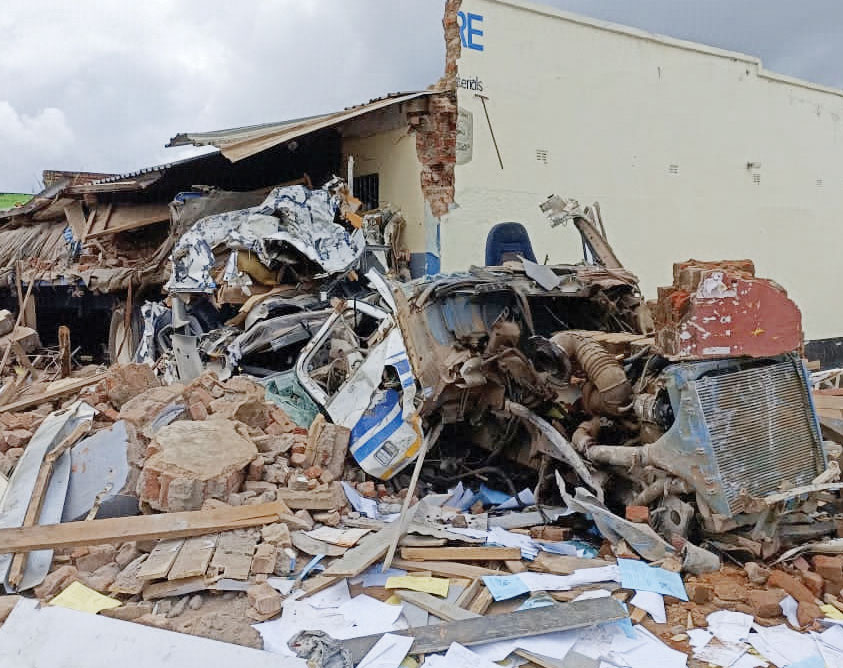

Malawi lost K394 billion to road accidents last year, The Daily Times has learned.
The World Health Organisation (WHO) indicates that, in sub- Saharan Africa, the fatality rate attributed to road crashes is 27 per 100,000 inhabitants.
It indicates that this is three times higher than Europe’s average of nine and well above the global average of 18, according to the UN Economic Commission for Europe (Unece), which manages 59 of the organisation’s legal instruments on inland transport, including the UN road safety conventions.
Unece further indicates that, every year, 1.3 million people around the world are killed as a result of road crashes, and millions more are injured.
BMJ Journal indicates that countries such as Malawi lose up to 3 percent of their gross domestic product (GDP) to road accidents, costs that are incurred through treatment of victims and other services.
- Advertisement -
The World Bank also indicates that Malawi’s GDP was worth $13.16 billion (about K13.16 trillion) in 2022.
This means, in 2022 alone, Malawi lost K394.8 million, which was used to cater for recovery of those that were injured in road accidents.
Transport and Public Works Minister Jacob Hara has since described the development as worrisome.
“Losing 3 percent of gross domestic product to road accidents is a worrisome situation.
- Advertisement -
- Advertisement -
“We are talking about the forex that we spend on damaged vehicles. We are also talking about hospital bills that we spend on those that are injured sometimes. If we reduced or even end cases of road accidents, that’s the amount that would be used to automatically grow our GDP,” Hara said.
Following this, the minister said there was a need to have standard road projects across Malawi’s cities and districts as one way of stemming cases of accidents.
“We are anticipating that the roads we are constructing now should last for the next 30 years. This means that, in future, we must have them still intact for such a particular period of time,” he said, adding that this is being done to reduce cases of road accidents.
Hara, therefore, said standard roads would go a long way in helping Malawi reduce cases of road accidents.
“Malawi has poor roads, yes; that is a fact which some people have attributed to the highest levels of accidents.
“However, people are running away from other facts. For example, why should a person drive carelessly on dilapidated roads? It means some accidents are avoidable,” he said.
The world Bank again says the GDP value of Malawi represents 0.01 percent of the world economy.
This year, the country registered fewer cases of road accidents in the first half of 2023 than during the corresponding period last year.
A Malawi Police Service (MPS) comparative analysis, released in July this year, indicated that there was a 4 percent and 16 percent decline in the rate of people involved in road accidents and people killed in road accidents, respectively.
A 2022 comparative analysis indicated that 2,728 cases of road accidents were recorded between January and June.
However, the number dropped during the corresponding period this year, after 2,627 cases of road accidents were registered across the country.
In terms of fatalities, the analysis indicates that 565 people died in 476 fatal road accidents last year.
There has been a remarkable reduction this year, with 380 fatal accidents recorded and 475 people losing their lives.
Earlier, MPS spokesperson Peter Kalaya said law enforcers have been keen on reducing the number of road accidents and people that die in road accidents.
“We are taking no chances,” he said.
In Africa, traffic deaths account for about one quarter of the global number of victims, even though the continent has barely 2 percent of the world’s vehicle fleet, the United Nations Secretary- General’s Special Envoy for Road Safety, Jean Todt, is on record to have said.