For close to six months, residents of several villages in Ntaja, Machinga, scampered for water at a few boreholes or dirty wells within their locations.
Two kiosks from which they had been fetching water were out of operation, driving hundreds of households to unsafe sources.
“It was chaotic,” Modester Makanga of Mdedza Village in Ntaja says.
She harks back to the time when physical fights could erupt at the boreholes as everyone strived to take home a bucketful of water.
It was survival of the fittest, Makanga says.
- Advertisement -
During those days, the kiosks, which were put up as part of an extensive government project to increase the number of people who access clean and potable water across the country, were solely being managed by a local committee.
“Members of the committee did not care whether water was flowing at the kiosks or not. All they were interested in was stealing the money meant for sustaining operations,” another resident of Ntaja Khadija Khan says.
She recounts that the committee’s failure to pay for electricity to power water into tanks to the kiosks resulted in the malfunctioning of the facilities.
According to Khan, even when power was available, there still were lengthy spells of dry taps at the kiosks because there was no money for paying bills or maintaining damaged sections.
- Advertisement -
- Advertisement -
“The coming of the kiosks was a great relief for people of this area, until poor management resulted in perennial scenarios of no water,” Khan, who draws water from a kiosk in Mdedza area, says.
Concerned about the poor management of the two kiosks at Ntaja, residents of the area, together with their traditional leaders, decided that they had had enough.
They fought for the kiosks to be taken away from the control of the committee that was managing them.
In 2022, Southern Region Water Board (SRWB), which is mandated to supply water to the region, except Blantyre City, took over management of the kiosks and ended a long spell of dry taps in the area.
“That was the beginning of incessant flow of water from the kiosks. People are happy again,” Makanga, who is in a new committee that is managing the kiosks with the supervision of the utility institution, says.
In the new arrangement, SRWB sells water tokens to the committee, which then sells the water to the people.
The board installed new pumps to amplify the flow of water, something which the previous managers of the kiosks, a Water Users Association (WUA), had all along ignored.
Makanga says during the WUA’s control, the kiosks would frequently suffer electricity bill non-payment, resulting in the taps running dry.
Today, two years after SRWB took over management of the kiosks through a committee, which also frequently alerts the board in an event of a supply fault, clean water consistently gushes out of the taps at the kiosks.
“People from surrounding villages have clean water once again. The new arrangement makes everything run smoothly,” Jacqueline Kaula, who is employed to sell the water at one kiosk, says.
She admits that hygiene and sanitation was a challenge in her own home during the months when the kiosk was out of service.
Now, Kaula no longer worries about the potential of cholera or any other waterborne disease attacking her family, because water is there in abundance.
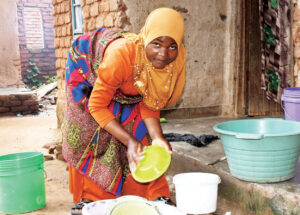
“Of course, on top of that, I am also earning money since this is work. I am able to buy household needs,” she says.
About one-and-a-half kilometres from the kiosk where Kaula sells water is a similar facility, which is also ensuring people on that side have access to clean water too.
Aisha William, whose house is situated a few yards from the kiosk, says ever since its services got revived by SRWB, she stopped trekking to a borehole to draw water.
She states that water drawn from a borehole might not be very “dependable” because it is untreated.
“But the water from the tap at this kiosk is safe because it is treated. It is just like any other tap installed by the water board that we see in various places,” the mother of two says.

SRWB supervisor for Ntaja Section, Alex Mapwetechere, states that the water utility institution is already working to reach more people with water in the area—beyond the 400 that it is currently serving.
He notes that while the two kiosks are close to a trading centre, people in the section’s far-flung locations also need clean and potable water.
Mapwetechere also admits that it was not easy for the WUA which was previously managing the two kiosks to give up on the facilities.
“They were making money out of them, but the pressure from the communities and traditional leaders was enough to force them to accept that their time was over,” he says.
In the meantime, the committee that is managing the two kiosks is planning to diversify the use of the money it realises from selling the water.
Makanga says the establishment of a group in which they can be saving and lending each other money sounds attractive.